


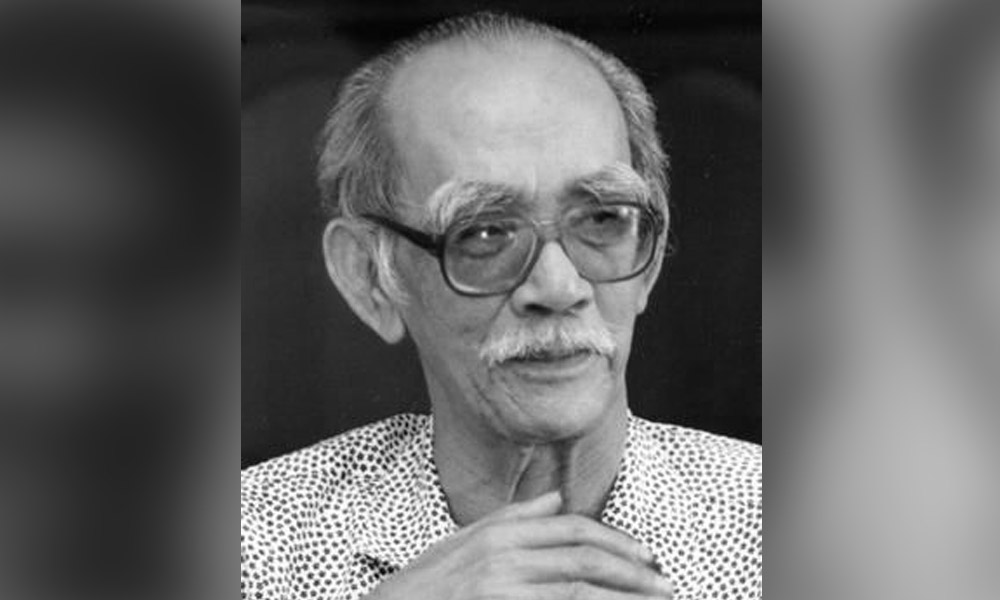

The many facets of Samad Ismail
obituary Reading the obituaries on Samad Ismail, who died at the age of 84 on Sept 4, in all their hagiographic monotony - that he was a great journalist, the guru of journalism, an unwavering nationalist, an exponent of literature for the raising of social consciousness - did little more than suggest that if he had an impact, it would be difficult to infer that from the paeans.
Temberang (Malay for boastfulness, puffery), Samad would have sneered at the stuff written about him. Not that the obituaries played up the myth and missed the man; something of the sort was bound to happen if only because only he could have written the great book about his life.
obituary Reading the obituaries on Samad Ismail, who died at the age of 84 on Sept 4, in all their hagiographic monotony - that he was a great journalist, the guru of journalism, an unwavering nationalist, an exponent of literature for the raising of social consciousness - did little more than suggest that if he had an impact, it would be difficult to infer that from the paeans.
 Temberang
(Malay for boastfulness, puffery), Samad would have sneered at the stuff written about him. Not that the obituaries played up the myth and missed the man; something of the sort was bound to happen if only because only he could have written the great book about his life.
Enigmatically, he declined to do so. The famous journalist did not see fit to write his summative memoirs, though he had plenty of time to do so. For a journalist who worked long hours, chain-smoked and did not exercise, he lived a long life, longer than his contemporaries - Leslie Hoffman (who died in Melbourne in the 1990s at age 77), and Lee Siew Yee (who died in Petaling Jaya at 80 in 1999). The latter two were group editors of the Straits Times (ST) and the New Straits Times (NST) respectively between the mid-1950s and early 1980s.
Samad became managing editor of the NST , second in the hierarchy after Siew Yee, when the ST was Malayan-ised in November 1972. Pernas, the government-owned investment arm, bought into the paper and reduced AC Simmons, the majority shareholder, to minor equity holder.
The change in ownership was an integral part of the implementation of the New Economic Policy (NEP), launched by Prime Minister Abdul Razak Hussein in January 1971. Not many know that the NEP grew out of the ideas on political economy of James J Puthucheary who, with Samad, was convenor when the People’s Action Party in Singapore was inaugurated in November 1954.
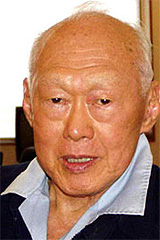 Founded to fight for Singapore’s independence from British rule, the PAP was a multi-racial party with Puthucheary and Samad its leading lights. The founding secretary-general was Kuan Yew
(right)
, a lawyer whose political leanings were to the right of the party’s two left-leaning intellectual convenors. Each would part with him within a few years of the PAP’s formation, with fateful consequences for Samad in particular.
In the late 1960s and early 1970s, Umno’s Young Turks, opposed to Prime Minister Tunku Abdul Rahman for supposed lethargy in pressing the cause of Malay economic advancement, would visit Puthucheary at his office in Skrine & Co. in Kuala Lumpur, where James was partner. Puthucheary’s ‘Ownership and Control in the Malayan Economy’ written in the late 1950s while he was under detention by the British in Changi, certified his standing as the intellectual whom politicians resorted to for ideas on economic issues.

 While practising law, he was a magnet for the intellectually questing. Among this set, hungry for ideas to uplift the Malays, were Dr Mahathir Mohamad
(left)
and neophyte entrepreneur Daim Zainuddin
(right)
. Puthucheary would joke with the young Daim: “You are the muscles and I’m the brains.”
Invariably, the man who steered Umno’s Young Turks to Puthucheary was Samad, himself a draw of sorts while holding down his job as editor of Berita Harian in the day and writing Malay novels by night.
Although never really an Umno man, Samad had the good journalist’s networking skills which gained him access to movers and shakers in all shades of the political spectrum. His wide array of contacts not only attested his skills as a newsman but was also a product of his engagements with the worlds of journalism, politics and the arts.
In the mid-1980s, the Indonesian envoy to Malaysia, Rais Abin, recalled with gratitude Samad’s contributions to the Indonesian fight for independence from the Dutch in the late 1940s. While working in Utusan Melayu in Singapore, Samad was apparently a conduit for aid to the Indonesian freedom fighters, among who numbered Rais Abin.
Limited revelations
The one book that Samad wrote about his life, or rather a part of his life, ‘Memoir A Samad Ismail Di Singapura’ (1993), was about his years in Singapore between his birth in 1924 and 1958 when ST managing director Simmons hired him to head Berita Harian, the group’s newly launched rival to the Utusan Melayu , where Samad had been among the pioneering group of journalists who had built up the paper from its inception in 1939. Samad moved to Kuala Lumpur the same year when the ST group shifted the locus of its Malayan operations to the country’s capital.
The memoir is like the squirt of ink an octopus makes to conceal itself. Seen from afar the cloud looks like a revelation, but it was clearly an attempt to ensnare the curious reader in the outer defences. The book recounts episodes that involved Samad in his years in Singapore but little is said about his worldview.
Someone whose life successfully fused the disparate strands of journalism, politics and literature as Samad’s did, could not possibly have gone through it without a worldview. By the time he was in his late twenties, Samad had already been detained twice by the British for anti-colonial activity, and by his mid-thirties, had seen two fraternal friends, Yusof Ishak and Devan Nair, become estranged from him.
Yusof, the first president of Singapore, was Samad’s closest collaborator in the larval stage of Utusan’s development as the voice of Malay nationalism, and trade unionist Devan was a classmate, fellow detainee and comrade-in-arms.
Both were prised from the intimate sphere of Samad’s influence by Kuan Yew, a man of compelling persuasive power who, however, discovered that Puthucheary and Samad were impervious to his suasion. Kuan Yew must have found Samad particularly grating. The latter had a tendency to speak in broken English and would otherwise hide his well-read self behind a patina of gruff manners and oral vulgarities.
I once asked Samad why Kuan Yew disliked him so and he replied: “He would come to Utusan to pick me up to go to the places where the Chinese Middle School graduates gathered. Many of them knew me from the publicity I gave them in the Utusan . They would greet me and ignore him. When (he) was not around they would ask me if they could trust him, that he was bourgeois and middle class, and all that. I would reassure them.”
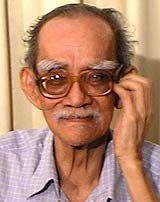 In April 2006, an ailing and wheelchair-bound Samad gave an interview to
Utusan
in which he was asked about the reasons for his break with Kuan Yew
(left)
. He had often given the impression it was a subject he was loath to discuss and that raising it was like peeling back the scab of an old but scarcely healed wound whose pain time’s passage had muted though not entirely assuaged.
Samad told his interviewer that he could speak some Chinese and had many followers among the Chinese educated in Singapore. He said Kuan Yew was craven-hearted in the struggle against the British. He further said that when Kuan Yew took power, he decimated the Chinese-educated friends of Samad in a merciless way. Samad said he felt betrayed and was aggrieved at the repression of his former cohorts who mainly enlisted with the Barisan Socialis, the party that by the early 1960s were bitter rivals of the PAP in Singapore.
Relationship with Razak
That Samad enjoyed a close relationship with Abdul Razak was known during the time the latter was premier of Malaysia from September 1970 to January 1976. The bond was first struck when Samad, as Utusan journalist, accompanied the Merdeka negotiating delegation to London that was headed by the Tunku, with Razak as member.
The ties warmed in the years Samad led Berita Harian in Kuala Lumpur while Razak was assiduous deputy to easy-going Tunku (August 1957 to September 1970). It would deepen in chats between Razak and Samad late at night after Razak had completed the day’s tour of rural projects (he had often held the rural development portfolio in Tunku’s cabinet), at times with Samad in tow. Workaholic Razak would unwind with a drink with Samad as company. Thus the journalist was privy to the inner workings of Razak’s mind.
 Though aristocratic by birth, Razak
(left)
had moved in Labour Party circles in London while reading law in the late 1940s. The Labour government under postwar Prime Minister Clement Atlee was strongly influenced by Fabian socialism, a socialist belief that held that the way to uplift the lot of the labouring classes was through selfless leadership by an enlightened coterie.
Puthucheary’s ideas for the regeneration of the Malay economy, disbursed to an avid circle of Umno’s Young Turks was, in essence, a mutation of Fabian socialism: state intervention in the national economy to take over expatriate-owned companies where a Malay managerial class could be trained to lead, grow and prosper the companies. Those ideas would find a sympathetic echo in Razak when he became premier.
In Singapore the steadily growing influence of Samad on Razak’s government was viewed with mounting unease. In the NST , Samad’s hiring of Ambrose Khaw, editor of the Singapore Herald that Kuan Yew had closed down in the early 1970s for displaying editorial independence, could not have helped soothe trans-causeway qualms.
 By January 1976, Samad had assembled a group of journalists skilled enough to steer the publications within the
NST
stable, already the market leader in the English newpaper sector in Malaysia, to new and more profitable heights. Success would have been construed as validation of the underlyng premises of the NEP.
But it was no easy task. Samad had to did deep into his resources of experience and skill to ward off nettlesome political interference from without and mercantilist pressures from within. Two examples would convey the nature of the intereference and the way Samad dealt with them.
The first in 1975 concerned a visit from Suhaimi Kamaruddin, the Umno Youth firebrand, who purpose was to pressure for the hiring of more Malay journalists into the English-language publications in the NST stable. Samad readied for his interlocutor by getting the human resources department to compile a list of hirings since the time of Pernas’s takeover. The educational and other qualifications of the non-Malays hirings were juxtaposed with that of the Malay hirings. The latter tabulation was markedly lower in comparison with the former.
Samad recalled that Suhaimi slunk away in embarrassment after being shown the disproof of his assumption that Malays were being marginalised. Of course, the incident did not dent the proclivity of mediocre but ambitious Malay journalists for ‘reporting’ to their Umno sympathisers that so-and-so in the hierarchy was inimical to bumiputra advancement. Such backchat, and their fanning by ambitious Umno pols keen on cultivating acolytes within the NST, was the unavoidable by-product of politically aligned ownership.
But only a strong and resourceful editorial supremo would be able to deflect its insidious effects. As anyone who knew Samad well was aware, he was always keen to cultivate and hire good Malay journalists, but a contempt for the mediocre was never far from his surface.
The second example of his mettle being adequate to meet the challenges from within concerned the question of whether the editorial department retained primacy over other departments, increasingly fitted with Malay graduates, some from multinationals where the pace of their promotions were thought to be slow.
In 1975, a decision by the night sub-editor to throw out a second lead story on the front page of a speech by Razak at the Malaysian naval base in Singapore caused a flap between the sub-editor and the production manager. The Johor Baru bureau chief who wrote the story based on the embargoed text of the speech, called up the sub-editor close to midnight to say that for some reason Razak had not delivered the speech at a dinner function.
The sub-editor ordered the presses halted despite something like 20,000 copies of the first edition already printed and loaded on to waiting transport lorries headed for Kuala Terengganu and Kota Baru. The production and marketing managers, with an eye to paring costs, remonstrated with the sub-editor but Samad, reached at his house in Petaling Jaya, interjected to support the sub-editor’s decision.
“We are not selling soap,” quipped Samad, who the morning after wrote a stiff memo affirming editorial primacy in the decision making process. The ‘not selling soap’ comment was a pun on the previous area of expertise of the marketing manager, recruited from Lever Brothers, the multi-national manufacturer of soap.
Within the NST the comment earned its fame as a feisty epigram and, at that point in time, stood as a timely reminder that the infusion of technocrats into other departments ought not to tip the management balance away from the editorial department in a newspaper company.
By January 1976, Samad armed with the requisite editorial expertise and not a little political savvy, was poised to lead the NST publications in a direction that would justify a premise of the NEP - that given opportunity and training, capable Malays would forge to play an equitable role in a socially re-engineered Malaysia.
But even the most optimistic scenario has a worm of destruction burrowing within. On 15th of that month, Razak died in London rather unexpectedly. The leukaemia he was suffering from for some years was known to a very few - to the deputy premier who had died in August 1973, to his English medical consultant attached to an upscale practice in Kuala Lumpur, and one or two others; but not to Samad.
Razak, knowing he had limited time and anxious to thwart Harun Idris, the popular Selangor menteri besar, who had been charged for corruption in November 1975, had after Ismail’s death fast-tracked Hussein Onn, a man of rectitude but precarious judgement, into the deputy presidency of Umno and the deputy premiership.
Innate candour
After Razak’s death a dithering Hussein wanted to pick Umno supreme councillor and powerful Home Minister Ghazali Shafie as his deputy but the three party veeps - Tengku Razaleigh Hamzah, Ghafar Baba and Mahathir - cautioned Hussein that the choice, by tradition, must be from among them or they would quit the cabinet. Hussein finally settled on Mahathir.
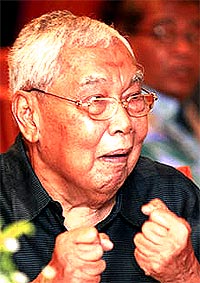 The thwarted Ghazali, a man of vaulting ambition, then rode on the fears caused by heightened communist terrorist activity, at the Malaysia-Thai border and in urban centres where frontline cadres had detonated explosives and carried out assassinations, to put before Hussein a list of people for detention under the Internal Security Act (ISA) as suspected agents of a communist plot.
Samad was on that list. In June 1976, shortly after being awarded national recognition for contributions to Malay literature (Hadiah Sastera Negara) , Samad, at the age of 52 and at the height of his powers as a journalist, was detained for nearly five years under the ISA. Also, in mid-1976, Hussein Jahidin, a Singapore Berita Harian editor, was detained by the Singapore police and publicly ‘confessed’ to being a pawn in a communist plot directed by Samad, who also ‘confessed’ on Malaysian television.
The tableaux of arrests and confessions, in the atmosphere of 1976 - the year after the fall of South Vietnam and the communist takeover of Indochina - gave the entire episode a surreal air. Only those who knew Samad were able to immediately discount his televised ‘confession’ because the particular variant of the Malay language in which he voiced parts of the text was not native to Samad, a man with a pronounced relish for the Javanese side of his heritage.
This side of him - his cageyness in the face of trying constraints, his ability to keep his essential self intact in the teeth of repressive circumstance - would have made Samad’s memoirs a plum pudding of a book. The man’s innate candour would have fitted nicely with the genre of the memoir as confessional.
Alas, Samad not only declined to write the book, he did not say why. Perhaps he was not capable of the larger coalescence of thought and reflection that book-length writing requires.
His Singapore-based memoir is actually an assembly of episodic reports with scant regard for chronological or thematic order. Considered as a whole, the book is a disappointment, particularly as it is reticent on the critical relationships of his life.
But if one regards the book as an omnibus collection of independent pieces, the picture changes somewhat. In some of its best episodes, the adversary is never a human being but adversity in all its guises and the narrator’s reactions oscillate between horror and excitement, admiration and curiosity. In them can be glimpsed the superb reporter Samad was and how fluid are the boundaries between reportage and literature.
In Samad’s best writing, described in ‘Samad Ismail: Journalism and Politics’ (1987) by Siew Yee as some of the “more lively copy” he encountered “in a long day’s march”, the raison d’tre of a good journalist is implied: that thousands can think for one who can see and report perceptively.
Unfortunately, in the long march of Samad’s life, witness as it was to the era’s epochal events and the signal personages involved, the protagonist who enjoyed a unique vantage point declined to furnish his complete recollections for thousands to think them through, thus leaving a void there is now no way of filling.


Report this comment
Are you sure you want to delete this comment?
This action cannot be undone.