




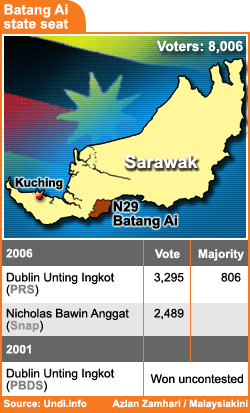
All BN needs is RM4 mil to bag Batang Ai
The Batang Ai by-election will be held on April 7, on the same day as the by-elections in Bukit Selambau in Kedah and Bukit Gantang in Perak. In the unlikely event that the Perak state assembly will be dissolved, we can expect the Perak state election to be held on that magic date of April 7 as well.
Authoritative decisions from our institutions of state can be so predictable. That is why we need radical change in our political landscape. For a birth of a new political order, we have to endure the birth pain before the new baby arrives.
 The fierce battle for the hearts and minds of the Iban voters in ulu Batang Ai would be just another wave of birth pain for
Malaysians dreaming of a significant meaningful change.
The political class in the old order will not surrender their stranglehold on power willingly. Power has to be pried from their grip, a little at a time.
The prospect for the opposition in Batang Ai looks daunting. Sarawak observers are generally cynical about the voting behaviour of the rural Ibans during the heat of a campaign. Money still rules.
A day or two before polling date, huge sums of money will flood the constituency and the poor opposition fighting cock will discover to his dismay that people who have pledged their su pport before voting are suddenly leaving him en masse.
In a small constituency like Batang Ai, all you have to do is to dish out RM4 million, buy up 4,000 votes at RM1,000 a piece, and you have already won.
On top of this, you can also book and rent all the long boats, all the four-wheel drives and all the petrol stations and your opponents will be denied access to the voters. All those voters from whom you have rented these facilities will feel obliged to vote for you then.
A party of Orang Malaya
On paper, the chance of an opposition victory looks quite remote. That is partly why the Sarawak BN feels and looks so confident. RM4 million is probably peanuts in their massive war chest.
But the PKR has a trick or two up their sleeve as well. There is no shortage of seasoned campaigners among their ranks who can speak the language of the people in more ways than one. The voters of Batang Ai have also had a history of show ing their rebellious streaks in the past. I know from experience that not all Ibans can be bought for a price.
 The propaganda war has already started.
PRS president Dr James Masing has already branded PK R as a Semenanjung party, a party of “Orang Malaya”. He is counting on the narrow parochial feelings of Sarawakians against West Malaysians.
The Batang Sadong MP and PBB Wanita secretary Nancy Shukri called on Sarawakians on March 4 to disallow “outsiders” (read West Malaysians, especially PKR people) into the state to prevent them from sowing the seeds of disunity.
When I was leading the fight on the opposition front in Sarawak from the late 1970s onwards, this is what the Supp used against the DAP, calling it a party from “outside”. It was very successful, for a while.
Now that the DAP has done well in the last state election, the Chinese voters will not see the party as Orang Mal aya again. Whether this tactic of negative labelling will work or not in an Iban constituency remains to be seen.
It is unfortunate that my friend, James Masing, who has a doctorate in anthropology has chosen to use this tactic against the opposition. After all, his party the PRS is a component of the Sarawak BN, which comes under the knuckles of the national Umno-dominated BN in Kuala Lumpur. PRS is an appendage of Orang Malaya in Umno.
Any election is not only a chance for a political party to win seats, but it is also a platform to educate and inform the voters on the most important political issu es of the day. Note how Barack Obama did it. He inspired, informed, and empowered his voters nationwide. If nothing else, the PKR language of Ketuanan Rakyat is inspiring and empowering.
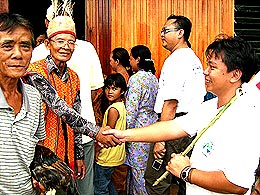
Iban hospitality
Only cynical politicians with a lot of vested interests will do all they can to stupefy their voters with non-issues and threats, while offering bribes for their votes. They would hope that voters would forever fear them and be dependent on them. They would hope to develop a master-slave relationship.
 Naturally, this
Batang Ai by-election also gives me the rare opportunity to do my bit for national integration.
Generally, the people in West Malaysia know next to nothing about the Ibans or any other Dayak groups. Why, even many urban Chinese like to call them by the derogatory name of “Lakia”, which is highly insulting to the Dayaks.
I did campaign among the Dayaks and had lived among them for quite a few years, trying to learn the Iban tongue and their adat.
Perhaps to outsiders, they seem to be a primitive tribe of people still living in the jungle like Rousseau’s nobel savages. T o foreign tourists, they appear merely exotic. To anthropologists, they are mere subjects to be studied objectively.
The bottom line is: the Ibans are just human beings like you and me. If you dig deeper into their culture, you will discover to your great delight they have a unique universe of human civilisation.
 This is where James Masing and Nancy Shukri have done such great disservice to the greatness of the Iban culture.
One of the most distinctive traits of the Iban traditions is their hospitality.
If you happen to be stranded while travelling through the Sarawak jungle, you can always walk up to the nearest longhouse and offer to meet the headman (tuai rumah) for help. Inevitably, you will be welcomed with open arms, offered coffee, sireh and such other refreshments. There will always a place for you at the family meal and a suitable spot for you to rest for the night.
The Ibans live in remote rural areas of Sarawak, tilling their land for their rice and their cash crops, hunting in the forest and fishing in the river for their protein. They welcome strangers b ecause these rare visitors are sources of valued news from the outside world and they present opportunities for making new frien ds. When the meal is over, men, women and children will gather at the ruai (communal corridor) and chat amiably into the night.
Living in the challenging conditions in the jungle, they have to be very communal in the daily struggle for existence. Helping one another in times of need is a necessity in this city people will describe as harsh existence. Providing hospitality lies at the core of their communal values.
Once, I had just entered an Iban house. I had to be at another place in a hurry, but the lady of the house would not have it. “The water is boiling on the stove,” she said. I was bound by their adat to sit down again, to drink the coffee that she would make shortly. Disregarding this offer of hospitality would be considered the height of rudeness in the Iban society.
I was once sternly told by an Iban old man that he would not turn away a stray dog that has come to rest in his house. What more to say about a human being, he asked.
Ancient animist beliefs
In a formal festival like the Gawai, the distinguished visitor from afar would be offered the honour of spearing and killing a pig at the foot of the staircase. The raw pig blood will then be offered to the dignitary. That is an honour given to heroes only.
 The VIP would then have to walk through a line of maidens, each offering a glass of their rice brew, the Tuak.
At times like this, I would usually be half drunk, by the time I set foot onto the longhouse!
Perhaps, the legendary hospitality of the Ibans originated in the large body of their ancient animist beliefs.
One of their most revered deities is Pulang Gana, the god in charge of the earth and therefore the guardian of the agrarian Ibans. He has been kn own to appear among longhouse dwellers in the form of various animals and human strangers, just to test whether the Iban people are truly hospitable. For safety’s sake, Ibans have to treat all animals and human strangers in the nicest way possible, just in case!
The complex and refined Iban adat has been handed down through god-knows-how-many generations, including and especially their famous hospitality extended to strangers from afar. To tell them to ban “outsiders” from Sarawak or from their longhouse is the paragon of disrespect for their Iban culture.
This is the tragedy in Sarawak politics. For the sake of an election victory, in their self-serving political career, politicians would stoop so low as to destroy the very culture that give the Iban people their unique identity.
SIM KWANG YANG was MP for Bandar Kuching from 1982 to 1995. He can be reached at kenyalang578@hotmail.com


Report this comment
Are you sure you want to delete this comment?
This action cannot be undone.