




Court to rule on RPK transfer on Friday
The Kuala Lumpur Sessions Court will decide on Friday whether it has the jurisdiction to hear Raja Petra Kamarudin's criminal defamation trial or to transfer the case to the High Court.
The Kuala Lumpur Sessions Court will decide on Friday whether it has the jurisdiction to hear Raja Petra Kamarudin's criminal defamation trial or to transfer the case to the High Court.
Earlier, Judge Mohamad Sekeri Mamat heard submissions from defence counsel Manjeet Singh Dhillon and DPP Anselm Charles Fernandes on whether he could hear the case.
 Yesterday, Manjeet in his
preliminary objection
brought a constitutional issue into question, on whether it was right for the Sessions Court to hear the case, as Raja Petra was initially charged with three counts of criminal defamation at the Magistrates' Court.
Yesterday, Manjeet in his
preliminary objection
brought a constitutional issue into question, on whether it was right for the Sessions Court to hear the case, as Raja Petra was initially charged with three counts of criminal defamation at the Magistrates' Court.
The counsel pointed out that this violated Article 8(1) for equality where if Raja Petra's case was heard at the Magistrates’ Court, there is a RM10,000 cap in fine limit compared to the Sessions Court, where there is no cap for fines imposed.
On Aug 15, the Magistrates' Court approved the prosecution's application to transfer the case to the Sessions Court.
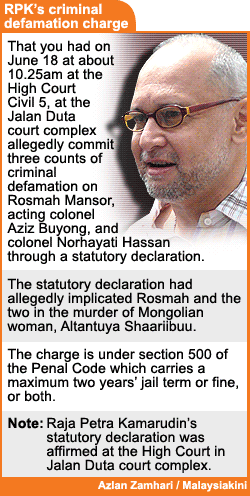
Raja Petra, 58, was charged on July 17 with three counts of criminal defamation against Rosmah Mansor, Acting Colonel Aziz Buyong and Colonel Norhayati Hassan through a statutory declaration.
He is alleged to have committed the offences at the High Court Civil 5 at the Jalan Duta court complex at 10.25am on June 18. Raja Petra stands to face a maximum two-year jail term or fine or both if convicted.
In his statutory declaration, Raja Petra implicated Rosmah, who is the wife of Deputy Prime Minister Najib Abdul Razak, and the other two in the murder of Mongolian national Altantuya Shaariibuu.
Suspend proceedings
Today, Manjeet also brought to Mohamad Sekeri's attention that the Raja Petra had filed a notice of motion with the High Court registrar to suspend proceedings at the Sessions Court and for its application on the constitutional issue to be heard at the High Court or the Federal Court.
 He also informed the court that since his client made the application under section 417 of the Criminal Procedure Code, the prosecution should have referred their application to transfer at the High Court and the High Court could then decide which lower courts could hear the matter.
"Hence, it is not necessary for this court to decide on this matter as it could let the High Court or the Federal Court decide on this constitutional issue and section 417 on which is most appropriate."
Manjeet also pointed out that it was the prosecution's discretion on where to charge an accused.
"The attorney-general has the provision to act on his institutionary proceeding powers to charge a person anywhere and that should be followed throughout.
"In this case, my client was charged at the Magistrates' Court. If the prosecution wanted then, they should have charged him at the Sessions Court. This was not done and this is our main concern," he said.
Court has the jurisdiction
However, Anselm submitted that the Sessions Court has the jurisdiction to hear the case on the transfer application by the prosecution.
 The DPP pointed out that Raja Petra had filed for a review over the transfer of the case on Sept 8 at the Kuala Lumpur High Court and the High Court judge replied three days later that it was not necessary for a review to be called as the transfer was made before the trial started.
Anselm also said case laws showed that the constitutional issue on equality had been decided by the Federal Court, Court of Appeal and High Court, and the matter could be heard at the Sessions Court.
Furthermore, he submitted that under Article 145 (3A), the attorney-general was empowered to determine which court or venue of any proceedings shall be instituted or transferred.
"Here, the prosecution was acting within its authority to transfer the case and our application under section 177 should be read together with this article.
"It gives the AG's Chambers the right to choose whatever court which it deemed fit," he said.
Anselm argued that since the constitutional issue raised by Manjeet had been decided by case laws, the trial should remain in the Sessions Court.
 Responding, Manjeet said the case laws cited by the prosecution were off a different scenario to the issue in question.
"Furthermore, the High Court's decision not to review this case was before the constitution issue was brought to question. However, I would leave it to this court to decide on the matter," he said.
Following the submissions, Mohamad Sekeri said he needed some time to study the arguments and fixed Friday for decision.
The judge also told Anselm that it was not necessary for the prosecution to summon its witnesses on that day should hearing resumes.
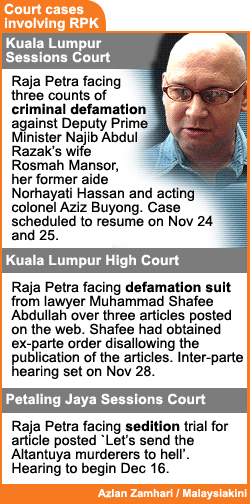
On the same day, the High Court is hearing an inter-parte injunction application on a suit brought by lawyer Muhammad Shafee Abdullah on Raja Petra over three articles which were posted in the Malaysia Today portal, of which the accused is the editor.


Report this comment
Are you sure you want to delete this comment?
This action cannot be undone.