




Altantuya case: Why Abdul Razak was freed
Shah Alam High Court judge Mohd Zaki Md Yasin has ruled that vital elements of abetment in the death of Mongolian national Altantuya Shaariibuu had not been established.
Shah Alam High Court judge Mohd Zaki Md Yasin has ruled that vital elements of abetment in the death of Mongolian national Altantuya Shaariibuu had not been established.
He read out a written judgment to explain why he freed political analyst Abdul Razak Baginda of the charge of abetment in the alleged murder.
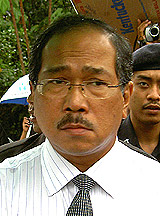 “Once the essential elements of abetment - by instigation, by conspiracy and by aiding - [...] are not proven on the basis of
prima facie
evidence, any other inferences and doubts that may have arisen must be resolved, as is trite, in favour of the accused person,” said Mohd Zaki
(left)
.
“Once the essential elements of abetment - by instigation, by conspiracy and by aiding - [...] are not proven on the basis of
prima facie
evidence, any other inferences and doubts that may have arisen must be resolved, as is trite, in favour of the accused person,” said Mohd Zaki
(left)
.
“It is not for the court to call for the defence merely to clear or clarify such doubts [...] I find there is no prima facie case for him to answer his charge. He is therefore acquitted and discharged.”
However, the judge ordered two police personnel - Azilah Hadri, 32, and Sirul Azhar Umar, 37, from the elite Special Action Force (UTK) - to enter their defence to the main charge.
They are jointly accused of murdering Altantuya, 28, at a location between Lot 12843 and Lot 16735 in Mukim Bukit Raja, Selangor between 10am on Oct 19, 2006 and 1am the following day.
They have elected to testify under oath when the hearing resumes on Nov 10. Their other options were either to give a statement from the dock or to remain silent.
Before he delivered his decision this morning, Mohd Zaki ruled on several specific matters that had been ‘reserved’ during the 151 days that it had taken for the prosecution to close its case. It had called 84 witnesses.
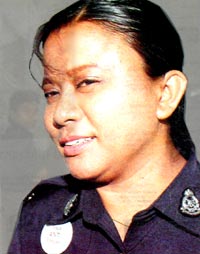 On the prosecution’s
application to impeach
the credibility of witness and police personnel Rohaniza Roslan (
right
), the judge found that her explanation was “not absolutely satisfactory”.
On the prosecution’s
application to impeach
the credibility of witness and police personnel Rohaniza Roslan (
right
), the judge found that her explanation was “not absolutely satisfactory”.
However, considering her evidence as a whole and the evidence of the remaining witnesses, her credibility “is to that extent restored and saved”.
Mohd Zaki made a similar ruling on the application to impeach the credibility of police officer Mohd Yusri Hassan Basri, on account of contradictory evidence on four parts of his statements to the police.
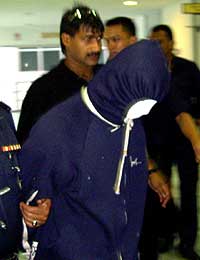 In this regard, the judge also noted that the statements had been recorded about 10 months after the event.
He then admitted as evidence several statements made in court against Azilah (left) and Sirul Azhar respectively, saying that “there is no cogent and tenable grounds for me to exercise discretion to exclude them”.
This was in relation to two applications to the court to use its discretion to exclude information offered as testimony by prosecution witnesses.
The following assertions had been attributed to Azilah in court:
- He (said he) could take me to try and find the place where the Mongolian girl had been killed, but the accused did not know the name of the place and was unsure of the location.
- This is the place where the (body of the) Mongolian girl was blown up.
- This is the place where the Mongolian girl was shot.
Statements attributed to Sirul Azhar were:
- I can show the jewellery belonging to the woman ... which I kept in my house in Kota Damansara.
- I kept the jewellery in my jacket.
- These are her items.
Razak’s affidavit
Mohd Zaki then examined the “status and weight” to be attached to Abdul Razak’s affidavit which had been tendered as an exhibit.
Citing case law, the judge pointed out that - unlike a cautioned statement and confession - the affidavit was not part and parcel of the investigation process.
But since the document was part of the prosecution’s case, he said “its entire contents including the exculpatory parts must be given the due weight as is given to the rest of the evidence for the prosecution”.
(An exculpatory statement refers to evidence and/or statements which tend to clear, justify or excuse a defendant from alleged fault or guilt.)
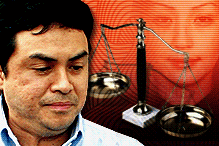 Mohd Zaki then read out 13 parts of the affidavit which detailed Abdul Razak’s
(left)
dealings with the police, in seeking assistance against the ‘nuisance’ caused by Altantuya when she went to his house on two occasions.
Mohd Zaki then read out 13 parts of the affidavit which detailed Abdul Razak’s
(left)
dealings with the police, in seeking assistance against the ‘nuisance’ caused by Altantuya when she went to his house on two occasions.
Abdul Razak described the course of events during which he had first met Azilah, and the last time he saw Altantuya being taken away in an unmarked police vehicle before the news of her death.
In view of absence of the rebuttal evidence and the fact that there is no legal onus on Abdul Razak to rebut any statutory presumptions, the judge said there is “no reason for (these parts) to be ignored and rejected”.
He agreed with Abdul Razak’s legal team that the exculpatory parts, which had been corroborated by four witnesses, as well as other surrounding circumstances “have clearly negated and nullified the act of abetment”.
Preparing for the defence
Outside the courtroom, lawyers for Azilah and Sirul Azhar told reporters that they would be calling several witnesses who had testified for the prosecution.
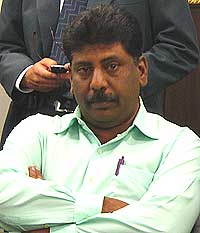 Sirul's lawyer Kamarul Hisham said he plans to put private investigator P Balasubramaniam
(right)
and popular blogger Raja Petra Kamarudin on the stand, as both have made statutory declarations involving his client.
Sirul's lawyer Kamarul Hisham said he plans to put private investigator P Balasubramaniam
(right)
and popular blogger Raja Petra Kamarudin on the stand, as both have made statutory declarations involving his client.
Asked if this was because the documents contain allegations linking deputy premier Najib Abdul Razal to Altantuya, Kamarul replied: "I am not saying it is relevant to us just because it links anyone. I am saying the statutory declaration is relevant as far as the defence of Sirul is concerned.
"I am not imputing anything to anyone. The question must remain at the moment on whether the statutory declaration has any basis at all.”
Najib has, all along, strenuously denied claims that he was involved with Altantuya.
However, Kamarul was uncertain whether he would be able to get in touch with Balasubramaniam, who has gone into hiding since retracting his statutory declaration .
 As for Raja Petra
(left)
, Kamarul said he would write to the Home Ministry to be allowed to interview the blogger who has been detained under the Internal Security Act at Kamunting detention camp in Perak since last month.
As for Raja Petra
(left)
, Kamarul said he would write to the Home Ministry to be allowed to interview the blogger who has been detained under the Internal Security Act at Kamunting detention camp in Perak since last month.
Azilah's lawyer, Hazman Ahmad, said six to seven witnesses would be called, including police personnel Musa Safri and Rohaniza.


Are you sure you want to delete this comment?
This action cannot be undone.