




Backbenchers rap Penang's multi-lingual road signs
Barisan Nasional backbenchers today urged the federal government to take action against the DAP-led Penang government for using multi-lingual road signs.
Barisan Nasional backbenchers today urged the federal government to take action against the DAP-led Penang government for using multi-lingual road signs.
 Mohamad Aziz (BN-Sri Gading) said the Penang government's decision to implement the multi-language road signs instead of road signs in the national language was disrespectful to the nation's social contract.
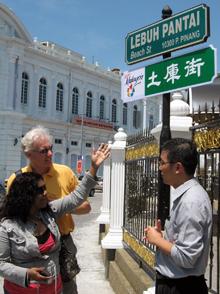 "I want the Ministry of Unity, Culture, Arts and Heritage, with courage, with honesty, to explicitly tell the House what kind of action will it take against the insolence displayed by the Penang government to use road signs with three languages which is disrespectful to the federal constitution," he said.
He then argued that the constitution stated that Bahasa Malaysia was the primary language of the nation and must be used as the main language for public road signs.
Deputy Unity, Culture, Arts and Heritage Minister Teng Boon Soon however responded by saying that the matter fell within the jurisdiction of the state government and not the ministry.
Teng, who is MCA MP for Tebrau, also said that the constitution emphasised on respect for other languages.
Umno bullies
Frustrated by Teng's reply, Mohamad raised his voice and accused Teng of attempting to evade his question.
The MP for Sri Gading also found an ally in Puad Zarkashi (BN-Batu Pahat) who intercepted and demanded that the Penang government retracted their multi-lingual road sign policy.
Pakatan Rakyat MPs, who remained silent during the entire ruckus, then took the opportunity to rile up both Puad and Mohamad by calling them as "Umno bullies" - referring to news reports on BN component party members' complaining about political bullying by Umno.
Deputy Speaker Ronald Kiandee at this point told both Mohamad and Puad to sit down and resume with the session.
The Penang state government revealed on Monday that it planned to put up street names and road signs in multiple languages at heritage areas for the benefit of tourists and visitors.
State Local Government, Traffic Management and Environment Committee chairperson Chow Kon Yeow said that the languages would depend on the cultural characteristics of the streets in question.
"There have been requests for road signs in various languages now that Georgetown has received Unesco recognition as a world heritage site.
"The state has, in principle, agreed to have signs in Bahasa Malaysia, English, Chinese and Tamil, and maybe even Arabic," he had said.
The DAP has drawn support from an unlikely parliamentarian today - Deputy Education Minister Wee Ka Siong.
The newly-elected MCA Youth chief said that multi-lingual signboards would help in attracting foreign tourists to Malaysia.
"Even KLIA (Kuala Lumpur International Airport) could set up Arabic, Japanese and Chinese signboards for the convenience of tourists," said Wee.
"Thus I see no reason why we should disallow putting up of signboards in multi-languages in the country to benefit the tourists."
No review on LRT fares
Meanwhile, the government also said that it was not looking into reviewing LRT fares for the time being, said Deputy Transport Minister Lajim Ukim.
Replying to question posed by Tian Chua (PKR-Batu), Lajim said the authority to review fares fell under the ministry's jurisdiction but no discussion over the matter have taken place.
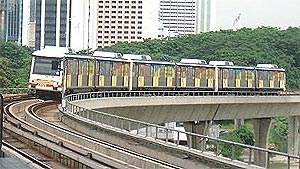 "Until now, we have not received any suggestion to review or increase fare prices by LRT operators," he said.
However, to accommodate the growing population of the city, he said that the government planned to extend both the Kelana Jaya and Ampang LRT stream by 15 kilometers each.
"Thirty-five sets of trains have been purchased by the government for the Kelana Jaya extension stream and is expected to be fully operational by 2010 with the cost of RM1.3 billion," said Lajim.
The government also planned to develop a new 42-kilometre LRT stream from Kota Damansara to Cheras and is estimated to provide public transportation for some 300,000 residents in these areas.
The project is estimated to complete by 2014.


Are you sure you want to delete this comment?
This action cannot be undone.