




By-election: PKR gets more Malay votes
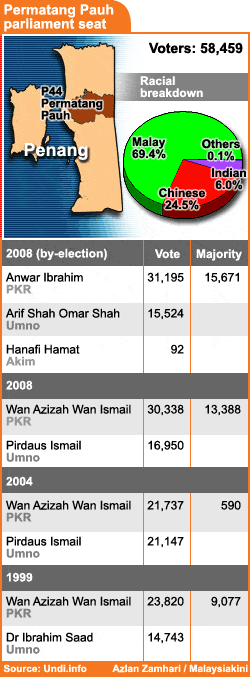
The two significant numbers to emerge from the recent Permatang Pauh by election are 13,388 and 15,671. The first is the majority achieved by Dr Wan Azizah Wan Ismail in the general election in March while the second is the majority achieved by Anwar in the Aug 26 by-election.
The larger majority is obviously significant for Anwar given that it was widely expected that his majority would decrease. But what else can we tell from the by-election results? Is there more to be gleaned from a careful investigation of the results at a more local level?
One of the more important questions leading up to the by-election was if Anwar would be able to maintain or even increase his support among the Malay voters in Permatang Pauh. There was a feeling that the sodomy accusations or the impression that he was giving in too much to the demands of the non-Malays within Pakatan Rakyat would cost him some Malay votes here.
The two significant numbers to emerge from the recent Permatang Pauh by election are 13,388 and 15,671. The first is the majority achieved by Dr Wan Azizah Wan Ismail in the general election in March while the second is the majority achieved by Anwar in the Aug 26 by-election.
The larger majority is obviously significant for Anwar given that it was widely expected that his majority would decrease. But what else can we tell from the by-election results? Is there more to be gleaned from a careful investigation of the results at a more local level?
 One of the more important questions leading up to the by-election was if Anwar would be able to maintain or even increase his support among the Malay voters in Permatang Pauh. There was a feeling that the sodomy accusations or the impression that he was giving in too much to the demands of the non-Malays within Pakatan Rakyat would cost him some Malay votes here.
A loss of Malay support would have no doubt given his political enemies cause to raise doubts about his intentions to build a multiethnic coalition, one that would be more ‘fair’ than the BN.
Without accurate exit polls, a norm in more developed countries, it is difficult to get a sense of how members of the different communities in Permatang Pauh vote in the recent by-election.
However, what is available to analysts such as myself is the fact that the electoral returns are calculated by polling streams or ‘salurans’ at the polling district or polling station level (or ‘daerah megundi’) which when finally tabulated gives the overall result at the constituency level.
We can also estimate the racial composition of each polling district by going through the electoral roll and allocating a racial identity for each voter. (The electoral roll released by the Election Commission does not provide the race of each voter but it is relatively easy to identify the race of the voter by his or her name).
We can then use the racial composition of each polling station together with the polling returns to estimate the level of Malay and non-Malay support for the BN as well as the opposition. A Harvard political scientist by the name of Gary King has developed a statistical method to do exactly this.
We can use this method to compare the level of Malay and non-Malay support received by Anwar in the recent by-election and that received by his wife, Wan Azizah, in March. But we can go further back. In fact, I have the polling station results from both the 1999 and 2004 general elections as well as for the 2008 general election and most recently, the by-election, thanks to Malaysiakini .
How the Malays voted
An examination of the racial voting patterns from 1999 to the recent by-election shows some interesting trends. [See table]
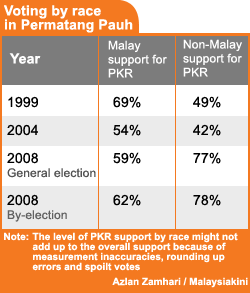 In 1999, the level of support for PKR, when Azizah ran in the place of Anwar, was 69%, the highest among the years for which we have data at the polling station level for.
This was of course reflective of the mood of the elections then, when a large proportion of the Malay electorate swung against the BN over the treatment of Anwar.
In contrast, the non-Malay support for Azizah was lukewarm at best and this reflected the ambivalent level of support among the non-Malays over the reformasi movement.
The level of support for PKR took a huge dent in 2004 because both Malays and non-Malays swung back to the BN in support of Abdullah Ahmad Badawi’s own reform agenda so much so that Wan Azizah almost lost this seat.
By March 2008, the level of Malay support for PKR had increased somewhat but still below that in 1999. What was significantly different was the fact that the non-Malay support for PKR took a huge jump, from 42% in 2004 to 77% in 2008. Again this was reflective of national trend which was a small decrease in the level of Malay support for the BN but a huge decrease among the non-Malays.
Not much changed from March to August, at least in terms of the racial voting patterns. This is not that surprising given that the majority did not increase by a very large margin. The Malay support for Anwar increased by about 3% and the non-Malay support by about 1%.
While patterns of racial voting have not changed much in six months, Anwar and his supporters can be assuaged by the fact that the Malay support in Permatang Pauh is still firmly behind Anwar despite (or maybe because of?) the many attacks that have been leveled against him and his party over the past few weeks and months.
Secure with this knowledge, Anwar should feel confident that he can press on with his self-appointed task of toppling the BN government, partly because he can make the argument that a majority of Malays support him (even though this was only proved in Permatang Pauh).
Too much made of Arif
A closer examination of the polling station returns also revealed another finding, which was that Arif Shah Omar Shah’s candidacy and some of his highly publicised skills such as the ability to speak Mandarin and Hokkien did not really help his or the BN’s cause.
In a way, BN’s decision to ask a sitting state assemblyman to stand for a by-election in a parliamentary seat was an unprecedented move. The BN, unlike the opposition, has a standing policy of not allowing any of its candidates in Peninsular Malaysia to stand concurrently for a parliamentary and a state seat. Former Kelantan Umno chief Mustapha Mohamed has been a notable exception.
Much was made of the fact that Arif managed to hold on to his state seat despite the large swing against the BN in Penang and in Permatang Pauh.
While it is true that he won his state seat of Seberang Jaya with 533 votes in the 2008 general election and his BN colleagues in the other two state seats of Permatang Pasir and Penanti lost by 5,433 and 2,219 votes respectively, many ignored the fact that the BN also won this state seat and lost the other two in the 1999 general election when Arif was not the candidate in Seberang Jaya.
Also ignored was the fact that most of the 500 postal votes in Permatang Pauh come from the Seberang Jaya state seat and that most of these votes were added after the 1999 general elections. [See table]
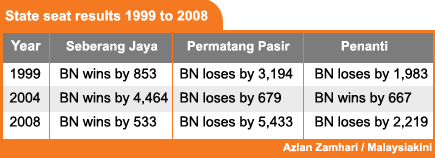
In other words, while Arif might be a good assemblyman in terms of service provision, he was also ‘lucky’ in being in the best seat in Permatang Pauh.
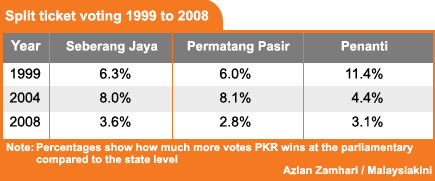
The other fact lost on most people is the prevalence of split voting in Permatang Pauh where more voters vote for the opposition i.e. Wan Azizah in 1999, 2004 and 2008 at the parliament level compared to the state level. PKR has always garnered more support at the parliamentary level compared to the state level in Permatang Pauh.
And the underlying rationale for this is simple – more people in Permatang Pauh wanted Wan Azizah to represent them in parliament as a proxy to Anwar. Given this rationale, it was unlikely then that even if a popular state assemblyman in the form of Arif were to stand at the parliamentary level that voters would want to take their vote away from Anwar, in this case, and give it to Arif. [See table]
If it were a more regular by-election, it would be natural to expect that the linguistic abilities of a Malay Umno candidate would appeal to Chinese voters and would presumably sway at least some of them to switch their vote to him or her. But this was not a regular by-election.
The voters here were possibly voting for the next prime minister of Malaysia and the non-Malay voters were well aware that a government under Anwar would very likely introduce policies which would be beneficial to them, not to mention the public expenditure he would bring to this constituency. Hence, the linguistic appeals of Arif came to naught.
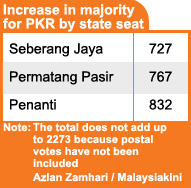
Arif wasn’t even able to prevent Anwar majority increasing in his own home ground of Seberang Jaya. Anwar’s increase of 2,273 votes was evenly distributed across all three state seats – 727 in Seberang Jaya, 767 in Permatang Pasir and 832 in Penanti.
Should Anwar worry?
Should Anwar be worried that he managed to win ‘only’ 62% of Malay support in Permatang Pauh? Probably not. After all, his 67% share of the valid vote in Permatang Pauh compares very favourably with Abdullah’s 66% share of the valid vote in Kepala Batas in the March general election.
He managed to successfully fend off the flurry of personal attacks made against him in the run-up to polling day. He also managed to focus the efforts of the Pakatan coalition on this by-election after many weeks of speculation on Umno-PAS talks and the more recent disagreement between PKR MP Zulkifli Nordin and DAP MP Chong Eng in parliament.
The focus will quickly shift away from this by-election and the majority achieved by Anwar to his ongoing efforts to topple the BN government. In the meantime, one probably could not blame Anwar and his supporters for basking in the glow of a successful by-election, at least for a little while longer.
Permatang Pauh by-election results - all polling districts
ONG KIAN MING is a PhD candidate in political science at Duke University. He would like to thank Lai Soon Keat of Gerakan, Dr Bridget Welsh of SAIS, Johns Hopkins and Steven Gan of Malaysiakini for some of the data used in this piece. All analytical errors are his own.


Report this comment
Are you sure you want to delete this comment?
This action cannot be undone.