




Demoralised BN faces a resurgent Anwar
Two anecdotal experiences by Oon in Permatang Pauh capture, in a nutshell, the main takeaway points from the ‘mother of all by-elections’.
Two anecdotal experiences by Oon in Permatang Pauh capture, in a nutshell, the main takeaway points from the ‘mother of all by-elections’.
The first was Oon's morning visit to a wet market in Seberang Jaya, Arif Shah Omar Shah's state constituency. When Anwar Ibrahim arrived at the same wet market, he was mobbed by well wishers and supporters who wanted to shake his hand and to take pictures with him. Deputy Prime Minister Najib Razak and Arif also made appearances there but their reception was lukewarm at best. They didn't stay for long.
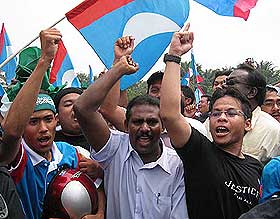 The second was Oon's walkabout with Jelutong MP Jeff Ooi of the DAP. Ooi's entourage was greeted warmly by PAS supporters who exchanged party flags with them and proceeded to proudly wave the DAP flag. Later on, a PKR van would come by and hand out some biscuits for both DAP and PAS supporters.
The first anecdote reflects the stark contrast between the levels of support for Pakatan Rakyat on the one hand and for Barisan Nasional on the other. The second reflects the level of genuine cooperation and the feeling of 'muhibbah' between the component parties within Pakatan, a level of cooperation that had not existed as recently as the general election in March.
Being on the ground only confirmed Oon's prediction before going to Permatang Pauh that Anwar would win with a bigger majority compared to Dr Wan Azizah Wan Ismail's victory in March.
This was also reflected in other events which he observed including the ceramah held the night before polling day which reminded him of the mood he felt at a massive DAP gathering in Han Chiang college on Penang island before the last general election.
Uncertainty over winning margin
But this is not to say that an increased majority was a foregone conclusion. In fact, on the contrary, many political commentators and even insiders within Pakatan were saying that Anwar's majority would be reduced.
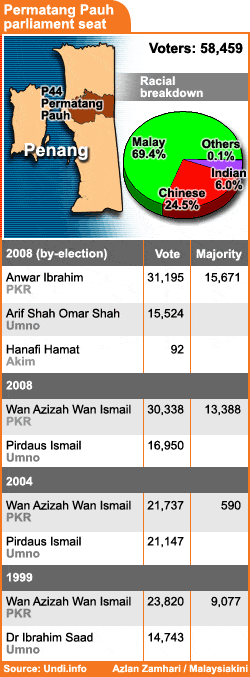
 The estimates ranged from a low of 5,000 votes to a high of 10,000 votes, still less than the over 13,000 majority obtained by Wan Azizah in March. Oon was the only one on the ground predicting an increased majority for Anwar leading him to be labeled as an 'optimist'. (Note: In a previous article in
Malaysiakini
, we predicted
an increased majority of 15,000
.)
The estimates ranged from a low of 5,000 votes to a high of 10,000 votes, still less than the over 13,000 majority obtained by Wan Azizah in March. Oon was the only one on the ground predicting an increased majority for Anwar leading him to be labeled as an 'optimist'. (Note: In a previous article in
Malaysiakini
, we predicted
an increased majority of 15,000
.)
Pakatan insiders were worried in particular about two issues – turnout and money. A lower turnout would obviously decrease the absolute majority that Anwar would receive, a distinct possibility when many voters work in other cities and states.
 The effect of the large amounts of money which BN was pouring into the constituency was hard to predict. Voters might feel compelled to vote for the BN after receiving handouts from BN politicians or they might easily accept BN's offer with the one hand and vote Anwar with the other. There was no accurate way of judging the ground sentiment amongst the Malay voters in Permatang Pauh.
In the end, Permatang Pauh delivered a resounding victory for Anwar, increasing his majority by slightly more than 2,000 votes. As political analyst Wong Chin Huat has stated elsewhere, this was the closest we'd get to a 'presidential' election in that voters were voting in who could be the next prime minister of the country.
In other words, this was a 'referendum' of sorts on Anwar, one which he passed with almost two-thirds of valid votes. Most importantly, he showed that he still had the firm support of Malay voters, a constituency which many people were arguing was wavering because of the accusations that Anwar was giving in too much to the non-Malay parties and voters.
Eggs on Najib’s face
If this by-election provided a resounding victory for Anwar and Pakatan, the flip side is also true, which is that it was a huge blow to the BN. No matter how one tries to spin it, the results were an unmitigated disaster for the government.
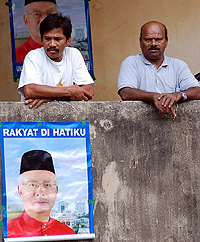 If the majority had been reduced, the BN could have argued that Anwar's support, especially among the Malays, was slipping. This did not occur. On the contrary, Prime Minister Abdullah Ahmad Badawi and Najib emerged with eggs on their faces.
Abdullah's appearances in Permatang Pauh were low key affairs, barely covered by the press. Najib, who was in charge of heading the operations on the ground, even had to resort to swearing on the Quran that he had never met Mongolian model Altantuya Shaariibuu but to no avail, at least judging by the results.
The campaigning on the part of the component party leaders was lackluster at best. Arif's command of the Chinese language and his record as a state assemblyman didn't have the intended effect.
There were also reports, yet to be confirmed, that the postal votes, cast largely by the police, 87 percent of which were cast in favour of the BN in March, were actually won by Anwar by a small majority.
A demoralised BN will now have to face an insurgent Anwar in parliament and one can be sure that he will continue his assault on the government by further de-legitimising it.
This was also an important first 'joint venture', so to speak, on the part of the Pakatan coalition. The coalition had been under fire of late, firstly over the Umno-PAS talks and then later over PKR MP Zulkifli Nordin's participation in the protest over the Bar Council discussion on conversion issues.
If there were BN supporters and leaders who were hoping that the Pakatan coalition would crack and splinter, this by-election should quash such notions.
While there is a faction within PAS, led by Nasharuddin Mat Isa and Mustafa Ali, that wants to cooperate with Umno, as long as PAS leaders such as Husam Musa and Nik Aziz are in firm control of the party, PAS commitment to Pakatan will remain strong. With control over the federal government within striking distance, Pakatan is not likely to implode anytime soon.
Perhaps the BN should have considered an alternative strategy that was bandied about by some within Umno which was to simply give Anwar a walkover. They could have saved themselves a lot of time, money and face and denied Anwar the legitimising effects of this by-election.
But if there's one thing BN is good at, it's scoring own goals. And it as has done so yet again.
ONG KIAN MING is a PhD candidate in political science at Duke University and OON YEOH is a writer and new media analyst. You can listen to both of them discuss this topic in their Realpolitik podcast .


Report this comment
Are you sure you want to delete this comment?
This action cannot be undone.