




Social contract: Fantasy to fiction
Those who attended today's Bar Council's forum, ‘The Social Contract', definitely had a lot of information with regards to the notion of social contract, Ketuanan Melayu and the federal constitution.
The event that was chaired by Bar Council secretary Lim Chee Wee saw four eminent speakers present their arguments on the whether there was such a thing called the social contract in the context of Malaysia.
Those who attended today's Bar Council's forum, ‘The Social Contract', definitely had a lot of information with regards to the notion of social contract, Ketuanan Melayu and the federal constitution.
The event that was chaired by Bar Council secretary Lim Chee Wee saw four eminent speakers present their arguments on the whether there was such a thing called the social contract in the context of Malaysia.
Dr Mavis Puthucheary of Ikmas and Dr Kua Kia Soong of Suaram argued against the motion whereas lawyer Tommy Thomas and renowned political scientist Dr Farish A Noor put forth their arguments that the social contract existed.
 In her presentation,
Malaysia's Social Contract: The Invention and Historical Evolution of an Idea
, Puthucheary stated that Article 153 of the federal constitution was used to promote the concept of Ketuanan Melayu or Malay supremacy since the 1980s.
In her presentation,
Malaysia's Social Contract: The Invention and Historical Evolution of an Idea
, Puthucheary stated that Article 153 of the federal constitution was used to promote the concept of Ketuanan Melayu or Malay supremacy since the 1980s.
Taking a historical perspective, she said there was no such social contract reached between the leaders.
"It was a leap into fantasy. There was no nationwide consensus," Puthucheary said, adding that the idea of it actually appeared in the Federation of Malaya Agreement.
Thus using Article 153 to support a social contract and equaling it to Malay supremacy was an attempt "to distort history for political expediency", she said.
Retracing historical chronology, Puthucheary explained that Umno became dominant after the citizenship rules were restricted in the years to follow the independence.
Comparing it to today's scenario, she said that real power sharing had diminished.
"Social contract is a smoke screen to allow Malay supremacy to gain dominance," she told a crowd of about 200 people.
National unity is hypocritical
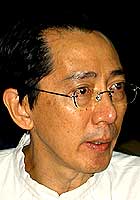 Kua on the other hand presented his paper entitled
So-Called Social Contract: A Class Perspective
and elaborated on a historical perspective chronologically.
Kua on the other hand presented his paper entitled
So-Called Social Contract: A Class Perspective
and elaborated on a historical perspective chronologically.
He said that the very term Ketuanan Melayu was used by Abdullah Ahmad, a member of parliament in Singapore on Aug 30, 1986, he said, quoting this fact from a book, Malay Dominance? The Abdullah Rubric , by K Das.
He then moved to present the background of Malaya in post-war period during which the colonial economy was heavily agro-based which continued up to post independence.
In forming the federation of Malaya in 1948, Kua explained, the British only consulted the Malay elites and not the others.
With plenty of references from numerous books, he supported Puthucheary's statement that not all were consulted in the making of the so called social contract.
He said that there were three points of transformation - 1957 was the beginning with Merdeka Agreement, in 1971 NEP came into force with Article 153 of the federal constitution and in 1986 the Ketuanan Melayu term was formed.
He also took a swipe at the BN and Umno.
"National unity is hypocritical when parties in BN are race based. The NEP and National Culture Policy brought in bumiputraism," he said.
He also defended the right of Chinese and Tamil vernacular schools as it was espoused in the Federal Constitution and the Universal Declaration of Human Rights.
To summarise, this former DAP MP stated that there was a need for non-racial alternatives. Among others, he proposed the need for Racial Relations Act.
A charter of protection
Thomas, a prominent lawyer, was the first speaker of the day who supported the notion of social contract with his paper Social Contract: 2008 & Beyond .
Beginning the talk from a historical perspective, he said "the most fundamental factor of Malaysia is the race factor".
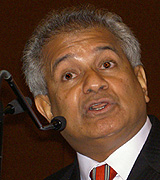 "Accommodating different groups is what the social contract is about. It exists," Thomas said.
"The Malays were not to be treated as second class citizens. In return the non-Malays were to give their undivided loyalty to Malaya," he explained.
This was historical reason why dual citizenship is not allowed in Malaysia.
In other words, the social contract is "a charter of protection for minority and a bill of rights for the majority".
He added that at present the greatest threat to the social contract came from the inculcation of Islamic values in educational institutions which was instituted by the then deputy prime minister Anwar Ibrahim under the Mahathir administration.
He also said that former premier Mahathir's unilateral declaration that Malaysia was an Islamic state in October 2001 also had played a role, just as the civil courts worsening it by abdicating its duties to syariah court and other prevailing racial insensitivities.
Malaysia : an artificial construction
The last speaker for the day was Farish, who supported the notion of a social contract but called it, and the notion of Malaysia, "a fiction".
He argued that "there was no reason for Sabah and Sarawak to be part of Malaysia. If at all it should have been Sumatera".
Thus, he said, Malaysia was an artificial construct.
 He asked the captivated audience why Malaysians today were bound by policies emanating from 1957 and May 13 1969 when they were not part of it.
He said the May 13 incident has often been used by the government to quell masses when in fact it was a three -ay incident that only took place in certain parts of the country.
The question-and-answer session was pretty intense as well.
One such moment was when Farish responded to the members of audience that Umno was a manipulation of fear to unify people.
There were some in the floor from Kelantan, who has raised the issue to Malays being sidelined.
To this, Farish responded: " Umno musuh Melayu. Umno ternak Melayu untuk disembelih (Umno is the enemy of the Malays. It is nurturing the Malays to sacrifice them)".
"The fear of Malays is baseless since the Malay Muslim community would reach 70 percent," he added.
His outburst on Umno did not go down well with several Umno Youth members who were present.
One of them said that "we don't want the Malays here to be as those in Singapore".
There were no untoward incidents at the forum despite objections raised yesterday by Independent parliamentarian Ibrahim Ali, who is president of Kelantan People’s Action Council.


Report this comment
Are you sure you want to delete this comment?
This action cannot be undone.