




June 9 ban stays on fuel sale to S'pore cars
The ban on the sale of petrol to Singapore-registered vehicles will take effect from June 9, and that’s that.
The ban on the sale of petrol to Singapore-registered vehicles will take effect from June 9, and that’s that.
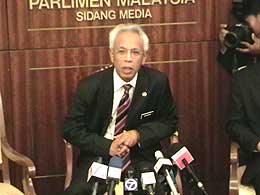
Domestic Trade and Consumer Affairs Minister Shahrir Abdul Samad told reporters at Parliament House this afternoon that there has been no change in the policy, which will apply to fuel sale within 50km of Malaysia’s border with Singapore.
 On Sunday, a
Bernama
news report filed from Singapore had quoted Deputy Prime Minister Najib Abdul Razak as
saying
that “a new effective date” will have to be found.
On Sunday, a
Bernama
news report filed from Singapore had quoted Deputy Prime Minister Najib Abdul Razak as
saying
that “a new effective date” will have to be found.
"Wait for the anti-inflation committee meeting, as I want to know the latest proposals on the matter. We will come up with a statement on Tuesday," Najib reportedly said.
"We have to find a new effective date because there are other matters, like for example, can we have separate pumps because the Singaporeans are saying that they don't mind paying the market rate.”
 Asked about this today, Shahrir said that he was unaware how
Bernama
got its information and reiterated the date of the ban.
Asked about this today, Shahrir said that he was unaware how
Bernama
got its information and reiterated the date of the ban.
He said that imposing the ban is the right thing to do as any country cannot subsidise another country’s fuel usage.
As for Malaysians who own Singapore-registered cars, he said those who earn Singapore dollars and buy Singapore-registered vehicles should be able to afford fuel at the market-price.
On concerns that petrol stations within the 50km radius would lose revenue, Shahrir said, “We will try to look at that later. We sympathise with the operators but it doesn’t make sense to let them earn eight sen (the estimated margin per litre) while the country subsidises almost RM2 per litre.
“The ministry will try to (re-examine) the profit margin and see if it can be increased. We will also try not to allow any more new petrol stations in the area to ensure that there is no new competition.”
Malaysia to save RM1 bil
According to a ministry official, Malaysia stands to save almost RM1 billion by banning the sale of fuel to motorists from Thailand and Singapore.
“In 2007, RM1.2 billion was spent subsidising fuel sales at petrol stations located near the borders of Thailand and Singapore,” said deputy director-general of enforcement Iskandar Halim Sulaiman.
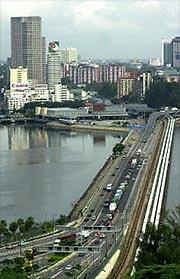 “Of total sales from these areas, we estimate that 80 percent of fuel was sold to foreign-owned vehicles. So, if we are able to reduce the sale of subsidised fuel to foreigners, a minimum of RM1 billion can be saved.”
At the current price level of US$127 per barrel (midday light crude oil price), the ministry expects that RM56 billion will be spent on subsidising fuel usage this year.
On the subsidy review, Shahrir said it will be carried out in August. Also expected then is an increase in the price of petrol.
“We can’t go on subsidising fuel usage forever, more so when the world price of oil keeps going up. To make matters worse, this is happening in tandem with the escalating price of food,” he said.
“If food prices are not moving up too, we might be able to hold off cutting back on oil subsidies. But as it stands, it is more logical to cut back on fuel subsidy and to transfer it to food instead.”
Among the elements for review are a subsidy system based on needs rather than usage. However, he did not provide any explanation on how the ministry intends to tackle the problem.


Are you sure you want to delete this comment?
This action cannot be undone.