




Putrajaya construction cost RM12 bil ... so far
Parliament snippets The federal administrative capital has cost a whopping RM11.83 billion in its construction cost so far, among other round-ups from the House today.
Parliament snippets The federal administrative capital has cost a whopping RM11.83 billion in its construction cost so far, among other round-ups from the House today.
Putrajaya construction cost RM11.83 bil
The construction of the federal administrative capital Putrajaya has cost a whopping RM11.83 billion, Prime Minister Abdullah Ahmad Badawi revealed in Parliament today.
In a written reply to Liew Chin Tong (DAP-Bukit Bendera), Abdullah said the cost covers the development of the government departments, the Putrajaya International Convention Centre, the official residences of the premier, his deputy, ministers, judges and other facilities.
 Elaborating, the premier said the development of the government departments in Putrajaya was done through privatisation via the build-lease-transfer approach.
The government is renting these premises from the Putrajaya Holdings Sdn Bhd for a concession of 25 years. At the end of the concession period, the buildings will be handed over to the government without any additional payment.
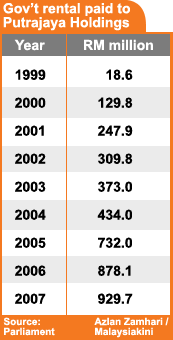
The prime minister also gave the breakdown of the rentals it paid to Putrajaya Holdings from year 1999 to 2007.
They are RM929.7 million (2007), RM878.1 million (2006), RM732 million (2005), RM434 million (2004), RM373 million (2003), RM309.8 million (2002), RM247.9 million (2001), RM129.8 million (2000) and RM18.6 million (1999).
Damansara school site to 'reopen' as new school
Education Minister Hishammuddin Hussein said today the government is prepared to 're-utilise' the site of the original SRJK (C) Damansara school in Petaling Jaya.
The minister said this in the Dewan Rakyat tonight during his ministerial winding-up that the government is ready to relocate another under-enrolment Chinese school from other area to operate on the grounds of the original Damansara school.
He said the government is prepared to do so should the original Damansara school site can fulfill the three conditions to ensure the "security, comfort and the health of the students".
The minister's statement, which fell short of announcing the school's reopening, was seen as a letdown after a seven-year struggle by the parents and educationists to fight for its reopening.
Met by reporters at the Parliament lobby after his winding-up, Hishammuddin also said his statement could not be construed as the re-opening of the original Damansara school.
"It's not a question of opening up the school again because the school has been shifted," he stressed.
The school was relocated by the Education Ministry on Jan 2, 2001, ostensibly because it no longer provided a "conducive learning environment".
A new building in Tropicana, located several kilometres away from the original premises, was built later.
Refusing to move their children, some disgruntled parents and supporters formed the SOS committee and since then, classes have been conducted in air-conditioned containers placed in a neighbouring temple.
PM: Kit Siang doesn't understand TI's corruption index
Abdullah has described Lim Kit Siang (DAP-Ipoh Timur) not being able to fully understand the Corruption Perception Index by graft watchdog Transparency International.
Lim had asked the premier to state whether a royal commission would be set up to investigate the reasons behind Malaysia's fall on the index from a ranking of 23 in 1995 to 44 and 43 in 2006 and 2007 respectively.
Denying the need for such a commission, Abdullah said in his written reply to Lim that the DAP leader had failed to understand that Malaysia cannot be judged solely on its TI ranking because the total number of countries in the index change from year to year.
"For example, in 1995, there were 41 countries that took part in the index. In 2006, that number increased to 163 countries, and in 2007 to 179," said Abdullah.
Abdullah also said Malaysia had improved its ranking in terms of corruption perception when it was higher than 44 percent of the countries on the index in 1996 to being better than 73 percent and 76 percent of the countries on the index in 2006 and 2007 respectively.
He, however, said that while public perception of corruption should be considered, what is more important is the substantial steps taken to tackle corruption and improve integrity.
Motion on anti-ISA rallies rejected
The Dewan Rakyat has rejected an emergency motion by a DAP MP to debate what he described as police "brutality" against demonstrators who were calling for the end of the draconian Internal Security Act (ISA).
Speaker Pandikar Amin Mulia shot down M Kula Segaran (DAP-Ipoh Barat) motion on the ground that matter was not urgent because "the police have taken action according to the laws in dealing with the assemblies".
Seven activists were arrested in Penang on Sunday for reasons ranging from illegal assembly, causing public disorder and disruption to traffic flow to alleged unruly conduct and video-taping a verbal argument between an activist and a police officer. They were later released.
Similar gatherings - which were aimed also at the release all ISA detainees and for Hindu Rights Action Force (Hindraf) legal adviser P Uthayakumar to be given proper medical treatment - were held simultaneously in Kuala Lumpur, Ipoh, Seremban and Johor Bahru.
Minister: ‘Anti-unity' sentiment exists
Unity, Culture, Arts and Heritage Minister Mohd Shafie Apdal has conceded the existence of ‘anti-unity' and ‘anti-Peninsular' sentiments among certain quarters.
In his reply to Dr Marcus Mojigoh (BN-Putatan) during the question session this morning, the minister said the sentiments were caused by several factors including the lack of understanding on the history of Malaysia and the special privileges enjoyed by the bumiputeras.
The sentiments were also caused by lop-sided development, the unequal distribution of posts for Sabah and Sarawak officials at the federal civil service as well as seat in local universities, the different price for essential items, the issue of illegal immigrants, those concerning the petroleum and government-linked companies.
"To resolve these issues, the government has introduced several integrated approaches to strengthen the racial and national integration ties among the citizens," Shafie told the House.
He added that it was important for Malaysians to understand the spirit of the Federal Constitution and the Rukunegara to protect the national unity.


Are you sure you want to delete this comment?
This action cannot be undone.