




Whistleblower Act: No U-turn, clarifies Nazri
The government has not made a U-turn on its plan to enact the Whistleblower Protection Act despite that the Dewan Rakyat was told earlier today that it had no intention to pass the proposed bill.
The government has not made a U-turn on its plan to enact the Whistleblower Protection Act despite that the Dewan Rakyat was told earlier today that it had no intention to pass the proposed bill.
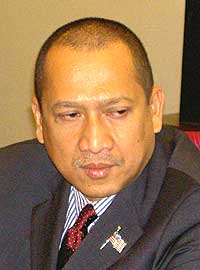 Minister in the Prime Minister's Department Mohd Nazri Abdul Aziz told the house this morning that the government had no plan to enact the Act, as well as the Freedom of Information Act.
"We have no plan to enact any of these acts because although we have the Official Secrets Act, the cabinet can decide on anything that need to be declassified at anytime," he said in replying to a supplementary question from Dr Siti Mariah Mahmud (PAS-Kota Raja) during the question session.
Siti Mariah had asked Nazri whether the government would enact the Whistleblower Protection Act and the Freedom of Information Act.
However when met later at the Parliament lobby, Mohd Nazri said he was misconstrued over his reply in the House.
"What I meant is that we have no intention to amend any existing Act and the Whistleblower Protection Act is not even an Act yet," he said.
Asked whether he would push through the tabling of the Whistleblower Protection Bill in the Parliament soon, he replied: "I hope so."
Nazri had said last November that the first draft of the bill was being circulated to government agencies and ministries for feedback.
"Then it will be brought to Parliament for the first reading and debated before it is passed and gazetted as an Act," Nazri was quoted saying by Bernama at the time.
Last month, in the wake of the ruling BN coalition's unprecendented polls setback, Prime Minister Abdullah Ahmad Badawi had promised to pass new laws to protect whistleblowers and witnesses.
Lim: Where's the political will?
In another supplementary question, Lim Kit Siang (DAP-Ipoh Timur) questioned the government's political will on battling corruption where the so-called 18 high-profile cases involving senior government officials were still untouched.
"The sharks are still free. They are free, but all the anchovies had been caught," he added, stirring up some indignation from the BN backbenchers.
The Ipoh Timur MP pointed out that the government's plan to commit to zero-tolerance for corruption has been long abandoned and asked whether there is a need to place its top priority on the national integrity plan, which he described as a "failed" plan.
However, Nazri puffed away the statement by the opposition leader.
"It is in the Barisan Nasional manifesto since the 2004 election that we would fight against corruption, but it was impossible to be done in a short time for such a big thing like that," said the minister.
He took a swipe on Lim who criticised the government was lacking in political will to fight graft.
"It's impossible that (Lim) can't see what we are doing today, which is clearly showing our political will to fight corruption," retorted Nazri.
Selangor to lead the way
Meanwhile, R Sivarasa (PKR-Subang) expressed his "shock" and disappointment with the government's about-turn given its declared seriousness in fighting against corruption.
Contrary to Nazri's assertion, the PKR vice-president said the BN-led government had never declassified any document that had previously been under the Official Secrets Act.
"The Selangor government under the leadership of Pakatan Rakyat will begin to declassify all secret documents that are of public interest as a first step towards improving the transparency of its administration," said Sivarasa in a statement issued to the media.
On a related matter, Sivarasa said he had submitted on April 14 a motion for the Dewan to debate a draft Freedom of Information Bill that had been prepared in consultation with various non-governmental organisations.
Despite being within the time period stipulated by parliament regulations, this motion has not been included in the Standing Orders, said Sivarasa.
"A Freedom of Information Act needs to be enacted soon as a first step towards transparent governance and as a concrete step in battling corrupt activities," he said.


Are you sure you want to delete this comment?
This action cannot be undone.