




Pre-dawn strikes against temples decried
"Stop desecrating and demolishing our temples. This has gone on long enough!" This cry of anger was greeted with applause at a parliamentary roundtable to discuss the spate of unbridled demolition of Hindu temples in several states.
"Stop desecrating and demolishing our temples. This has gone on long enough!" This cry of anger was greeted with applause at a parliamentary roundtable to discuss the spate of unbridled demolition of Hindu temples in several states.
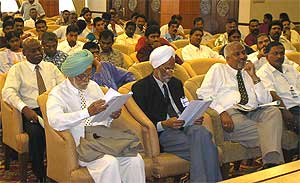
Present in Parliament House on Sunday were more than 160 representatives of temple committees and groups from Perak, Selangor and Negeri Sembilan, many for the first time in their lives, to complain of past incidents and express concerns that these may be repeated.
A common claim in almost all accounts was that local authority enforcement officers, assisted by police personnel, had employed high-handed tactics to demolish long-standing structures in the wee hours of the morning.
There were numerous allegations that enforcement teams of 10 to 300 personnel had destroyed or set fire to temples in Shah Alam, Klang, Seremban, Damansara, Sungai Petani, Petaling Jaya and Jasin. Some of these had been built a century ago.
 A temple caretaker from Kampung Sungai Kayu Ara, Damansara, broke down as she recounted her horrifying experience of being rudely awoken by explosions from petrol bombs.
"It was early in the morning and I was asleep at the temple when a group of 100 to 200 MPPJ (Petaling Jaya Municipal Council) and police personnel started throwing petrol bombs," she alleged.
"I screamed for help and shouted at them to stop but they ignored me. My heart broke at the sight. I cared for the place and the goddess was like my own mother."
A caretaker from Klang observed: "All the operasi (operations) are done in the early morning when everyone is still sleeping."
Another from Jalan Davies in Kuala Lumpur claimed that the temple and the statues were dug up and buried on-site last February to make way for the RM2 billion Stormwater Management and Road Tunnel (Smart) project running through the area.
MIC, MCA 'powerless'
Almost all the stories were accompanied with a slide presentation by lawyer P Uthayakumar. In listing the demolished temples, he said Malaysian Hindus deserved better.
"We only want a proper place of worship. Official figures show that the community tops the list for high crime rates but we're banking on our temples for youths to improve."
 He also told the audience to stop depending on political parties or elected representatives as "they are powerless despite sitting in high government office".
"Politicians can't do anything, so let them be. The MIC, the MCA have no power. It's time we as citizens take the responsibility of knowing and protecting our rights."
Citing an example, Uthayakumar said Kelantan was led by Islam-based PAS, which supposedly comprised Muslim fundamentalists, but that the state has yet to demolish a single temple.
"This includes Terengganu when it was under PAS (for a term). In fact, the Kelantan government has even given land for a Sikh temple to be built. We have to fight the system. If the temples are demolished, build them again."
He said the mainstream English and Malay media did not find this issue newsworthy because "it is a minority issue" that is closely covered only by the Tamil papers.
Citing an example of freedom of religion, he said that Indonesia, despite being the world's largest Muslim nation, has a depiction of the Hindu deity Lord Ganesha on its Rp20,000 currency note.
"That is freedom of religion, which we hardly have here when our places of worship are continuously being destroyed."
Ipoh Barat DAP MP M Kula Segaran, who hosted the dialogue, plans to move an adjournment speech when Dewan Rakyat sits at the end of the month.
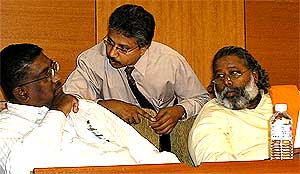 "This is necessary given the urgency of the situation and I expect the government to act on it. I will also see (minister Mohd) Nazri (Abdul Aziz) about this," he said.
"If not addressed, this could escalate into a serious racial issue. We want to put a forceful memorandum to the government because we are citizens and have every right to the facilities under the constitution."
Taking a swipe at the MIC for the prevailing state of affairs of Indian Malaysians, he blamed it as being the "biggest stumbling block" to the community's progress.
"The MIC has aggravated the situation by shirking its responsibilities to its constituents while the media's poor coverage, all caught up with the 'sensitive issue' argument, is of no help at all," he said.
Police inaction
Hindraf chairperson P Waytha Moorthy said 50 police reports had been lodged following the demolition of seven temples in the last three months.
"The figure now stands at 12 after we were informed of five more today (Sunday). It is time to protest against such crimes because our complaints and plight have fallen on deaf ears.
"The point is to register our protest. It doesn't matter if we win or lose in court. Section 295 of the Penal Code makes it a crime to injure or defile a place of worship."
On May 2, an injunction was sought to stop the demolition of a temple along Jalan Tampin near Senawang, Negeri Sembilan, believed to be 150 years old going by the gigantic tree under which it is located.
The plaintiffs are four individuals acting on behalf of the Sri Maha Mariamman-Muniswarar Aalaiyam temple committee. The Seremban district and land office and the state government have been named as defendants.
The hearing date for the application has not been fixed, said Waytha Moorthy.
Also present at the roundtable were Hindu Rights Action Force (Hindraf) advisor TM Ramachandran, P Gunasegaran and lawyers A Sivanesan and R Kengadaran who deliberated on an 11-point resolution that was adopted at the end of the meeting.
It called for, among others, the prime minister to be made the minister of non-Muslim affairs, for a freedom of religion and worship law, and for a national consultative interfaith council to be set up.
On May 11, a group of Malaysian Hindus led by Hindraf had petitioned the government through a memorandum to Nazri to stop the demolition of temples.
"But more temples have been demolished since that meeting," said Uthayakumar, adding that a letter was also sent to Culture, Art and Heritage Minister Dr Rais Yatim to declare old places of worship as a national heritage.
The first protest over temple demolitions was held on May 25 by about a group of 100 who gathered at the Kuala Lumpur City Hall building but were ignored by officials.


Are you sure you want to delete this comment?
This action cannot be undone.