




Police 'attack' IPCMC in internal bulletin
exclusive As the government mulls over its decision to implement the Independent Police Complaints and Misconduct Commission (IPCMC), the police force has on the other hand launched a campaign to step up its rejection to the proposal.
exclusive As the government mulls over its decision to implement the Independent Police Complaints and Misconduct Commission (IPCMC), the police force has on the other hand launched a campaign to step up its rejection to the proposal.
In a special edition of an internal bulletin Berita Bukit Aman, the Royal Malaysian Police (PDRM) attacked the IPCMC among others as 'unconstitutional, prejudicial to national security and public order, can cause a state of anarchy and undermines the ruling coalition's power'.
 The bulletin also warned that if the IPCMC is established by the present Barisan Nasional-led government, the police force will vote for the opposition in the next general election.
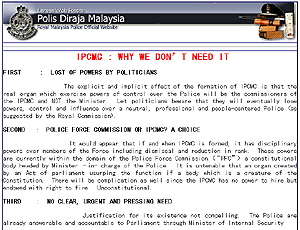
The special edition titled 'IPCMC - an unchallenged power?' is available on the PDRM's official website . It has 12 chapters covering the IPCMC's background, the dialogue between Prime Minister Abdullah Ahmad Badawi and PDRM and why the force opposes the IPCMC.
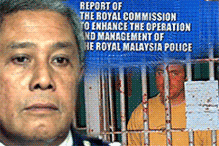
The IPCMC is touted as the most significant recommendation among the 125 recommendations made by the government-backed Royal Police Commission. The commission was formed to improve the police force, widely considered as riddled with corruption and abuses.
'Politicians lose power' in IPCMC
The bulletin stated that the special edition was published as suggested by the Inspector General Mohd Bakri Omar himself to "provide views by the PDRM top brass and those who have opined that the IPCMC is not appropriate to be implemented".
Nine reasons listed by the bulletin in the chapter of 'rationale' in opposing the IPCMC included:
- Against national security and public order.
In another chapter, 'IPCMC - Why We Don't Need It', an additional reason to oppose the IPCMC is that it will eventually cause the politicians "to lose their powers".
"The explicit and implicit effect of the formation of IPCMC is that the real organ which exercise powers of control over the police will be the IPCMC's commissioners and not the minister," the bulletin claimed.
"Let the politicians be aware that they will eventually lose powers, control and influence over a neutral, professional and people-centred police (as suggested by the Royal Police Commission)," it added.
Police turn to opposition?
When contacted, the bulletin's editor ASP N Venugopal said the bulletin is for internal circulation but the special edition - printed and published two months ago - was uploaded on the website a week ago to let the police personnel know the IPCMC's latest development.
 He denied that the special edition was done with the purpose of lobbying the public to oppose the IPCMC, saying: "This (setting up IPCMC) is not an issue at all, there is nothing controversial, we just want to let the police personnel understand the matter."
However, Bukit Aman federal police headquarter public relation officer, who only wish to be known as 'Rasidi', said the bulletin did not represent the stance of PDRM but it was meant to let the police personnel understand the action taken by the police top brass.
This contradicted with what was stated in the bulletin that the special edition was done in line with the IGP's suggestion.
The bulletin also quoted the Association of Gazetted Senior Police's head ACP Jamaludin Khalid as saying that the proposal to form IPCMC has created "negative sentiments and reactions" among police.
If the IPCMC is formed, he warned that the police will vote for the opposition in the next general election due 2009 and turn to the opposition to ask them to 'fight for police rights in Parliament'. The police will also be disappointed with the 'mute' Internal Security Ministry.
Jamaludin further cautioned that PDRM top brass will resign en bloc, policemen will refuse to work overtime and demand for an eight-hour five-day working week, should the IPCMC be established.
Apart from the police force, several Umno backbenchers have strongly opposed it, despite being given the green ahead by Prime Minister Abdullah Ahmad Badawi. The opposition and civil society groups are pushing for it.
The government later revealed that it was also considering the possibility of setting up an ombudsman to monitor all enforcement agencies. Civil society groups however reacted by saying the government should not set up the ombudsman at the expense of the IPCMC.
The royal commission has recommended to be set up by May, but with the end of the Dewan Rakyat sitting on May 11, the government will not be able to meet the proposed deadline by tabling the IPCMC draft bill to Parliament to pave way for its establishment.


Are you sure you want to delete this comment?
This action cannot be undone.