




The Ming Court Affair, Pt 1
special report No grasp of recent Sarawak political history can be said to be firm without an understanding of the Ming Court Affair, the pivotal event of the last two decades, the fallout from which is felt to this day as the state gears up for the 9th Dewan Undangan Negeri (DUN) elections on May 20.
special report No grasp of recent Sarawak political history can be said to be firm without an understanding of the Ming Court Affair, the pivotal event of the last two decades, the fallout from which is felt to this day as the state gears up for the 9th Dewan Undangan Negeri (DUN) elections on May 20.
Essentially there were four main actors in the drama, not all of whom were present at the eponymous hotel in Jalan Ampang in Kuala Lumpur where simmering discontent with the leadership of Taib Mahmud came to a head in a plot to remove him as chief minister in early March 1987.
The major players were the then eminence grise of Sarawak politics, Rahman Yaakub; the man who would be king, Taib Mahmud; the man who had aspirations to be chief minister, Leo Moggie; and the affair's late joining but main casualty, Daniel Tajem.
 Tajem's filing of his candidacy for the Bukit Begunan seat today, and his unofficial leadership of a loose opposition coalition, called Barisan Bersatu Sarawak (BBS), grouping together Parti Keadilan Rakyat, Sarawak National Party (Snap), and the yet-to-be-registered Malaysian Dayak Congress (MDC), is only the latest permutation in the cascade of effects stemming from the Ming Court Affair of 19 years ago.
Sarawak's politics are not unlike its rivers - long, winding, its murky waters seemingly placid on the surface until a crocodile emerges to snare its dinner. Needless to say, the waters are the most dangerous when they are most placid.
There is no ideology in Sarawak politics. A state as big as Peninsular Malaysia, minus possibly Perlis, a goodly proportion of its 2.4 million people continue to be beset by the tyranny of topography.
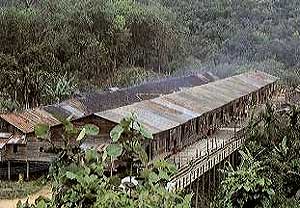 When children domiciled in longhouses in the interior have to walk for two hours to the nearest bus stop to get to school, fortune often means a good job in the oil town of Miri, or the commercial metropolis of Sibu, or the administrative capital of Kuching, where prospects for upward mobility are brighter for reason of their better schools and the avenue that provides for tertiary education and occupational advancement.
The speech in the Parliament last month by the Sri Aman MP Jimmy Donald on the 9th Malaysia Plan, where he lamented the now 43-year-old failure to keep the promises of merger to the Sarawakian people, captured the flavour of discontent felt in the interior.
A good leader in the Sarawak political idiom would be someone who could expand the pool of exemplary and inspiring teachers in schools, cut down travel time so that people are liberated from the bondage of geography, and wean adults away from the lassitude that wearying travel and manual labour in tropical humidity induces, the assuagement of which is that potent brew (tuak) which is the bane of many a family.
Crony capitalists
By his politics of development, enunciated early in his tenure, Taib Mahmud was on to a very good tack in Sarawak politics but his version of this panacea for the poverty of the multi-ethnic people of this vast state with its forbidding jungle-clad terrain was seen as increasingly skewed towards crony capitalists.
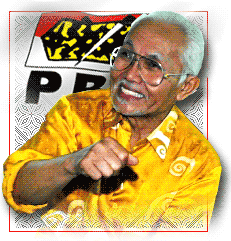 By March 1987, Taib, post-merger-with-the-Federation of Malaysia's fourth chief minister of Sarawak, was six years in the post, and already the object of deep disaffection in the ruling state Barisan Nasional (BN) coalition, not only among Sarawak National Party (Snap) stalwarts like James Wong Kim Min and Edward Jeli but also among his own Parti Bumiputera Bersatu (PBB) bigwigs like Noor Tahir, Salleh Jafaruddin and Wan Yusof.
Discontent with Taib was also felt by another state coalition partner, Parti Bansa Dayak Sarawak (PBDS), but it was of a vague sort, having more to do with general Dayak unhappiness that the chief minister's post had not been in the hands of one of them for 17 years.
The main factor for upheaval in the relationship between PBDS and Taib Mahmud was Taib's perception that Leo Moggie, the PBDS president with the federal cabinet portfolio of energy, post and telecommunications, was seen as growing close to the then prime minister Dr Mahathir Mohamad, the federal BN supremo whose panache at balancing contending forces in his disparate coalition by manipulating their antagonism was matchless.
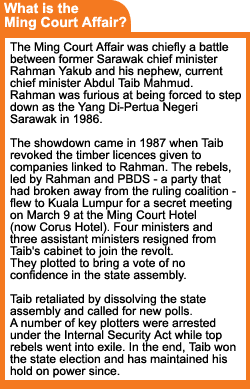 As Moggie's ingratiation with Mahathir continued to cause unease in Taib, the latter gave subtle hints to deputy chief minister Tajem, Moggie's deputy in PBDS, he ought to move up a notch in the party. Tajem did nothing to endear himself by resisting Taib's blandishments.
In a political arena devoid of ideology, personality differences can become a febrile cause for instability. Snap's James Wong distaste for Taib stemmed from the latter's non-consultative approach. Veteran Wong, inured to the British colonial tradition of consultation before major moves and policies are made, snapped at one meeting with Taib that it was easier to see God than the chief minister.
Edward Jeli's resentment towards Taib arose out of the difficulties the Snap strongman ran into after taking a RM5 million-plus loan from a bank to develop shop houses in Miri. He wanted Taib to give him a timber concession so that he would find easier to service the loan.
Taib appropriately declined but not from principle.


Are you sure you want to delete this comment?
This action cannot be undone.