




Dr M's ex-aide: Classified no more
The government can no longer cite state secrecy to escape from explaining the reasons for junking the half bridge project, said an ex-aide of former premier Dr Mahathir Mohamad.
The government can no longer cite state secrecy to escape from explaining the reasons for junking the half bridge project, said an ex-aide of former premier Dr Mahathir Mohamad.
This is because Singapore had already released classified Malaysian documents in its book Water Talks? If Only It Could published in March 2003 chronicling bilateral negotiations.
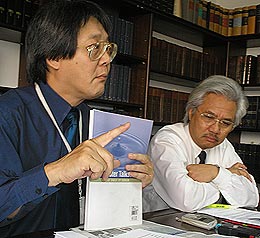 In a two-hour press conference yesterday, lawyer Matthias Chang's told Foreign Minister Syed Hamid Albar not to threaten him with the Official Secrets Act 1972.
"Singapore has published classified documents from our side, the whole thing is no longer under OSA.
"The government should publish all and tell the rakyat the truth," said Mahathir's former political secretary. He was accompanied by senior lawyer and former Bar president Zainur Zakaria.
"No more excuses. Be transparent. Be accountable. And be responsible. After this, it is up to the rakyat and others to take the matter further to reach the truth," he added.
'Insidious method'
He cited a letter on former Senior Minister and current Minister Mentor Lee Kuan Yew's recollection of eight 'agreed items' with Mahathir in August 2000 at Putrajaya which Singapore used to push for a binding agreement on water.
"I'll show to you the craftiness and the insidious method of presenting evidence by Lee and the Singapore government.
"(But) we will take the bull by its horns. We will use their same document to expose their lies to show their selectiveness in what to agree and what not to."
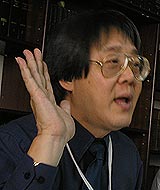 He demanded that Lee, former Singapore premier Goh Chok Tong and both foreign ministers explain the document.
"If it's in our favour, then why not use it now?" he said, adding that 'a sword cuts both ways'.
"It is the height of arrogance to do what they did to Malaysia, and it is the height of incompetence on our part to let them unilaterally revoke the agreement and then say it is the right decision, and that we're protecting our sovereignty."
Officially confirmed
Late Monday night, Foreign Ministry's Ambassador-At-Large Ahmad Fuzi Abdul Razak issued a statement to Bernama on the bridge project but it was embargoed until 1am.
Chang, a lawyer of 30 years, said the statement confirmed the points he had made at a press conference on April 18.
"I want to make that very clear. It confirmed everything I said and cited the same documents.
"It confirms my stand that we're no longer bound by the OSA because Wisma Putra has brought these documents into the public domain," he said.
Demanding for key points to be highlighted as presented, he said the media would be doing a disservice and acting unfairly to the public who remain confused over the project.
 He pressed forward with questions on whether legal advise was sought during negotiations and what were the agreed terms after sand was added to the negotiations.
"When I was in charge of this case, I brought in a team of local lawyers including international law experts.
"When was the legal opinion or advise from the Attorney-General obtained, QC or local lawyers? In 2003? In 2004, after the receipt of the diplomatic note? In 2005? In 2006?
"If not, why? If yes, why wasn't this disclosed? And given the advice, why did we proceed to build the scenic bridge?" he posed, waving the book and banging the table to make a point.
"And if it was a non-starter as alleged by Syed Hamid, why did he continue with the negotiations?"
Gross incompetence
Chang also asked if the AG's advice had been sought during the course of five rounds of negotiations between Sept 7 last year and March 11 this year as mentioned by Ahmad Fuzi.
Pinning the whole of yesterday's rebuttal and arguments on the contents of Singapore's book, he said it was "a sad case of gross incompetence and a failure to negotiate at the highest levels".
He chided the Malaysian negotiating team for allowing themselves to be outwitted and led by the nose by Singapore, naming Syed Hamid for his dismal performance.
"The statement itself is clear evidence that Malaysia was incompetent in every particular and was repeatedly outflanked and outmanoeuvred by the Singapore negotiating team.
"In fact, the statement has given rise to more questions than answers and has failed to address the issues I had raised in my previous press conference."
He cited letters signed by Singapore's Lee and Goh dated Sept 8, 2001 and April 11, 2002 respectively to prove a binding agreement.
Speaking animatedly, Chang argued that a binding agreement had existed or else Singapore would not have bothered with a diplomatic note dated Nov 29, 2004, unilaterally revoking it.
"In any event, this is a legitimate issue for international arbitration," he said, citing the Sipadan and Pulau Batu Puteh cases as an example.
Outfoxed, repeatedly
He also narrated how Singapore outfoxed Malaysia by surreptitiously slipping in a "limited package" approach when both had agreed on discussing water, airspace, CPF, bridge and KTM land separately.
"The bridge was never an issue. Singapore's flip-flop over the bilateral agreement is merely to drag the other outstanding issues into the negotiation.
"I want to know why the government had agreed to incorporate airspace and sand into the negotiation and thus get entrapped in a limited package approach?"
Quoting Ahmad Fuzi's statement, Chang said upon assuming office Prime Minister Abdullah Ahmad Badawi had asked for each and every issue to be considered on its own merit.
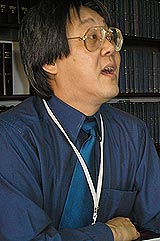 "The package approach used over the last 10 years was abandoned, dead, and both sides agreed to discuss the least problematic bridge issue which was a done deal except for actual implementation.
"How else do you explain the attitude of the Malaysian negotiating team? They must have been confident of their case, otherwise they would not have proceeded as they did."
Noting that Singapore had hinted at playing hardball back in 2003, and which was subsequently proven in the Nov 29 diplomatic note, Chang asked Syed Hamid to explain why Malaysia had dragged on with negotiations.
"This was a repeat of the song-and-dance routine by Singapore prior to (Mahathir's) retirement. They were being naughty, trying to entrap Malaysia.
"It's purpose was to scuttle all prior agreements and understanding, throw the spanner in the works and then make outlandish demands to try by the backdoor to introduce extraneous factors to link the bridge issue with intractable issues like airspace.
"Sand was a totally new issue," he said, referring to Ahmad Fuzi's statement.
He also noted that disconnecting the water supply to divert the pipes when the bridge was built was never a security issue for Singapore in 2001.
"How come out of the blue, all these problems are coming out now? This, they have failed to explain."
Picking and choosing
The lawyer then blasted Singapore for "picking and choosing" what was agreeable whereas Malaysia was forced to keep its side of the bargain even when circumstances changed.
"They can unilaterally hantam (whack) us and revoke a prior agreement but we can't. Singapore has the freedom and legitimacy to run circles around Malaysia and make fools out of us," he said, repeatedly drawing an analogy of reneging on a marriage contract.
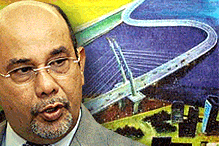 "What is worse, our negotiating team is at pains to justify Singapore's position and appeal to us, the citizens to appreciate the sensitivities involved. We must keep on giving while Singapore is at liberty to keep on asking."
Weaving through media reports, he refutes relevant statements and reserved the most scathing comment for Syed Hamid by telling him to stop making childish public statements.
Chang asked the foreign minister what were the four options cited during a briefing for Barisan Nasional members of Parliament on March 28.
Parliamentary Opposition Leader Lim Kit Siang was also not spared his offensive for supporting the decision to scrap the project without any details or prior explanation.


Are you sure you want to delete this comment?
This action cannot be undone.