




'Immigration kept extending contract of underperforming ferry company'
AUDIT REPORT | Despite repeatedly flouting contractual obligations, a ferry company was awarded the job to deport foreign nationals by the Immigration Department for 10 years and had its contract extended four times, the Auditor-General's Report 2016 Series 1 revealed.
In its audit of the Home Ministry, the report scrutinised the Immigration Department’s system of deporting foreign nationals.
“Ferry service contracts were renewed four times with the same company, from 2007 to 2017.
“From Nov 1, 2007, to Oct 31, 2009, the Immigration Department (first) signed a contract with a ferry service company (contractor) for two years after obtaining clearance from the Ministry of Finance (MOF) through direct negotiations, at a rate of RM205 per immigrant.
“Till today, the contract has been renewed four times and the latest one was renewed on Nov 1, 2015, through to Oct 31, 2017,” the report states.
MOF had approved the latest contract renewal for the company, despite previously ruling that its third renewal, from Nov 1, 2013, to Oct 31, 2015, would be the last.
Federal government policy rules that contracts can only be extended once for a period not exceeding two years...
AUDIT REPORT | Despite repeatedly flouting contractual obligations, a ferry company was awarded the job to deport foreign nationals by the Immigration Department for 10 years and had its contract extended four times, the Auditor-General's Report 2016 Series 1 revealed.
In its audit of the Home Ministry, the report scrutinised the Immigration Department’s system of deporting foreign nationals.
“Ferry service contracts were renewed four times with the same company, from 2007 to 2017.
“From Nov 1, 2007, to Oct 31, 2009, the Immigration Department (first) signed a contract with a ferry service company (contractor) for two years after obtaining clearance from the Ministry of Finance (MOF) through direct negotiations, at a rate of RM205 per immigrant.
“Till today, the contract has been renewed four times and the latest one was renewed on Nov 1, 2015, through to Oct 31, 2017,” the report states.
MOF had approved the latest contract renewal for the company, despite previously ruling that its third renewal, from Nov 1, 2013, to Oct 31, 2015, would be the last.
Federal government policy rules that contracts can only be extended once for a period not exceeding two years.
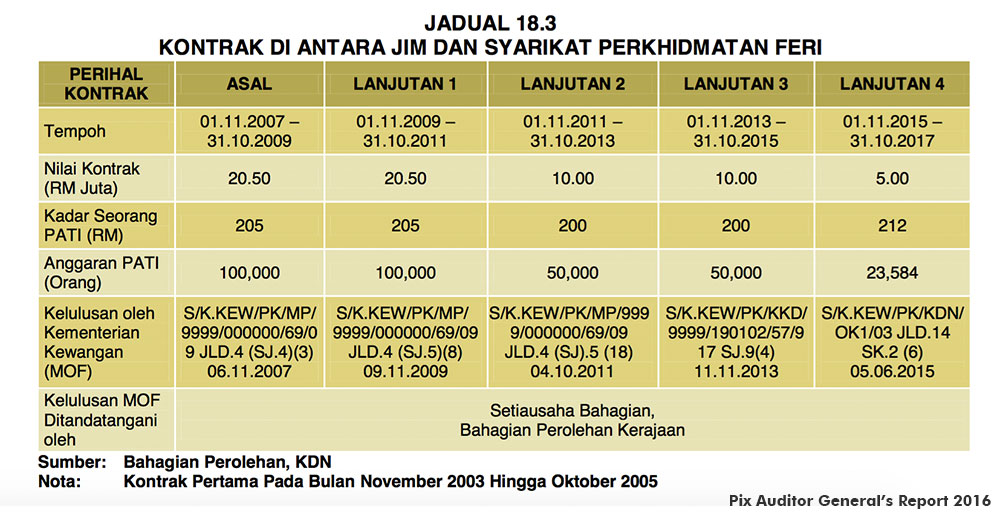
The table above also shows that the value of contracts had shrunk as they were renewed - from RM20.5 million in 2007-2009 and 2009-2011, to RM10 million in 2011-2013 and 2013-2015, and then to RM5 million in 2015-2017.
In a response dated May 11, the Home Ministry expressed plans to implement an open tender process when it next recruits ferry contractors after the current contract expires this Oct 31.
Deportees not ferried to destination
Ferries are contracted to deport Indonesian immigrants, by far the largest group at 75,580, who are unable to afford their own transport home.
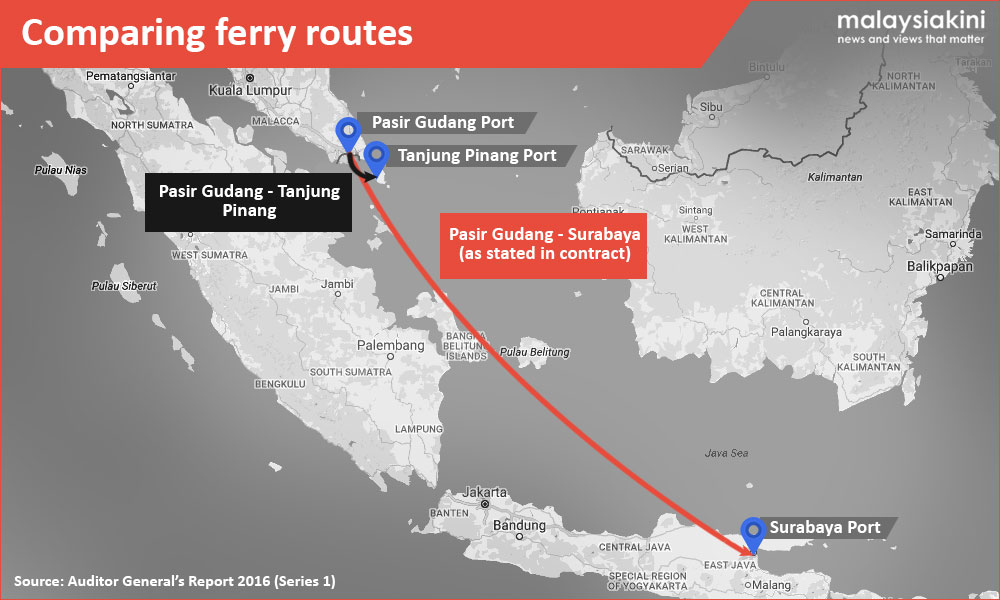
Deportees board the ferry at the Pasir Gudang Port in Johor.
However, they never arrived at their stipulated destination of Surabaya, Indonesia, revealed the report.
“The (ferry) contractor only sent the immigrants to the Tanjung Pinang port (on Bintan Island, Indonesia).
“However, there is not a single document to prove that the number of immigrants arriving at Tanjung Pinang was the same as the number of immigrants deported from Pasir Gudang.
“Payment was made even though requirements stipulated in the contract were not followed,” the report says.
In its reply dated April 26, the Home Ministry repeated that an open tender process would solve these problems, and said the next contract would require ferry companies take responsibility when delays occurred during voyages.
In addition, the rate the ferry company charged the Immigration Department a sum of RM212 per deportee, inclusive of the goods and services tax (GST), and this was an inflated fee, the report added.
“The rate charged by the contractor... is higher if you compare it to what other private ferry companies in Tanjung Pinang charge.
“For example, the route from Stulang Laut jetty in Johor Baru to Tanjung Pinang port in Indonesia is RM160,” says the report.
At a rate of RM160, the government could have saved RM2.8 million on deporting 53,924 immigrants between 2014 and 2016, it said.
No travel insurance
The report also revealed that the ferry company had failed to provide insurance coverage for deportees from 2007 to 2015, a period of eight years.
This is despite it being a contractual obligation.
“There is no proof any insurance was taken because the relevant documents could not be presented by the Immigration Department to auditors,” it said.
The department replied, saying the contractor failed to provide it with insurance documents for the years 2007-2015, despite being asked twice last year.
The ferry contractor was only able to provide insurance slips and premium receipts for 2016 and 2017, the department said.
Between 2014 and 2016, the total cost of detaining and deporting undocumented immigrants was RM95.24 million.
Aside Indonesians, a large number of Bangladeshis (27,283) and Myanmar (17,627) were also deported through air, sea and land routes.
Tabled in Parliament yesterday, the Auditor-General’s Report scrutinised 25 federal ministries, 18 departments and 38 statutory bodies.


