


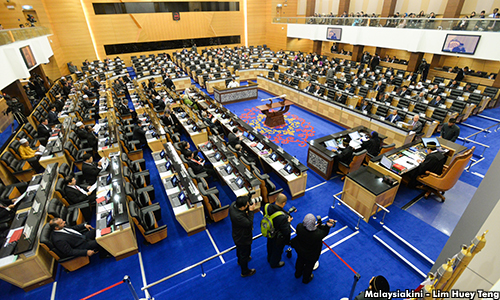

What happens next to Act 355?
KINIGUIDE | After taking into consideration the strong objections by BN component parties, Umno abandoned its plan to take over the controversial amendments to the Syariah Courts (Criminal Jurisdictions) Act or Act 355.
Prime Minister Najib Abdul Razak said it is now up to Dewan Rakyat speaker Pandikar Amin Mulia to decide whether to allow PAS president Abdul Hadi Awang to amend Act 355 through his private member's bill...
KINIGUIDE | After taking into consideration the strong objections by BN component parties, Umno abandoned its plan to take over the controversial amendments to the Syariah Courts (Criminal Jurisdictions) Act or Act 355.
Prime Minister Najib Abdul Razak said it is now up to Dewan Rakyat speaker Pandikar Amin Mulia to decide whether to allow PAS president Abdul Hadi Awang to amend Act 355 through his private member's bill.
After Umno made the U-turn, can the amendments to Act 355 be passed?
How would PAS push through the amendments?
How would Parliament and the government react to this?
Malaysiakini will attempt to explain how the private member's bill navigates through the august House and the subsequent developments.
1. What is the consequence of government declining to table the amendments to Act 355?
According to the standing orders, government businesses shall receive top priority. In this regard, a minister could table any bill and have it debated without Parliament's approval.
However, backbenchers and opposition members do not enjoy such privileges. They must seek leave from the Parliament before the private member's bill is allowed to be debated and passed.
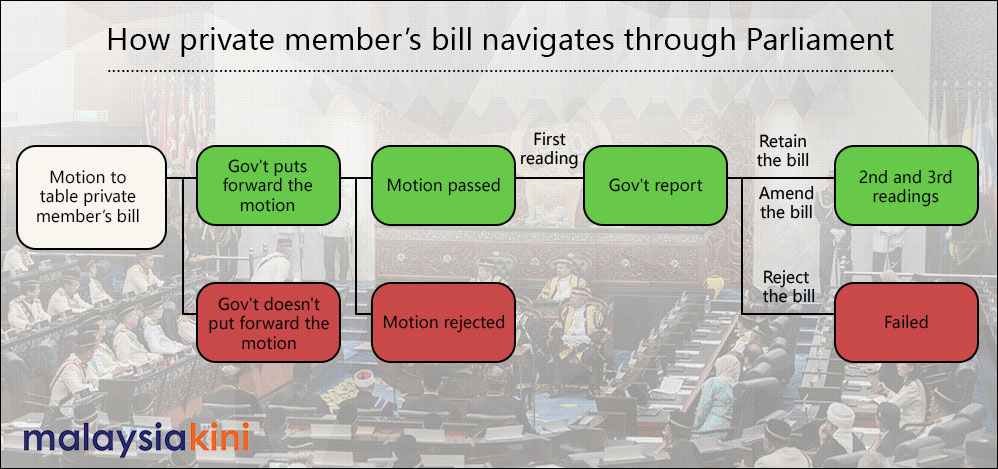
Typically, the private member's motion will only be listed in the last part of the order paper and the motion can be tabled and debated only with the government's approval.
Following the government's latest decision not to table the Act 355 amendment, everything has reverted to status quo. It means Hadi's motion must be approved at every step to seek federal legislative approval.
2. What's next?
Despite being listed in the order paper, Hadi's motion can only be debated with the approval of the government by two methods.
Firstly, the government can table a motion to request Parliament to debate Hadi's motion ahead of other government business. This was done by parliamentary affairs minister Azalina Othman in May 2016 to fast track Hadi's motion.
Secondly, the government can finish its business earlier to make way for Hadi's motion.
With the approval of Putrajaya and speaker Pandikar Amin Mulia, Parliament can then debate and vote upon Hadi's motion.
MPs would therefore discuss and vote by voice or bloc whether to allow Hadi to debate the motion.
Should Parliament pass the motion with a simple majority, Hadi would succeed in making his private member's bill pass the first reading.
3. What's next after the first reading?
The government will take over the amendments and a minister will be tasked to look after it. Later he or she will table a statement to Parliament before it can proceed to the next reading.
At this juncture, the government can keep Hadi's version of the bill, amend it or delay it.
At the very extreme, the government may abandon the bill but this is very unlikely under this scenario.
It is difficult for the government to abandon the amendments once Parliament had passed Hadi's motion, Sungai Siput MP Dr Michael Jeyakumar told Malaysiakini.
This is especially so in this case where the amendments to the Act 355 have been politicised to defend Muslim rights.
Think-tank Political Studies for Change (KPRU) executive director Ooi Heng said like other Westminster governments, the BN government is less likely to abandon the bill after its approval for first reading.
“They may delay it for two or three years and decide based on current political situation. It is rare to be rejected outright by the government,” he said when contacted.
4. What if Hadi's bill is backed by government through its passage to Parliament?
It will be just like any other conventional government bill, which needs to go through second reading, committee stage and third reading.
After it is passed by the house of representatives, the bill will be considered by the senate before it receives the royal assent and gazzetted as law.
In short, Hadi's private member's bill must have the government's support before it is passed, which is required in at least three stages in the parliamentary procedure.
As Deputy Minister in Prime Minister's Department Asyraf Wajdi Dasuki stated, should Parliament approve Hadi's motion, the government will then take over to prepare a statement.
However, MCA, MIC and Sarawak BN parties would not agree for the amendments to the Act 355 to reach the government's report stage.
It means the disagreement between BN component parties on the amendments, like what is happening now, may occur again.


Are you sure you want to delete this comment?
This action cannot be undone.