




Police should outsource some tasks
The police force must outsource non-core policing, mainly administrative functions, to civilian professionals instead of under-utilising uniformed personnel who could be redeployed to crime-busting jobs.
The police force must outsource non-core policing, mainly administrative functions, to civilian professionals instead of under-utilising uniformed personnel who could be redeployed to crime-busting jobs.
In this way, the 90,000-strong police force will need fewer or even no additional uniformed personnel.
The Royal commission to enhance the operation and management of the Royal Malaysian Police said this would be possible if personnel redeployment is "meticulously planned and diligently executed".
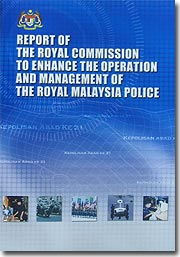 "Recruitment will focus on civilian personnel with the necessary skills," it said in the 607-page
report
released Monday.
"Recruitment will focus on civilian personnel with the necessary skills," it said in the 607-page
report
released Monday.
It also reinforced the fact that Malaysia had one of the highest police-to-population ratio in the world.
"The present situation, where literally thousands of trained, uniformed police personnel do work that hardly utilises the policing skills is a waste of trained manpower."
The recommendation is to cease or outsource non-core police functions and to start recruiting civilian professionals such as forensic experts, accountants and trained analysts.
The commission estimates that re-deployment of uniformed police and outsourcing of non-core policing functions will free up about 20,000 personnel for core policing jobs, but with the requisite re-training.
The recommendation to outsource non-core functions is based on the increasing number of sophisticated or white-collar crimes such as money-laundering, credit card fraud and intellectual property infringements.
Other non-core functions that needed to be divested, particularly by the General Operations Force, are airport security, security at festivities and big entertainment events.
Serious under-staffing
The committee also found that the lack of a comprehensive human resource management has led to sub-standard services, with financial constraints dictating the approval of the establishment of new posts or new recruitments.
The Public Services Department approved 8,018 of 13,101 new posts that the police force had applied to fill between 2002 and 2004.
The department is still considering an additional request for 41,252 staff of which over half (21,294) are for new posts in the Criminal Investigation Department (CID).
The commission noted that the need for additional CID personnel was only "too clear" given that the division was "seriously understaffed with only 7,869 personnel" as at last December.
Therefore, it said, alternative options must be considered although the police-to-population ratio (including an estimated three million migrant workers) was at 1:310 and comparable to Singapore (1:308).
To overcome the approval and financing problem, the commission proposed that posts be re-aligned, instead of new posts being created.
Inadequate training facilities and support capacity such as audio-visual aids, ICT equipment and reference material were also found to lead to neglect of lower-ranking personnel said to be prone to graft .
Equally inadequate was the emphasis on the vital component of ethics and integrity as well as the inability to produce sufficiently competent personnel in terms of communications and language skills.
Other factors hindering optimum performance were obsolete and deficient hardware such as essential equipment and logistics including typewriters, old computers, vehicles under repair and inadequate weaponry.
Decrepit buildings
The commission also found that deteriorating buildings and poor facilities contributed to the dismal performance of the police force.
 Decaying and cramped semi-permanent wooden police stations, ageing and rented shops housing stations, absence of information counters, old and poor infrastructure, dilapidated trainee hostels and clinics, corroded fencing, unsafe weapons storage facility and ammunition depots, and old lock-ups were among the conditions cited in the report.
"The extremely poor condition of a significant proportion of police housing and office premises require urgent attention. Continued neglect will make a mockery of (any modernisation initiative
undertaken)."
The commission also recommended that the Inspector-General's Standing Orders (IGSO) should be encoded as subsidiary legislation under the Police Act 1967 for a better compliance with criminal procedures and evidence gathering.
"Unlike rules and regulations under the Police Act, the IGSO is not a public document. (It was) classified as terhad (restricted), but (the police force) has now taken steps to update and declassify the IGSO to make it more accessible to all personnel."
It also recommended that Bukit Aman federal police headquarters should formally monitor compliance with rules, regulations and directives or internal circulars pertaining to detainees' rights, exhibits and progress reports to complainants.


