




Statutory body tops police commissions plans
A draft bill for an independent external oversight statutory body is among the 125 recommendations submitted to the government for action by the royal police commission.
A draft bill for an independent external oversight statutory body is among the 125 recommendations submitted to the government for action by the royal police commission.
The permanent body, proposed as the Independent Police Complaints and Misconduct Commission, is the star recommendation in the 607-page comprehensive report by the commission to be released next Monday.
If accepted by the government and subsequently passed by Parliament, the statutory body will institutionalise the role and function of the royal police commission, which had completed its work early this month.
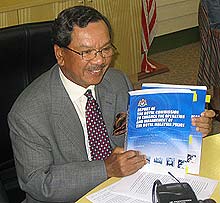 Commission chairperson Mohamed Dzaiddin Abdullah said the recommendation for a statutory body was based on queries over the next venue for public complaint against the police.
"Everywhere we go, we are asked about what would happen to future complaints with the expiry of the (royal) commission's term," he told a press conference today.
"So we thought why not propose for this process to proceed through a statutory body."
The 16-member royal police commission, whose term officially expired on May 3, took nearly 15 months to complete the report containing a total of 125 recommendations culled from about 50 chapters.
The main report has 433 pages, the annexure has 149 while the executive summary totals 25 pages.
"Unfortunately, I cannot release the executive summary report because it has not been declassified yet," said Mohamed Dzaiddin before proceeding with a brief overview during his last public function as chairperson.
"The commission is now functus officio , as it is known in Latin, which means we have discharged our duties or completed our terms of reference."
Secretariat remains
Royal police commission secretary Hamzah Md Rus, who also serves as Internal Security Ministry deputy secretary-general, said the secretariat will continue to operate but as part of the ministry.
"I'm no longer the secretary but the secretariat will continue to function, mainly to receive public feedback which we expect to be coming in following the extensive recommendations."
On Monday, Bahasa Malaysia copies of the report will be sold at the secretariat in Wisma Selangor Dredging, Jalan Ampang, while the English edition will be on sale Thursday. Both editions are priced at RM100 each.
On why the reports were not given free, as done by the Human Rights Commission (Suhakam), Mohamed Dzaiddin said the practice even in the United Kingdom was to sell such reports, which were difficult to produce.
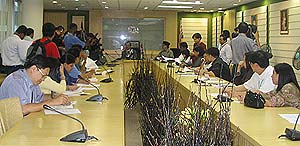 He said copies will also be distributed to members of Parliament but it was not clear if they will be given free.
Early last month, Amnesty International had submitted a compilation of complaints and feedback containing a similar recommendation of a statutory body to the commission.
Asked if the draft bill was based on that, Mohamed Dzaiddin said the commission started working on the idea of a statutory body following visits to Australia, the UK and Hong Kong.
Both Australia and UK have permanent bodies which investigate complaints against the police force, while Hong Kong is mulling over the idea.
Decision unappealable
On the differences between the proposed body and Suhakam, Mohamed Dzaiddin said the former has more powers in terms of initiating probes and handling of complaints.
"The proposed commission can initiate investigations even without receipt of any complaint. Let's say a commission member knows about something, he or she can get the commission to move on it.
"The decision of the proposed commission is also final and unappealable," he said, conceding that a subsequent challenge in court was not precluded.
In producing the report, the royal police commission - officially called Royal Commission to Enhance the Operation and Management of the Royal Malaysia Police - held public inquiries, made overseas visits and obtained feedback from the police and relevant enforcement agencies including the Anti-Corruption Agency (ACA).
The report, he said, also identified three main challenges, namely crime reduction, eradication of corruption and compliance with human rights and prescribed laws.
"Most people are concerned with the high crime rate in the country. There is also a high public perception of corruption at all levels in the police force.
"We met the ACA first and then reverted the police for their response before coming up with a strategy," he noted.
Core police duties
 Most importantly, said Mohamed Dzaiddin, the perception of corruption was not just confined to the police but included other sectors as well.
"We cannot eradicate corruption but we can reduce it and this is why we need to focus on zero tolerance for corruption with everyone's cooperation."
He said Internal Security Act detainees also related how they were mistreated, and wanted the royal police commission to help address human rights violations and breach of laws.
On the shortage of personnel, he said the commission found that despite being trained, many did not perform core police duties.
"These personnel should be red-eployed into core police duties and given incentives to perform."
Mohamed Dzaiddin, gratified with Prime Minister Abdullah Ahmad Badawi's commitment towards the recommendations, said the report will be tabled in Parliament once the government has gone through all the 125 recommendations.
He said the Criminal Procedure Code and particularly the Police Act 1967 have been recommended for a review.
On April 29, the commission submitted copies of report to the King and Prime Minister Abdullah Ahmad Badawi, whose office announced on Wednesday that the report will be made public on Monday.


Are you sure you want to delete this comment?
This action cannot be undone.