




Gov't: Chinese and bumiputera income gap the largest
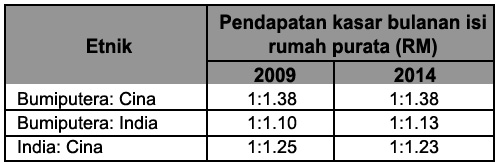
The gap between average household incomes is widest between Chinese and bumiputera households as at 2014, government statistics show.
The average ethnic Chinese household is earning 38 percent more each month, compared with the average earning of a bumiputera household.
The data was provided by Minister in the Prime Minister’s Department Abdul Wahid Omar, in a written reply to Parliament yesterday.
Wahid was responding to a question by Ahmad Hamzah (BN-Jasin) who wanted to know the Gini coefficient for bumiputera, Indian and Chinese households for 2009 and 2014, the projection for 2020 and efforts to reduce the inter-ethnic income gap.
However, Wahid said, the income gap among households was better reflected by comparing the average household incomes of each ethnic group, instead of the Gini coefficient for each group.
 This is because the Gini coefficient measures income gap between households of the same ethnicity, and not among ethnicities, he said.
The statistics provided showed the income gap between ethnic Chinese and bumiputera households remained stagnant between 2009 and 2014.
However, average ethnic Indian household incomes seem to be growing, with the gap narrowing between the incomes of ethnic Indian households and households of bumiputera and Chinese ethnicity.
For 2014, the average ethnic Indian household also made 13 percent more each month compared with the average bumiputera household. In 2009, the figure was 10 percent.
Similarly, ethnic Chinese households made 25 percent more than ethnic Indian households, but this shrunk to 23 percent in 2014.
The average ethnic Chinese monthly household income in 2014 was RM7,666, followed by ethnic Indian households that earned RM6,246 and bumiputera households (RM5,548), Economic Planning Unit data published on its website shows.
Gov't aims to bring inequality down
This comes as Khazanah Research Institute found that the 15 richest families in Malaysia control assets worth 76 percent of the entire gross domestic product (GDP) of country, raising concerns of inequality.
This is compared with 48 percent in Singapore and 47 percent in the Philippines.
Wahid said the Gini coefficient for the entire population in 2014 was 0.401 – an improvement from 0.462 in 2009.
The government aims to bring it down further to 0.385 in 2020, he said.
Gini coefficient is a measure of income distribution, with 1 denoting perfect inequality and 0 denoting perfect equality.
Wahid said the government is focused on raising the income of the bottom 40 percent, and growing the middle class through access to tertiary education, raising productivity through technology and supporting entrepreneurship.
It is also trying to address the rising cost of living by focusing on affordable housing, healthcare, clamping down on errant traders, household debt management and introducing a comprehensive social safety net.
“The focus will be to continue to raise economic participation of the bottom 40 percent of households, irrespective of gender, ethnicity, socio-economic background or geography,” he said.


Are you sure you want to delete this comment?
This action cannot be undone.