



Native Christians mount revival campaign in Sabah
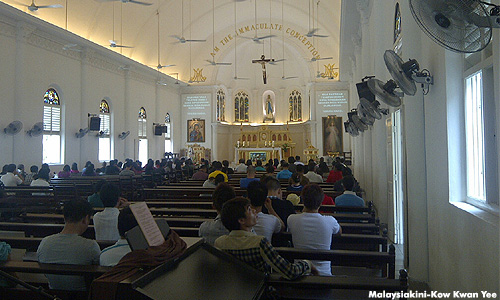
COMMENT Irked by what they consider to be the growing oppression of religious freedom in Sabah, a new grassroots movement of native Christians is mounting a six-month spiritual revival campaign in the KadazanDusun-Murut (KDM) heartland.
This could well see the erosion of the ruling coalition’s vote bank - voters that the BN badly needs to remain in power.
The campaign kicked off with a ‘mamnagkis’ ceremony in Penampang, the KDM heartland in Kota Kinabalu, during the Christmas period. Another ‘mamangkis’ is to be held over this weekend in Ranau, starting this evening.
COMMENT Irked by what they consider to be the growing oppression of religious freedom in Sabah, a new grassroots movement of native Christians is mounting a six-month spiritual revival campaign into the KadazanDusun-Murut (KDM) heartland.
This could well see the erosion of the ruling coalition’s vote bank - voters that the BN badly needs to remain in power.
The campaign kicked off with a ‘mamnagkis’ ceremony in Penampang, the KDM heartland in Kota Kinabalu, during the Christmas period. Another ‘mamangkis’ is to be held over this weekend in Ranau, starting this evening.
The new group, known as Perpaduan Anak Negeri (PAN) or Solidarity of Natives, is relatively unknown and surfaced suddenly, during Christmas last month, as an inter-denominational indigenous movement led by Malay-speaking lay people and rural pastors. Its membership strength is not known.
The group is believed to be inspired by the Gempuru Besar Kristian Jaku Iban or the Great Gathering of Iban Christians in Sarawak, which has grown from its humble beginnings 16 years ago into thousands of people cutting across denomination lines, throughout Sarawak.
Spiritual in nature
A PAN organising committee member, who asked that he not be named, said the revival campaign known as ‘mamangkis’ in the local language, is spiritual in nature, although its members are also mounting a political campaign at the same time.
“The time has come for us to be a voice for our people, who have been oppressed for the past 50 years since the formation of Malaysia,” he said, and added: “The time has also come for a revival of our faith as Christians.
“When Sabah agreed to be part of Malaysia, we made it clear that we will continue to have complete freedom of religion and Islam would not be the religion of the state of Sabah.
“But within 10 years, the state constitution was amended to make Islam the official religion. We were betrayed by our own kind in the semenanjung (peninsula), and this is the worst kind of betrayal.”
The hardening of the government’s position in handling the ‘Allah’ controversy has also angered Sabah’s bumiputera Christians, who together with Sarawak’s native Christians make up two-thirds of the two million Christian population of Malaysia.
“What is Prime Minister Najib Abdul Razak doing and why is he still keeping quiet over our complaints? He must choose whether he wants to be a statesman or a jaguh kampung . He cannot be both,” the PAN member fumed.
He said the last straw was when 74 Christians in the Pitas District, the most impoverished place in Malaysia, were deceived into converting to Islam on New Year’s Day by dakwah representatives from Peninsular Malaysia, who were sponsored by the Sabah Department for Islamic Affairs.
For 'financial aid', but...
They were told the ceremony was for them to receive financial aid from the federal government. They were told to produce their MyKad and sign a piece of paper each.
To their horror, they later found out that the paper they had signed was actually a consent form to convert to Islam!
He said even though a police report had been made, the police referred the matter to the Sabah Islamic Council (MUIS).
“So, what is the prime minister doing about this?” he demanded to know.
He also explained that although the native Christian community faces threats from outside, the concern is also about internal weaknesses.
“Our people are not well grounded in their faith, thus we need a spiritual revival and continuing Christian education. And, at the same time, mounting political action,” he said.
He said the ‘mamangkis’ ceremony has its origin in the head-hunting days, when warriors went out with a ‘mamangkis’ – a shrill war cry – and returned victorious with another ‘mamangkis’.
“However, today we have contextualised it as part of our liturgy, where we consecrate ourselves before God. We go into a spiritual battle protected by the blood of Jesus shed on the Cross and claim our victory in His name, for the battle really belongs to God,” he said.
The ‘mamangkis’ in its cultural form today is also seen in the Kadazandusun ‘sumazau’ dance. The dance leader makes the ‘mamangkis’ call to signal to the dancers to change formation or direction.
Part of the revival ceremony is also the setting up of a memorial altar, made of river rocks in the same fashion as in the Old Testament, to remind adherents of the greatness of God and their promise to be obedient to God.
For instance, when the Israelites crossed the Jordan River into their ‘Promised Land’, they erected a stone to commemorate the occasion.
“All we ask of the government is to allow us to practise our faith, to be able to use our Al-Kitab (the Malay language Bible), and to use the word ‘Allah’ to refer to God as we have been doing for generations. Is this too difficult for the PM to understand?” the PAN member asked.
The Ranau ‘mamnagkis’ this evening will begin with a prayer and the setting up of the stone altar, followed by a consecration ceremony on Saturday.
The PAN committee member said a hard-hitting statement addressed to the prime minister would also be read out after the ceremony, which will be conducted by a senior Kadazandusun clergyman.
GIDEON LEONG is the nom de plume of the writer who is an analyst of current affairs in Sabah.


Are you sure you want to delete this comment?
This action cannot be undone.