




Acquittals in key cases again raise eyebrows
FOCUS Judicial independence has always been an important pillar to a democratic society, in instilling judicial credibility which can ensure social justice and social order.
FOCUS Judicial independence has always been an important pillar to a democratic society, in instilling judicial credibility which can ensure social justice and social order.
In 2013, five high-profile trials have come under the spotlight as the court acquitted the accused due to alleged insufficient evidence. This again casts doubts on the heavily-criticised judiciary system.
These were the murder cases of Mongolian national Altantuya Shaariibuu and Chee Gaik Yap, 15-year-old youth Aminulrasyid Amzah being shot multiple time by police, businessman Chia Buang Hing’s assault trial and controversial former transport minister Ling Liong Sik’s cheating trial.
While the prosecution had filed appeals in the murder trials of both Altantuya and Chee, as well as Chia’s assault trial, Aminulrasyid’s trial has exhausted its appeal mechanism, and Ling now a free man after the prosecution decided not to appeal.
All the cases had caused great concern as they involved social justice.
Murder case of Chee Gaik Yap
 On June 25, the Alor Star High Court
acquitted
the 32-year-old accused over the murder of Chee (
right
) in 2006 after finding the prosecution had failed to prove a
prima facie
case.
On June 25, the Alor Star High Court
acquitted
the 32-year-old accused over the murder of Chee (
right
) in 2006 after finding the prosecution had failed to prove a
prima facie
case.
The court reportedly believed that there was no clear evidence to implicate him with the murder.
The prosecution was criticised for not slapping the accused with a rape charge. More than 80,000 signatures were collected nationwide urge that an appeal be made against the judgment.
On July 5, the Attorney-General’s Chambers filed a notice of appeal amid pressure.
Altantuya Shaariibuu’s murder
 The Appellate Court had
acquitted
Special Action Unit officers Chief Inspector Azilah Hadri and Corporal Sirul Azhar Umar on a charge of murdering the victim.
The Appellate Court had
acquitted
Special Action Unit officers Chief Inspector Azilah Hadri and Corporal Sirul Azhar Umar on a charge of murdering the victim.
It ruled that the prosecution’s failure to call Deputy Supt Musa Safri, a former aide-de-camp of then-deputy prime minister Najib Abdul Razak to testify consituted a serious misdirection to the trial.
This, however was rebutted by attorney-general Abdul Gani Patail, who said Musa Safri’s testimony has “no relevance” to the prosecution.
Shooting case of Aminulrasyid
The shooting case of then 15-year-old Aminulrasyid Amzah in April 2010 shocked and angered the nation, and there was public demand for justice for the deceased.
Prime Minister Najib Abdul Razak, in his letter dated May 7, 2010, had promised the family that the government would carry out investigations with “fairness, transparency and as soon as possible in pursuit of justice for all”.
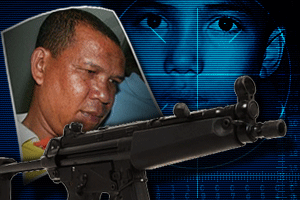 On May 12, Corporal Jenain Subi was charged with culpable homicide, and four months later the accused was convicted and
sentenced
to five years’ jail.
On May 12, Corporal Jenain Subi was charged with culpable homicide, and four months later the accused was convicted and
sentenced
to five years’ jail.
However, the Shah Alam High Court later overturned the Session Court’s decision, which was reaffirmed by the Court of Appeal, which ruled that there was no merit in the prosecution’s appeal.
Dr Ling Liong Sik’s cheating trial
Two former transport ministers - Ling Liong Sik and Chan Kong Choy - were charged with cheating following the Port Klang Free Zone scandal.
In March 2012, Kuala Lumpur High Court ordered Ling to enter his defence , but later acquitted him last October. And in a suddent twist of events that surprise most people, the AG’s Chambers decided against appealling the case.
“When your main witness says he was not cheated, what case do we have? The court threw out the case by this finding of fact,” explained Abdul Gani early kast month, amid much criticism.
Chia Buang Hing’s assault
 Businessman Chia Buang Hing (
left
) tearfully complained that during the four days that he was
detained
by police over an expired road tax disc, he was assaulted repeatedly by cops and money was taken from him.
Businessman Chia Buang Hing (
left
) tearfully complained that during the four days that he was
detained
by police over an expired road tax disc, he was assaulted repeatedly by cops and money was taken from him.
Four police were charged with six counts of assault and two counts of making false statements, but the magistrate’s court acquitted them on the grounds that Chia’s injuries occured during the lawful arrest where he had struggled.
AG’s Chambers must be answerable to parliament
One may wonder what led to the failure of prosecution and conviction?
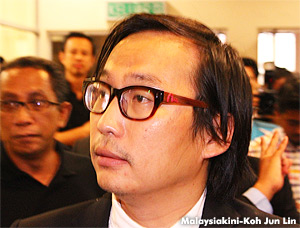 Lots of effort are needed before a conviction can be reached in a case, and the prosecution needs to fill in the gap with adequate evidence, said Eric Paulsen (
right
), the adviser of law reform and human right group Lawyers for Liberty (LFL).
Lots of effort are needed before a conviction can be reached in a case, and the prosecution needs to fill in the gap with adequate evidence, said Eric Paulsen (
right
), the adviser of law reform and human right group Lawyers for Liberty (LFL).
“To prosecute a case without key witnesses will definitely sabotage the case,” he said.
To a question, he noted it was difficult to tell whether the failure to call for key witnesses to testify was done deliberately or unintentionally.
“Even a junior prosecutor knows that if the prosecution did not summon key witnesses, this would forc the judge to acquit the accused,” he told Malaysiakini through a phone interview.
He cited the acquittal of both Azilah and Sirul as an example of not summoning a key witness, where the judge claimed the absence of Musa Safri had amounted to misdirection of the trial.
The judge may perceive a witness’s testimony as favourable to the defendant, if he or she wasn’t called to court, he said.
While agreeing that the conviction and subsequent acquittal in Aminulrasyid’s case was hard to accept, Paulsen argued that the crux of the case wasn’t trying to stop the car driven by the victim, but anyone would know that shooting at the car repeatedly would cause casualties.
The failures of conviction in high-profile case would have an impact on judicial credibility, and the public’s trust would be hard to restore if it collapses.
“Whether a judicial system enjoys credibility depends on the conviction rate and whether big fish were brought to justice,” he said.
In countries like India and Cambodia, the collapse of judicial credibility made the citizens take the law into their own hands as they thought the law may favour the rich and powerful, he said.
In Malaysia, the attorney-general is like a king who holds the power to prosecute and make decisions on the amount of resources for political prosecution, where he need not answer to the public and parliament, he said.
The system adopted in developed countries have held the prosecution office to be answerable to the parliament and the public, and the Attorney-General’s Office in the UK needs to answer if too much resources are used in political prosecution, he said.
He suggested that the government instill checks and balances into the system, removes the AG’s power and replace the controversial Abdul Gani as moves to reform the judicial system.
Half-hearted prosecution, sloppy investigations
The acquittal and lenient sentence in the recent high-profile cases, as well as cases that cause the government great embarrassment, have nothing to do with the capability of the prosecutor, but highlights the lack of seriousness during the prosecution, said PKR Padang Serai parliamentarian N Surendran.
“The AG’s Chamber have been long in this business, most of the deputy public prosecutors are experienced, so their abilities are not questionable,” he said.
The failure of conviction may also have been caused by sloppy investigation by its police counterpart, with which the defence in court can easily find fault, said the PKR vice-president.
“The prosecution was done in a half-hearted manner. In the case of Aminulrasyid and (police custodial death victim) A Kugan at least, the resources and time put in the case weren’t comparable to (PKR de facto leader) Anwar Ibrahim’s Sodomy II trial,” he said.
“If the chambers can put forward the best prosecutors in Anwar’s sodomy trial, why can’t it do the same to the two case which involve public interest?” he asked.
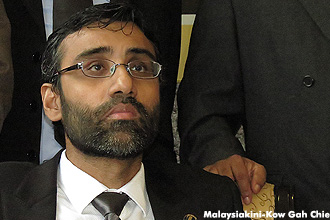 He also complained that the accused in Kugan’s case should have been charge with murder instead of two counts of causing hurt.
Surendran also criticised the prosecutors for not bringing up the issue of the Inspector-General’s Standing Order (IGSO), which stated that firearm can be discharged only where the lives of police personnel or the public are threatened.
Following the acquittal of Ling in the PKFZ trial, Surendran said he “doesn’t feel good” over Chan Kong Choy’s prosecution.
He advised the government to follow the UK’s system, to set up a professional body to oversee the AG’s power in deciding whether to prosecute, while the AG’s Chambers follow order to prosecute.
Malaysiakini has tried to contact Minister in the Prime Minister’s Department Nancy Shukri, deputy solicitor-general II Tun Abdul Majid Tun Hamzah, Abdul Gani and head of prosecution division Abdul Wahab Mohamed for comments through phone and text messages, but to no avail.
“No comment,” Tun Majid replied through a text message.
KOW GAH CHIE is a member of the Malaysiakini team.


