




Regional polls watchdog urges EC to be transparent
A regional polls watchdog has urged the Malaysian Election Commission (EC) to show transparency in the accreditation of election observers.
A regional polls watchdog has urged the Malaysian Election Commission (EC) to show transparency in the accreditation of election observers.
In a press release yesterday, the Asian Network for Free and Fair Election (Anfrel) said it was important for the EC to prove that it was not acting in bias.
"
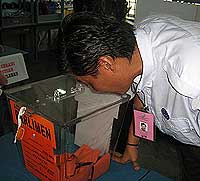 To minimise the dangers of this, when the EC decides not to accredit a particular group, it should provide due process to the groups to whom it refuses to provide accreditation.
"If the EC believes it has reason to deny a particular group, it must show proper cause and provide an explanation for, and the evidence behind, their decision-making," said the Bangkok-based group.
Rejections should be open to appeal, said Anfrel. This will help the EC avert accusations of arbitrary or non-partial decision-making.
"This process needs to be a part of a broader framework of regulations or guidelines for election observation that the EC will hopefully establish," read the statement.
On Monday, it was revealed that the EC had accredited five groups, whose core activities are unrelated to polls , as election observers in peninsular Malaysia for the 13th general election.
The EC had also accredited three groups as observers in Sabah and Sarawak, also not experienced polls monitors.
Some peninsular Malaysia-based groups rejected by the EC have complained that such appointments appear arbitrary and they are not aware of the commission's requirements.
Another group which has several years of experience in monitoring elections overseas, the National Institute for Democracy and Electoral Integrity, turned down the EC's invitation to become an election observer on grounds that no proper legal framework was in place for such work to be done properly.
International observers' presence urged
While urging the EC to accredit several "experienced, professional election observation groups" that currently exist in Malaysia, Anfrel also urged the commission to admit international observers.
"International observers add an additional objective voice and third party judgment as non-citizens of the country where they are observing," said the group.
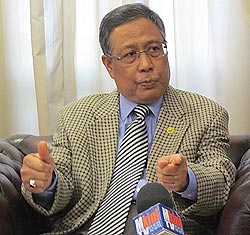 There is no firm word yet on the accreditation of international observers, but EC chief Abdul Aziz Yusof (
left
) had said that all Asean members - except Brunei and Singapore - will be invited.
There is no firm word yet on the accreditation of international observers, but EC chief Abdul Aziz Yusof (
left
) had said that all Asean members - except Brunei and Singapore - will be invited.
He said the EC was also looking at inviting international bodies, such as the United Nations, to monitor the polls.
In April, Abdul Aziz said: "What we can do is to have international observers come here as government guests and ask the government to pay for their lodging, food and transport. We want to do this for the coming election".
Anfrel stressed that there is still time for the EC to accredit more professional election observation groups to maximise their coverage across the country.
"Once they (the EC) do this, they will send the signal that they are confident in their management of the polls and are transparent about the manner in which the polls will be conducted.
"By establishing a more clear and transparent accreditation process, the EC can strengthen the observation of the election and, by doing so, the election itself," the statement read.


Are you sure you want to delete this comment?
This action cannot be undone.