




AELB: Radiation at Bukit Merah factory high, but safe
The Atomic Energy Licensing Board (AELB) said that the radiation at the site of the decommissioned Asia Rare Earth (ARE) factory in Bukit Merah, Perak is about four times higher than the national average, but is safe and not caused by ARE.
The Atomic Energy Licensing Board (AELB) said that the radiation at the site of the decommissioned Asia Rare Earth (ARE) factory in Bukit Merah, Perak is about four times higher than the national average, but is safe and not caused by ARE.
AELB licensing director Hasmadi Hassan said the above average radiation in Perak was because it was a former tin-mining area.
“The tin industry came before independence; I think 100 or 200 years ago. It was during these tin mining days that they left the amang (tin tailings). The amang ’s content of naturally occurring radiation is very high,” he said.
Hasmadi was answering questions from a member of the public on why radiation levels at the site of the decommissioned ARE factory and the disposal site of ARE’s waste are lower than in the surrounding areas, and suggested the possibility of unknown dump sites.
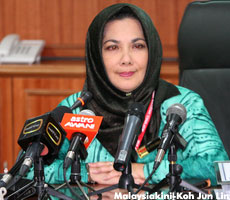
 Hasmadi (
right
) urged members of the public with information on such dump sites to submit their claims to AELB for further investigation.
Hasmadi (
right
) urged members of the public with information on such dump sites to submit their claims to AELB for further investigation.
Quoting figures from United Nations Scientific Committee of the Effects of Atomic Radiation (UNSCEAR), Hasmadi said the national average background radiation level was 0.05 microsieverts per hour.
By comparison, the AELB’s monitoring at the ARE site showed that the radiation is at 0.17 microsieverts per hour; and one to 1.14 microsieverts per hour at the new disposal facilities in Mukim Belanja, Perak.
The radiation measured by 125 monitoring stations within 10km of Mukim Belanja, which includes Papan, Bukit Merah, and parts of Ipoh, are about 0.6 microsieverts per hour.
At the lobby of AELB’s headquarters in Dengkil, Selangor, where this weekly public briefing was being held, a digital signboard indicated that the radiation level there was about 0.33 microsieverts per hour.
Hasmadi said a study in four locations overseas with very high background radiation such as Ramsar, Iran, did not show any relationship between the radiation and cancer.
 He added that background radiation can be naturally high due to local geology, such as 2.2 microsieverts per hour at Pasir Hitam beach, Pulau Langkawi, and 20 to 50 microsieverts per hour in Ramsar.
During the press conference, the AELB director-general’s special advisor, Noor Hasnah Khairullah ( left ), also said a total of 1,124 items of feedback were received during the public feedback period for the Lynas Advanced Materials Plant in Gebeng, Pahang.
Of these, only 334 were from those who had read the documents on public display, and over 900 had concerns about Lynas’ as yet undecided Permanent Disposal Facility.
‘Responses statistically insignificant’
In addition, she said the number of responses are small, and are hence “statistically insignificant” compared to the population of Malaysia, or even that of Kuantan, Pahang
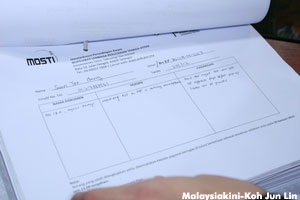 “[But] this is the feedback from the public after the documents have been displayed, so we have to take it seriously,” she said.
In addition, she said AELB did not made the statement that 97 percent of respondents agreed with Lynas and the responses were not categorised as ‘agree’ or ‘disagree’.
Noor Hasnah and Hasmadi also said that the limit for Lynas is one millisievert per year, meaning that it is not allowed to add that amount of radiation into the existing background radiation.
One millisievert per year is equivalent to 0.1142 microsieverts per hour of constant exposure to radiation for a year.


Are you sure you want to delete this comment?
This action cannot be undone.