




Karpal to seek review of imam's 'excessive' sentence
Veteran lawyer Karpal Singh will file an application for the Federal Court to review its decision to sentence imam Hoslan Hussein’s to one-year imprisonment over the latter’s infamous shoe throwing incident.
Veteran lawyer Karpal Singh will file an application for the Federal Court to review its decision to sentence imam Hoslan Hussain’s to one-year imprisonment over the latter’s infamous shoe throwing incident.
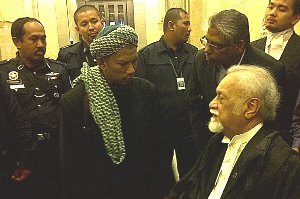 Karpal, who is lawyer for Hoslan and DAP national chairperson, said the Federal Court’s
sentence
was "manifestly excessive".
Karpal, who is lawyer for Hoslan and DAP national chairperson, said the Federal Court’s
sentence
was "manifestly excessive".
Karpal said Hoslan would have no opportunity to appeal the sentence as it was imposed by the Federal Court.
However, in exceptional cases, the court can call for a review of its own decision, he said.
"No doubt what Hoslan did was wrong. It was unjustifiable and indefensible, but on the other hand, the Federal Court should take into account the circumstances surrounding the imam's act," Karpal told reporters at a press conference today.
"He was thrown out of his living quarters at the mosque in Kampung Pandan, and the case was on-going since 1999.
"He was told that his appeal to the Federal Court was rejected because it was out of time, therefore he acted in frustration on the spur of the moment," the veteran lawyer added.
In 2008, the Federal Territory Islamic Affairs Department issued an order to evict the imam who was living within the compounds of the Ar Rahimah mosque, after allegations of disciplinary problems were leveled against him.
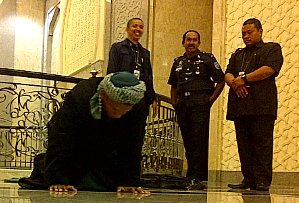 Hoslan, a father of seven, threw his shoes at the three-member panel of the apex court, comprising Federal Court judge Suriyadi Halim Omar, Court of Appeal judge Zaleha Zahari and headed by chief judge of Malaya justice Zulkifli Ahmad Makinuddin.
The shoe-throwing incident had occurred on Feb 22, more than a fortnight after that he was abruptly summoned and sentenced on March 8.
Courts shouldn’t have ‘absolute power’
Meanwhile, Karpal also lamented that in the matter of contempt of the appellate courts, there is no restriction on punishments imposed.
He added that according to the 1948 Subordinate Courts Act, the Sessions and Magistrate Courts can impose a maximum punishment for six weeks only.
Karpal cited the case of India where the 1971 Contempt of Courts Act has control for the imposition of penalties.
However, in the Malaysian High Court and Federal Court, there is no law to restrict such punishment, he said.
"In other words, these courts (High/Federal/Appeal) can mete out any punishment they like.
“To place absolute power in hands of the judiciary is wrong," said Karpal.
Karpal said these courts must be restrained by the Act of Parliament, and punishment for contempt of court must be regulated by the August house.
"I do not see why there is no control for punishment imposed for contempt for High Court, Federal Court or the Appellate Court," he said.
"Technically, if we take this matter very far, this would mean that these courts can impose a death sentence for contempt of court. I am not saying the courts will do that," he said
"However, if placed in the wrong hands, such cases can be exploited," he added.
Karpal said contempt of court is "criminal in nature".
He added that the imam was a public servant, and with this conviction he stands lose his livelihood.
Therefore, he said, a more appropriate and less extreme punishment should be imposed.


Are you sure you want to delete this comment?
This action cannot be undone.