




RM500 aid boosts Najib's approval rating
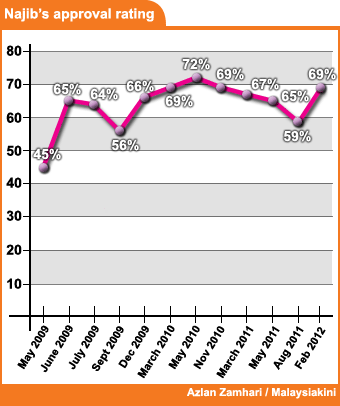
A recent survey among voters in Peninsular Malaysia shows that Prime Minister Najib Abdul Razak's approval rating has risen to 69 percent, largely due to disbursement of Bantuan Rakyat 1Malaysia (BR1M) and improving mood over the economy.
A recent survey among voters in Peninsular Malaysia shows that Prime Minister Najib Abdul Razak's approval rating has risen to 69 percent, largely due to disbursement of Bantuan Rakyat 1Malaysia (BR1M) and improving mood over the economy.
Najib's approval rating peaked at 72 percent in May 2010, before taking a dive to 59 percent in August 2011, one month after the Bersih 2.0 demonstration. It then steadily picked up to 71 percent in December, after the RM500 BR1M financial aid was announced in Budget 2012
 Support for the prime minister was highest among households with income lower than RM1,500 per month at 78 percent, Indian respondents at 80 percent and Malay respondents at 74 percent.
Along ethnic lines, Najib enjoyed higher popularity from all races compared with the finding in August last year.
Although Chinese voters' support for Najib was the lowest among all races, it stood at an amazing 56 percent, a hike of 18 points, while support from the Malay and Indian voters increased by five and 11 points respectively.
The survey by independent public opinion survey organisation Merdeka Center also found that satisfaction with the premier was higher among respondents above 50 years old.
This group clocked more than 73 percent, compared with 64 percent among the younger respondents aged 21 to 30 years.
Interestingly, disapproval for Najib was higher among respondents of the higher income group. Up to 45 percent of those whose household income exceed RM5,000 were dissatisfied with him.
PM's people-friendly initiatives
"In our view, the rise in public satisfaction may be due to widespread awareness of the prime minister's people-friendly initiatives and proposals to improve Malaysia's democratic credentials, such as the replacement of the Internal Security Act (ISA), proposed amendments to the University and University Colleges Act (UUCA) and reforms to improve transparency of the electoral process," Merdeka Center said in a press release today.
 The findings also show that as many as one-third of the respondents who were inclined towards Pakatan Rakyat, reported satisfaction with the prime minister, indicating that such expressions of approval may not all translate into votes for the ruling coalition.
Another evidence of such a trend was that only 48 percent of respondents responded that "they were happy with the government" despite the high satisfaction for Najib.
The survey found that positive feelings towards the government were higher among older voters and lowest among younger voters, in that only 39 percent of voters under 30 years old were "happy" with the government, compared with 54 percent among those aged 60 and above.
The survey was done between Feb 10 and 23 to gauge voters' perceptions of current developments in the country.
The poll involved telephone interviews with 1,022 registered voters, comprising 59 percent Malay, 32 percent Chinese and nine percent Indian respondents.
Respondents were selected on the basis of random stratified sampling along ethnicity, gender and state of residence. The survey was funded internally by Merdeka Center for release to the public.


Are you sure you want to delete this comment?
This action cannot be undone.