




DAP: Gov't manipulated laws to legitimise debt
DAP has blamed the country’s rising debt level on the ruling BN having raised the statutory borrowing ceiling “multiple times” to legitimise the debt.
DAP has blamed the country’s rising debt level on the ruling BN having raised the statutory borrowing ceiling “multiple times” to legitimise the debt.
 DAP national publicity secretary Tony Pua slammed the government for modifying the ceiling “at its whims and fancies over the past decade, rendering meaningless the legal debt ceiling”.
Therefore, Pua said, the government’s debt at 53.8 percent of GDP, as reported in the Economic Report 2011-12, is below the statutory borrowing ceiling of 55 percent and purely the result of the government’s “creative manipulation”.
“What is worrying is the fact that the ‘statutory borrowing ceiling’ has actually been raised multiple times by the BN government over the past decade to ‘legalise’ the federal government debt level, which has been increasing at a much faster pace than our GDP.
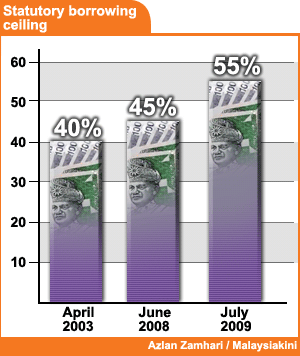 The 55 percent statutory borrowing ceiling only came into effect in July 2009 by an order of current second finance minister Ahmad Husni Hanadzlah.
“Prior to the revised limit, the limit was set at 45 percent in June 2008, barely 13 months before by the then second finance minister Nor Md Yakcop,” Pua said in a statement today.
He added that the limit was raised to 40 percent five years before that, by then second minister finance minister Jamaluddin Jarjis.
“Hence our statutory borrowing ceiling has been raised by 15 percent of our GDP in just six years.
“The question is, if the ceiling is repeatedly raised with such nonchalance, why does the government bother setting a limit at all?” said Pua, who is also Petaling Jaya Utara MP.
More creative accounting?
Pua then questioned whether the government will again raise the ceiling as the country's debt level is expected to scale beyond 55 percent over the next two years.
Yesterday, citing the government's Economic Report 2011-2012 published last year, Pua pointed out that the federal government debt would hit RM455.7 billion as at the end of 2011 or 65.2 percent of our GDP, well above the current limit.
 Besides shifting the goal posts, Pua also noted that the government was using other 'creative measures' to by-pass the limit set by law.
One of the glaring examples is the first phase of Klang Valley MRT mega-project which costs around RM20 billion.
Pua pointed out that since the MRT project was never debated in the Budget 2012 tabled in Parliament for approval last year, it was clear that the funding would be raised by a wholly-owned 'special purpose vehicle' (SPV) known as Dana Infra, and guaranteed by the government.
"This way, the BN federal government kills two birds with one stone.
"Firstly, the debt raised will not be part of the federal government debt because Dana Infra is 'not' federal government and hence will not be perceived to jeopardise our credit standings.
"This is despite the fact that all parties are expecting MRT to be a financially loss-making project and that the federal government will have to fund Dana Infra’s debt repayments at some point in the future," he explained.
Secondly, Pua elaborated, by placing the debt and expenditure of the MRT project in a SPV, such expenditure then escapes the purview of direct parliamentary oversight because it is never debated in Parliament as an official Budget item.
Where's the transparency?
Such ‘creative’ manipulation of federal government debt and expenditure is not limited to just the MRT project but to many other multi-billion ringgit projects as well, he said.
Other examples are the construction of 74 police headquarters with government-guaranteed RM10 billion debt by Ministry of Finance-owned Pembinaan BLT Sdn Bhd, and the proposed RM20 billion sukuk plan by Pengurusan Aset Air Bhd (PAAB) to restructure the country’s water assets.
"Governments all over the world, especially in developed countries like the UK and Germany, are now changing their laws to require such debts and contingent liabilities to be incorporated into the government’s financial statement to ensure greater transparency and financial accountability.
"This is to avert a financial crisis, which has already enveloped the Euro-zone over the past two years.
"However, it appears that the Malaysian government is still sitting back and resting easy, while making full use of the 'loophole' in our government financial reporting standards to continue to recklessly indebt future Malaysians with none of the checks put in place," Pua added.


Are you sure you want to delete this comment?
This action cannot be undone.