




Indelible ink for polls to be gazetted next week
The new regulation to implement indelible ink during election will be gazetted next Wednesday, making it a compulsory requirement in the next general election.
The new regulation to implement indelible ink during election will be gazetted next Wednesday, making it a compulsory requirement in the next general election.
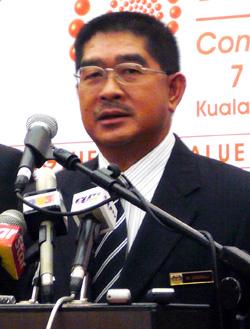 This was announced today by the chairperson of Parliamentary Select Committee (PSC) on electoral reforms, Maximus Ongkili (
right
).
This was announced today by the chairperson of Parliamentary Select Committee (PSC) on electoral reforms, Maximus Ongkili (
right
).
“It will be gazetted on Feb 15 and ready to be implemented,” he said during a press conference at parliament building after chairing the committee meeting this afternoon.
Rasah MP Anthony Loke, who is one of the committee members, revealed to reporters after the press conference that the Election Commission (EC) will start training its staff on using the indelible ink beginning March.
The PSC was also informed by EC chief Abdul Aziz Yusof, who was present at the meeting, that the legislation process to ban candidates from withdrawing after nomination, and to enable early voting - a more transparent alternative to postal voting - will be completed by early April, meaning they will be enforced in the next general election.
Postal voting option for journalists
“Representatives of candidates will be allowed to monitor polling stations of early voting,” Maximus elaborated.
However, some 3,000 police and military personnel will still cast their ballots as postal voters as they will be stationed at borders and islands where early voting is not possible, said Maximus.
Both the EC and PSC also agreed to allow journalists on duty on polling day to apply as postal voters.
Maximus explained that postal voting is a better option for journalists compared to early voting because the latter requires substantial number of voters in the same place which is not applicable to journalists who are deployed to various constituencies in the country.
However, critical services personnel including nurses and doctors are not allowed to use such facility as the health ministry has committed to let them vote on polling day.
On the issue of imposing criteria for overseas voters who want to be listed as absentee voters, it will be discussed at the next meeting, he said.
The EC also informed the committee that it has appointed assistant registrars at Malaysia consulates to assist citizens abroad to register as voters, but according to the current law, only civil servants and full-time students can apply for postal voting.
To have a close study on the election system of other countries, Maximus said the PSC will make fields trips to three advanced countries - United Kingdom, Germany and Denmark - in the last week of February.
The committee will submit its full report to parliament on Apr 2, when its six-month tenure ends.
“We will finish our mission at the end of March,” Maximus added.


Report this comment
Are you sure you want to delete this comment?
This action cannot be undone.