




Election rules on indelible ink use ready by Feb 1
Amendments to election rules to implement the use of indelible ink in the next general election are expected to be ready by Feb 1, the parliamentary select committee (PSC) on electoral reform announced today.
Amendments to election rules to implement the use of indelible ink in the next general election are expected to be ready by Feb 1, the parliamentary select committee (PSC) on electoral reform announced today.
 The PSC was earlier given a demonstration on the process and application of the ink in Parliament House by Election Commission (EC) officials.
The application of the ink involves the dipping the tip of the left index finger past the fingernail.
Those who refuse to undergo the process will not be allowed to vote.
The use of the ink, which will last for at least 48 hours after the application, was among the PSC recommendations to prevent multiple voting.
According to a PSC source, an ink sample has been sent to the Chemistry Department for testing and the results will be submitted to the National Fatwa Council and the Health Ministry.
Speaking to reporters after the demonstration, PSC chairperson Maximus Johnity Ongkili said the EC had been very receptive to seven out of the 10 electoral reform recommendations the PSC made.
Besides the use of indelible ink, the EC will also ready amendments to replace the postal voting mechanism with advance voting.
These regulations would be finalised and presented to Parliament by March 1, Ongkili said.
'Doubtful' voters can't be traced
“As for the recognition of overseas voters, it might consume more time as the EC has to work out the criteria and the mechanism required,” added Ongkili, who is also science, technology and innovation minister.
“As far as the cleansing of the master voter list is concerned, details of 42,051 doubtful voters have been displayed for verification… the EC has been searching for these people for a long time, but can’t find them and that’s why their status is suspicious,” he explained.
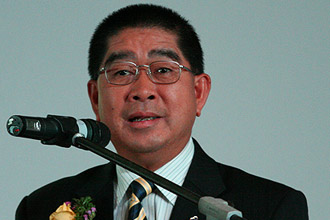 Asked whether the earlier rejection of the use of indelible ink by the National Fatwa Council still stood, Ongkili (
left
) said: "The National Fatwa Council made the decision with respect to the previous ink, but this ink is supposed to be an improvement of that... the EC does not anticipate any problem."
Asked whether the earlier rejection of the use of indelible ink by the National Fatwa Council still stood, Ongkili (
left
) said: "The National Fatwa Council made the decision with respect to the previous ink, but this ink is supposed to be an improvement of that... the EC does not anticipate any problem."
The PSC, which still has three months until the first week of April to complete its task, will oversee the implementation of the reforms, Ongkili added.
The PSC electoral reform recommendations are part of its interim report, which was tabled in Parliament on Nov 30 after two rounds of public hearings in Kuala Lumpur and in Kota Kinabalu.
The 10 recommendations it made are:
- Introducing the use of indelible ink;
- Implementing advance voting for security personnel, members of the armed forces and expanding it to other essential service personnel;
- Extending overseas voting to all qualified Malaysians living abroad;
- Allowing out-of-district voting;
- Requiring a statutory declaration with the change-of-address application;
- Cleaning up the electoral roll;
- Extending the period the electoral roll is put on public display to allow for a longer protest period;
- Removing serial numbers from voting slips and ensuring stricter monitoring of voters;
- Abolishing protests on nomination day and dropping the withdrawal period for candidates; and,
- Strengthening the EC to ensure its independence.
However, election reform coalition Bersih 2.0 is dissatisfied with the preliminary recommendations, saying the PSC had neglected to implement five out of its eight demands.
“There are two more public hearings - on Jan 7 and 8 in Kota Baru, Kelantan, and on Jan 12 and 13 in Johor Baru, Johor.
“We will concentrate on the implementation of the recommendations after the public hearings,” Ongkili added.


Are you sure you want to delete this comment?
This action cannot be undone.