




Kuantan MP: No DEIA, no licence for Lynas
Kuantan MP Fuziah Salleh wants a detailed environment impact assessment (DEIA) produced before the Lynas Advanced Material Plant (Lamp) is granted an operating licence.
Kuantan MP Fuziah Salleh wants a detailed environment impact assessment (DEIA) produced before the Lynas Advanced Material Plant (Lamp) is granted an operating licence.
 This, she said, was in light of the prescribed activities list requiring a DEIA which was amended on June 20 to include "activities using radioactive material and generation of radioactive waste".
"Since the Water Leach Purification (WLP) waste produced by Lamp has been classified as radioactive, as admitted by the Science, Technology and Innovation Minister Maximus Johnity Ongkili in the Dewan Rakyat on Nov 14, a DEIA is compulsory before the Atomic Energy Licensing Board (AELB) approves an operation licence for Lamp," she said in a statement yesterday.
In Malaysia, the convention for EIA procedure involves producing a Preliminary EIA (PEIA) report, but if the project is on a DOE prescribed activities list or is deemed to have a significant impact on the environment, then a DEIA is required.
"Even though in early 2008 this rule was not used for Lamp, but owing to the concerns by the people of Kuantan, I stress that it is the responsibility of the Environment Department and AELB to postpone the issuance of an operation licence until a DEIA has been performed," said Fuziah ( above ).
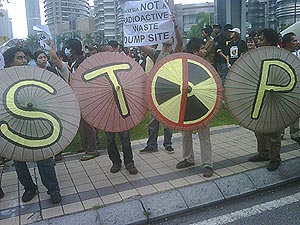 The DEIA process requires public display of the EIA report for comments and its contents have to be reviewed by an expert panel.
"Public consultation, which is a DEIA condition, is the appropriate action for the DOE and the BN government to undertake in a transparent manner, and it has to involve all stakeholders and the people of Kuantan."
The government, adds Fuziah, must put the safety of the people above all else and this should justify any delays.
Residents are concerned that the RM700 million plant which is being constructed in Gebeng would become an environmental hazard as the rare-earth processing factory will produce radioactive waste as its byproduct.
Once completed, the plant will be the first such facility built outside China in the last 30 years.
It is expected to supply one third of the global demand outside China, for rare-earth.


Are you sure you want to delete this comment?
This action cannot be undone.