




Australian High Court blocks Malaysia refugee swap
Australia's High Court dealt a heavy blow to the government today by blocking its plans to send asylum-seekers to Malaysia, ruling they could not go to a nation lacking legal safeguards.
Australia's High Court dealt a heavy blow to the government today by blocking its plans to send asylum-seekers to Malaysia, ruling they could not go to a nation lacking legal safeguards.
Australia had hoped to send up to 800 asylum-seekers to the Asian nation in exchange for resettling 4,000 of its refugees, and the decision leaves hundreds of boat people in legal limbo.
The nation's top court found that under Australian law the government could not send asylum-seekers to be processed in another nation unless that country was compelled to adequately protect them.
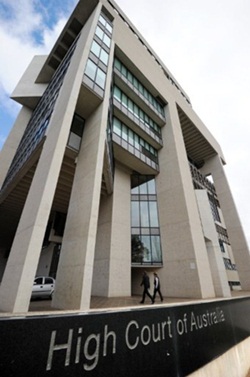 "The country must be legally bound by international law or its own domestic law to... provide protection for asylum-seekers pending determination of their refugee status," it said in a summary of the judgment.
[Full judgment]
"The country must be legally bound by international law or its own domestic law to... provide protection for asylum-seekers pending determination of their refugee status," it said in a summary of the judgment.
[Full judgment]
"In addition to these criteria, the Migration Act requires that the country meet certain human rights standards in providing that protection."
Refugee activists rejoiced at the decision which they said vindicated their view that Malaysia was a dangerous destination for asylum-seekers and that sending vulnerable people there would breach Australia's legal obligations.
The government was despondent at the ruling on the politically divisive issue, which comes as the minority coalition government's popularity sinks to record lows in opinion polls.
"Let's make no bones about it, today's decision by the High Court is a profoundly disappointing one," Immigration Minister Chris Bowen said.
Ruling cannot be appealed
The so-called Malaysia Solution was part of Australia's regional response to halting the flow of thousands of boat people who arrive on its shores each year, which is also set to involve a centre in Papua New Guinea.
 Bowen (
right
) said the court ruling could have ramifications for the regional policy, but he would not indicate how his centre-left Labor government of Prime Minister Julia Gillard would react.
Bowen (
right
) said the court ruling could have ramifications for the regional policy, but he would not indicate how his centre-left Labor government of Prime Minister Julia Gillard would react.
Human rights groups had slammed the Malaysia deal, accusing Australia of abandoning its international obligations to asylum-seekers by dumping them in a country without proper protections for its more than 90,000 refugees.
Lawyers for the two Afghan men at the centre of the High Court case had argued that the deal breached Australia's duties towards asylum-seekers because Malaysia is not a signatory to the UN convention on refugees.
The High Court sided with them in a majority ruling which cannot be appealed.
Experts said the government could, however, attempt to amend the Migration Act to get around the ruling.
The court said that in deciding the matter, it expressed no view about whether Malaysia met relevant human rights standards or whether refugees in that country were treated fairly.
"The court's decision was based upon the criteria which the (immigration) minister must apply before he could make a declaration," it said.
Policy a ‘complete and utter mess’
Canberra unveiled its new strategy in May, promising that all maritime arrivals would be processed offshore with the first 800 to go to Malaysia and that they would be treated humanely.
The first group were set to leave for Kuala Lumpur two weeks ago, but refugee lawyer David Manne applied for an injunction pending a High Court hearing saying the men feared for their safety in Malaysia.
Amnesty International said Canberra should never have contemplated "outsourcing Australia's refugee protection obligations to a country which regularly canes, detains and abuses asylum seekers".
Conservative opposition MP Scott Morrison agreed, describing the government's asylum and border policy as "a complete and utter mess."
"I've been to Malaysia. I've seen the conditions under which asylum-seekers would be living, and it was clear to me that the protections the minister (Bowen) boldly claimed existed simply didn't exist," he said.
 Lawyers for the two asylum seekers had asked the High Court to declare the people swap illegal, because Malaysia had no legal guarantees to protect the rights of asylum seekers.
Australia is a signatory to the UN convention on refugees but Malaysia is not.
"They were actually petrified about being sent to Malaysia and they are extremely relieved," said David Manne ( right ), a lawyer acting for the two asylum seekers.
Flashpoint political issue
Australia, a nation of about 23 million people, receives up to a few thousand asylum-seekers by boat each year, but the arrivals stir intense political debate over border security versus the rights of refugees, a row that can swing votes.
In 2001, then conservative Prime Minister John Howard won voter support for his decision to use the military to prevent entry into Australian waters of a ship which had rescued asylum
seekers from a sinking boat in the Indian Ocean.
Howard's government had appeared to be heading for electoral oblivion ahead of that incident, but he went on to win a general election three months later.
"What we have seen today in the High Court is yet another recognition of yet another policy failure by this incompetent government," said opposition immigration spokesman Scott
Morrison.
Former Labor politician Graham Richardson, now a political commentator, said the government would have little choice but to look at other options.
"I think Malaysia is just dead," he said, adding the government would have to look at other possible locations.
Australia has already begun negotiations with Papua New Guinea to re-open the mothballed Manus Island immigration detention centre, which closed down in 2004.
Suaram welcomes ruling
Today's High Court ruling means Australia might also need to re-open a detention centre on the remote Pacific islands nation of Nauru.
 Both the Manus Island and Nauru detention centres were used by the former conservative government under its controversial Pacific Solution, where asylum seekers who arrived by boat were sent to other countries to have their refugee claims processed.
Meanwhile, rights groups welcomed the ruling.
“Amnesty International is delighted that the High Court has prevented this outrageous, politically-motivated scheme from going ahead," said refugee spokesman Dr Graham Thom.
Malaysian rights group Suaram said the Australian government should not try to reopen a detention centre in Papua New Guinea after the blocking of the Malaysian plan.
"That is not a good policy by the Australian government because this is outsourcing a responsibility that belongs to Australia," said Andika Abdul Wahab.
- Agencies


