




Don: Only God has the power to indefinitely detain
An expert on the federal constitution today supported the call to review laws that allow for indefinite detention, arguing that the home minister should be not be given the power of God over other Malaysians.
An expert on the federal constitution today supported the call to review laws that allow for indefinite detention, arguing that the home minister should be not be given the power of God over other Malaysians.
"I don't think any human being should have this kind of power over another human being... that is a power only for the God," said UiTM constitutional law professor Shad Saleem Faruqi during a forum at Kuala Lumpur today.
 Shad Saleem commented that laws including the draconian Internal Security Act (ISA) and Emergency Ordinance (EO), that grant the home minister absolute discretion to approve indefinite detention, are in dire need of drastic review.
Recognising that the nation needs preventive laws to address new security threats such as terrorism, Saleem proposed that such laws should be judicialised to clip the absolute ministerial power and impose strict limitations on usage.
He further suggested that the current advisory board, tasked to review the minister's decision on detention without trial, should change its name to "special security board" and its decision should bind the minister.
Currently the advisory board can only provide advice to the Agong, while the government could, and have in many past instances, gone against its advice.
The special security board should also have access to crucial information related to any detention rather than this being withheld by the Home Ministry, Saleem added.
He said that the current situation in which the police and minister play the multiple roles of accuser, investigator and adjudicator is "not right".
PSM6 release ‘calculated’
The forum entitled ‘Promoting Constitutionalism, Empowering Citizens’ was one of the discussion sessions during the two-day Malaysian Student Leaders Summit organised by the United Kingdom and Eire Council of Malaysian Students (UKEC).
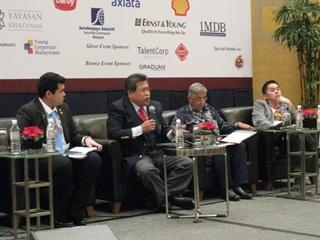 The other two speakers were Dewan Rakyat speaker Pandikar Amin Mulia and lawyer Edmund Bon (
photo, far left with
with Pandikar and Shad Saleem
on his right
), a campaigner for the Malaysian Centre for Constitutionalism and Human Rights.
Pandikar commented on the ISA claiming that it is an issue that only the activists care about, whereas ordinary Malaysians and the ‘silent majority’ have no reason to bother about the draconian law.
He accused the activists of raising the ISA issue to attract public attention and to incite people’s emotions.
Meanwhile, when asked by a student on the possible reasons behind the release of the six Parti Sosialis Malaysia (PSM) members earlier held under the Emergency Ordinance (EO), Shad Saleem opined that it was a calculated move by the government to avoid further embarrassment.
 He elaborated that the government had probably anticipated that the advisory board would eventually deny the PSM 6's continued detention should the home minister attempt to extend the detention period, therefore the government decided to release the six before the case was brought to the board.
Bon, however, stressed that it was not the government that released the PSM 6 but the people, NGOs and civil society that had exerted intensive pressure on the government through nightly candlelight vigils and various statements to the media.
‘Follow English model on rallies’
About 800 overseas and local Malaysian students attended the forum, and almost all of their questions to the speakers were aimed at the government’s policies including the clampdown of the Bersih 2.0 rally, the Official Secret Act and the detention of the PSM 6.
 Pandikar repeatedly maintained he was not defending the government over the Bersih crackdown, arguing that Article 10 of the federal constitution that guarantees freedom to assembly, and it also empowers the government to restrict that freedom when it foresees threats to ‘national security’.
Bon however rebutted that the Bersih 2.0 crackdown was not merely a restriction but had nullified the freedom of assembly entirely, and that was against the spirit of the constitution.
Sharing the same view, Shad Saleem said that the current law is unbalanced, and cited England’s laws on the matter as a model for Malaysia to follow.
The UiTM professor explained that English laws set no prior requirements for a static assembly, and that the organiser needs only to inform the police if they intend to hold a procession.
Should the police expect trouble from the procession, it would require the organiser to apply for permission from the elected local authority that has the power to ban the procession or impose conditions on it.
Shad Saleem commented that by giving police the power to ban a rally, the government has politicised the enforcement agency and put them in a difficult position.


Report this comment
Are you sure you want to delete this comment?
This action cannot be undone.