




Minister denies IPPs enjoy gas subsidy
It is absolutely not true that independent power producers (IPPs) enjoy gas subsidies amounting to RM19 billion annually from the government, Energy, Green Technology and Water Minister Peter Chin Fah Kui said today.
It is absolutely not true that independent power producers (IPPs) enjoy gas subsidies amounting to RM19 billion annually from the government, Energy, Green Technology and Water Minister Peter Chin Fah Kui said today.
He said the RM19 billion was the profit that Petroliam Nasional Bhd had to forgo for having to sell gas below the market price to the IPPs and Tenaga Nasional Bhd (TNB).
The RM10.70 per MMBtu price tag was fixed by the government to keep electricity tariff low.
“The market price for gas presently is far more expensive which is RM40 per MMBtu,” he told reporters when asked to comment about the RM19 billion subsidy given to IPPs.
 Last week, an opposition party said the government should first remove “big opium” gas subsidies worth RM19 billion for IPPs and commercial power sectors before dealing with the opiate for the masses such as sugar, diesel and petrol subsidies.
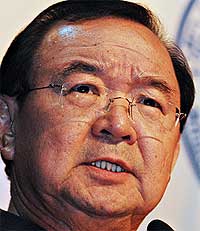
“It’s a big misconception saying that the subsidy is given to the IPPs and making them fat cats,” said Chin ( left ).
In fact, he said, the IPPs did not receive any benefits if the price of gas was raised.
“Fuel for power generation is a pass-through cost. It has nothing to do with the IPPs. It doesn’t affect them at all.
“That fuel element is not part of the calculation of payment from TNB to the IPPs. That fuel element is neutral,” he said.
“I’ve explained this several times including in Parliament but they still want to politicise it. It's not good for the people,” he said.
He said the RM10.70 per MMBtu price was the result of a review by the government in March 2009 when the price at that time was fixed at RM14.31 per MMBtu.
Chin said an IPP incurred an investment cost when building the plant and this was taken into account in the Power Puchase Agreement (PPA).
“What they collect every month relates to payment for their investment and is agreed upon in the PPA but it has nothing to do with the price of gas or coal at all.”
‘Fuel not included in agreement’
Meanwhile, Energy Commission chief executive officer Ir Ahmad Fauzi Hassan said the monthly payment by TNB to the IPPs also took into account the interest on the loan taken as well as the cost of operating and maintaining the plants.
“But fuel is not included in the agreement. It is 100 percent borne by TNB. If the price of fuel decreases, the cost on TNB will be less and vice-versa,” he said.
He said the price for electricity bought by TNB from the IPPs also depended on the capacity of the plants. The higher the capacity, the cost of buying would be higher, he said.
Ahmad Fauzi said power generated by IPPs met about 60 percent of the country’s electricity requirement while TNB the remaining 40 percent.
- Bernama


Are you sure you want to delete this comment?
This action cannot be undone.