




Prioritise 'opium' reduction move, says DAP
The DAP has questioned the federal government's decision to cut "small subsidies" on which ordinary consumers rely, while allowing corporations to enjoy "big subsidies".
The DAP has questioned the federal government's decision to cut "small subsidies" on which ordinary consumers rely, while allowing corporations to enjoy "big subsidies".
 "The government should remove ‘big opium’ such as the huge subsidies enjoyed by independent power producers (IPPs) and other corporations,” said secretary-general Lim Guan Eng.
“It is (now) hitting poor people by cutting subsidies for ‘small opium’ like sugar and petrol, while letting off the big and the rich.”
Lim, who is also Penang Chief Minister, was speaking to journalists in Kuala Lumpur today after launching the George Town Festival 2011.
Yesterday Prime Minister Najib Abdul Razak said fuel subsidies, "like opium", should be reduced gradually to bring the budget deficit under control.
After increasing the price of sugar last week, the government will review the price of RON95 petrol next month.
'Remove super subsidy of gas'
In a written statement released later today, Lim claimed the government had forked out RM19 billion in annual gas subsidies for IPPs and commercial power sectors.
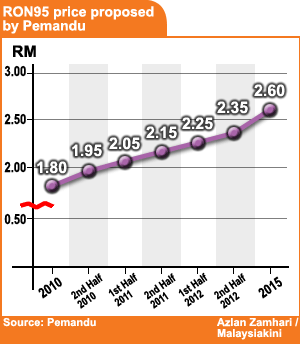 “DAP strongly opposes the removal of the subsidy for diesel from June 1, 2011, without first removing the super subsidy of gas that affects the few giant IPPs because it will cause inflation, directly impacting on small businessmen and consumers,” the statement said.
Those affected by the diesel subsidy cut include general cargo movers, vans, rigid-lorry for bottled beverages, tankers for flour transport, refrigerated goods, water tankers, limousine taxis, prime movers, luton box vans and category C-2 deep sea fishing vessels.
“Why should the masses and the ordinary 27 million Malaysians be made to bear these price rises when the few big corporate giants in the IPPs do not suffer a single cent in gas subsidy cuts?” Lim asked.
He pointed out that stagnant wages in the last 10 years, which only recorded a growth of 2.6 percent, could not match the rising cost of living.
“This follows the country’s household debt to the GDP at 78 percent, and in the next two years, it will rise to 80 percent.”
Lim proposed a two-pronged approach in dealing with the removal of subsidies.
“First, deal with the bigger opium of corruption, which causes a minimal annual loss of RM28 billion annually, with some estimates of these losses running up to US$100 billion since the 1980s.
“Second, remove the big opium of gas subsidies that can save tens of billions of ringgit annually before dealing with the opiate for the masses that only saves hundreds of millions of ringgit,” he added.


Are you sure you want to delete this comment?
This action cannot be undone.