




Gov't won't allow projects that affect public health
Prime Minister Najib Razak said today the government will not compromise on projects that jeopardise public safety and their well-being.
Prime Minister Najib Razak said today the government will not compromise on projects that jeopardise public safety and their well-being.
Commenting on the project undertaken by Lynas Malaysia Sdn Bhd, a subsidiary of Lynas Corporation from Australia, Najib said an independent panel comprising experts would carry out a study on the safety aspects and impact arising from the plant to be built.
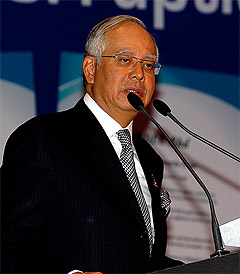 "We have decided, firstly that we will not compromise in terms of public safety and well-being, we give top priority to public security and health. It's not the factor that we want the project," he told reporters after opening the general meeting of the Pahang chapter of the Malaysian Malay Contractors Association in Pekan.
Najib said the panel would be given one month to undertake a study on the matter before preparing the report.
"The project must not jeopardise public security and health, and in line with this principle, we will set up a panel of experts made up of those who are extremely skilled in areas pertaining to the Lynas project to study all aspects within the next one month.
"They will come up with a report, and based on this report, the government will make a final decision," Najib said.
Public urged to stay calm
The prime minister hoped everyone would remain calm and let the panel carry out a detailed study.
 "Let the panel of experts make its detailed study and come up with recommendations to the government.
"What should be done is based on the main principles, that public health and security must not be compromised. We will also not allow (the plant) to carry out pre-operations until a final decision is made," he said.
Yesterday, International Trade and Industry Minister Mustapa Mohamed said an independent panel would be set up as soon as possible to carry out a study on the health and security aspects arising from the setting up of the plant and it was hoped that the report would ease the concern of Kuantan residents and explain the actual situation to those who had politicised the
issue.
Lynas has described the facility as the largest of its kind in the world and the plant is set to be one of the few sources of rare earths - used in everything from iPhones to wind turbines - outside China.
Concerns over radioactive wastes
Campaign groups and residents, however, have expressed concerns over the environmental and health implications, saying the Lynas Advanced Materials Plant in the town of Kuantan will produce huge quantities of radioactive waste.
A similar facility built by a Japanese firm in Perak was forced to shut down in 1992 due to protests.
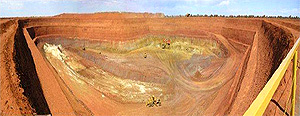 Rare earths such as super-magnet dysprosium and red-glowing europium are vital components in hard-drives and computer screens, while the metals are also pivotal in making laser missile systems and solar panels.
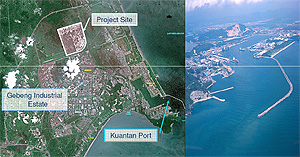
The plant, which is due to come online in the third quarter of this year, will refine raw materials extracted from Western Australia.
World attention has shifted to Australia's nascent rare earths industry after China, which dominates global production, began restricting exports, sending shudders through major consumers Japan, Europe and the United States.
In December, the United States called on China not to use rare earths as a "trade weapon" after Japanese industry said Beijing temporarily cut off exports in 2010 amidst a territorial row.
China, which produces more than 95 percent of the world's rare earths, has denied any political motivation, insisting the restrictions on exports were due to environmental concerns and the need for a more sustainable approach.


Are you sure you want to delete this comment?
This action cannot be undone.