




Dr M memoirs: Between fact and fiction
BOOK REVIEW Throughout his public life, Dr Mahathir Mohamad has been almost predictably unpredictable.
He has delighted in being a maverick, breaking the rules whenever they appeared to make no sense, or got in his way. It was often politically risky and required courage, but it also glorified his image and caught his rivals off balance at times, opening opportunities that Mahathir seized.
His 843-page book, ‘A Doctor in the House: The Memoirs of Tun Dr Mahathir Mohamad’, falls into this pattern.
At 85 years of age, Malaysia's longest-serving prime minister might be expected to reflect on the past, answer critics while underlining his achievements, mull unmet goals and mistakes, and no doubt settle a few scores but generally make peace with adversaries.
Not Mahathir...
BOOK REVIEW Throughout his public life, Dr Mahathir Mohamad has been almost predictably unpredictable.
He has delighted in being a maverick, breaking the rules whenever they appeared to make no sense, or got in his way. It was often politically risky and required courage, but it also glorified his image and caught his rivals off balance at times, opening opportunities that Mahathir seized.
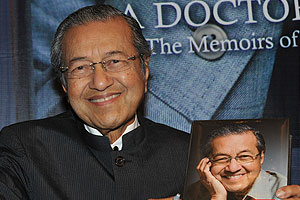 His 843-page book, ‘A Doctor in the House: The Memoirs of Tun Dr Mahathir Mohamad’, falls into this pattern.
At 85 years of age, Malaysia's longest-serving prime minister might be expected to reflect on the past, answer critics while underlining his achievements, mull unmet goals and mistakes, and no doubt settle a few scores but generally make peace with adversaries.
Not Mahathir. A polemicist to the end, he ignores much of the documented criticism levelled against him and his policies during 22 years as premier. He indulges in selective memory and advances a host of dubious propositions, while taking the credit for what he sometimes - though not always - deserves.
Like his spectacularly broken promise to stay out of politics after retirement in 2003, this book will do little to enhance Mahathir's reputation among researchers, analysts and informed readers.
But his ardent fans - who admire him for putting Malaysia on the world map, for his can-do approach to development and for his sheer cussedness - will love him all the more for thumbing his nose once again at convention.
Like a long political speech, Mahathir's book contains almost no supporting evidence, not even self-serving official reports, despite any number of loose assertions that require substantiation. The text is also peppered with factual errors and contradictions.
Imaginary allegations
The harsh conclusion must be that sections of the book can best be described as faction - a word derived from "fact" and "fiction" - which is a literary genre that depicts real historical figures and actual events woven together with imaginary allegations.
For example, Mahathir claims that "eventually a group of Malay contractors was persuaded to build and operate" the North-South Expressway. Actually, United Engineers (Malaysia) Bhd did not take much persuading. The company was controlled - secretly, for a time - by his Umno and given the contract to build the road and collect the tolls for 30 years to secure the ruling party's financial base.
Mahathir's contention that "nothing of significance resulted from" his first official visit to the United States in 1984 is no less egregious. In fact, in Washington, Mahathir approved the Bilateral Training and Consultation (Bitac) agreement, which was effectively a secret security pact.
It provided for US naval ship visits, joint military exercises and American training in Malaysia, and the establishment of facilities to repair transport aircraft and small vessels. Bitac, still undisclosed, makes a mockery of Mahathir's loudly proclaimed opposition to the US military presence in Southeast Asia.
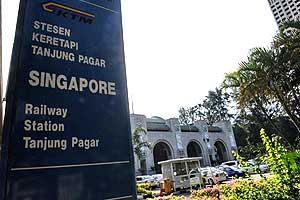 Equally flagrant is Mahathir's claim that the dispute over Malaysia's railway land in Singapore is deadlocked, and likely to get further entangled in complications over plans for a so-called crooked, or half, bridge he proposed to replace the Causeway.
When he finally realises that the matter was settled by the leaders of both countries last year, he is going to get even angrier. His beloved crooked bridge is not part of the settlement, which is being implemented by a joint team.
Having presided over a socio-economic transformation, lessening Malaysia's dependence on commodities and deepening its industrialisation, Mahathir is entitled to claim considerable success. Driven hard by him, the country became the envy of the developing world, a favourite destination of foreign investment and an export dynamo.
A striking reduction in poverty and increasing affluence gave Malaysia the look and feel of a sophisticated, prosperous country, with a greatly expanded middle-class that included significant numbers of Malays.
Understandably, Mahathir takes pride in the North-South Expressway, the Kuala Lumpur International Airport and some of the other physical infrastructure that would not exist without his obsession with creating a modern, fully developed and respected nation.
Incredible claims
But sometimes he is too eager to declare victory. For instance, he pronounces himself satisfied with Malaysia's state-led stampede into heavy industry, even though the major elements of it, which he personally selected, floundered.
Proton, the national car, is uncompetitive and doomed unless rescued by a global auto manufacturer. Perwaja, the steelmaker, swallowed a fortune before being practically given away to a private operator in the late 1990s. And a cement factory on Langkawi also racked up losses and had to be sold during the Asian financial crisis.
Despite the hands-on style that characterised his rule, Mahathir presents himself as somehow above the vicious, increasingly corrupt jungle of Malay - specifically Umno - politics. Large-scale vote buying invaded Umno in 1986, but "unfortunately" he could not stop it, though he managed to resist unspecified "attempts to corrupt me".
As Umno president, Mahathir says he seldom tried to influence party elections, and "saw no great need to campaign" even when challenged for the leadership by Tengku Razaleigh Hamzah in 1987. "If I did involve myself, it was with a general, not a personal, objective," he says.
In reality, Mahathir secretly backed Musa Hitam against Razaleigh to be his deputy in 1981. After that, his open support for Musa ahead of another challenge by Razaleigh provoked widespread unhappiness that boiled over at the Umno General Assembly in 1983.
W
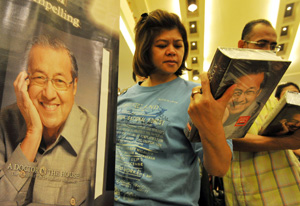 ith this sort of dissembling, readers may be "incredulous", as Mahathir concedes, when it comes to accepting his version of critical events.
Notably, readers are asked to believe that he, the elected leader of a constitutional monarchy, sacked the Lord President of the Supreme Court, Salleh Abas, in 1988 for no other reason than the Agong asked him to.
Then, Mahathir says he had to overcome his "personal doubts and feelings" and defer to the "expertise of the police" when detaining 119 people in Operation Lallang in 1987.
Corruption and cronyism
As for his children, "They did not directly benefit from my years as prime minister." Perhaps not, though having a politically dominant father in an era whose hallmarks were corruption and cronyism was clearly no handicap.
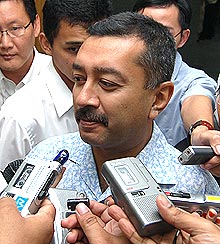 According to a recent edition of
Forbes Asia
, Mokhzani Mahathir, 50, is the
15th richest Malaysian
, worth a cool US$560 million.
According to a recent edition of
Forbes Asia
, Mokhzani Mahathir, 50, is the
15th richest Malaysian
, worth a cool US$560 million.
Mahathir is proud that he always insisted on looking into details, "taking care of the pennies", as he puts it. The trouble is that the pounds slipped through his fingers - and often into someone's pocket.
While he admits losses of "some RM600 million" in Malaysia's ill-fated attempt to manipulate the international price of tin in 1981, Mahathir shrinks from putting a price on three other world-class financial scandals that marred his tenure.
Foreign exchange speculation by Bank Negara in the early 1990s, which he concedes was a "second mistake" in the management of the country's finances, cost an estimated RM23 billion. Perwaja, bled from within, lost RM15 billion or more, while the former state-owned Bank Bumiputra, routinely abused for years, dropped at least RM10 billion as it was bailed out four times.
The total, RM50 billion or so in direct losses, would easily double if a full professional accounting were made.
 BARRY WAIN, author of ‘Malaysian Maverick: Mahathir Mohamad in Turbulent Times’, published by Palgrave Macmillan, is writer-in-residence at the Institute of Southeast Asian Studies in Singapore.


Are you sure you want to delete this comment?
This action cannot be undone.