




Scrap nuke plans, says Penang CM
The federal government should cancel its plan to build two nuclear plants in the country, Penang Chief Minister Lim Guan Eng says.
And at the same time, he said, any plan for a nuclear plant on Penang soil would be rejected outright.
The federal government should cancel its plan to build two nuclear plants in the country, Penang Chief Minister Lim Guan Eng says.
And at the same time, he said, any plan for a nuclear plant on Penang soil would be rejected outright.
Speaking on behalf of the state executive committee, Lim said, "With all due respect, the Penang government wishes to make a stand that we will not agree to the federal government's plan to build nuclear plants in the country."
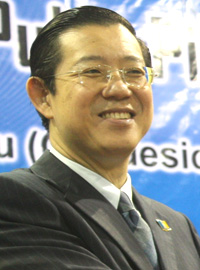 In an open letter to Green Technology, Energy and Water Minister Peter Chin Fah Kui, the chief minister also expressed reservations about Malaysian standards of safety.
"Considering that Japan - despite it expertise and technological know-how - is facing one of the most serious nuclear crisis in the world since the Chernobyl tragedy 25 years ago, Malaysia's own plans must be cancelled.
"We must take into consideration that our prowess in the field of nuclear fusion is still very limited, compared with Japan's.
Furthermore, other more technologically developed countries such as Germany and China, the world's second largest economy, have cancelled plans (for nuclear plants) in their own countries.
"The safety of Malaysians should be of utmost priority and we should not take high risk gambles," he added.
Penang has little faith in federal projects
Pointing out that the country had a less-than-stellar record for structural safety, Lim said the Penang government had little faith in federal government projects.
"If a stadium roof, schools and bus terminals can collapse, how can we be convinced of the safety of a nuclear plant, which carries such high risks and dangers?" he asked.
Lim also said there were always other alternative sources of energy sources that could be tapped.
The government announced in December last year that two nuclear plants would be built by 2022, to generate 1,000 megawatts of power each.
 This is apparently to move away from the country's dependence on fossil fuels for energy generation.
However, fears over the safety of nuclear plants have arisen with Japan, a major operator of such plants for electricity generation, facing the threat of a meltdown at its stricken Fukushima nuclear power plant following the recent 9.0 magnitude earthquake in the Miyagi prefecture.
Meanwhile, Associated Chinese Chambers of Commerce and Industry Malaysia (ACCCIM) president William Cheng called on the government to be careful about nuclear power, adding that it should be "the last resort".
In Malaysia, Cheng said, there are a lot of rivers in the states of Sabah, Sarawak, Kelantan and Pahang that can be used to produce hydropower.
Hydropower is the cheapest compared with other sources of energy, especially if compared with nuclear power, for which the investment required is 10 times more than that required for power generation from fossil fuel or coal.


Are you sure you want to delete this comment?
This action cannot be undone.