




No repeat of Bukit Merah bungle, says agency
The Bukit Merah radioactive bungle will not repeat itself with the new rare earth refinery in Pahang, said the Atomic Energy Licensing Board (AELB).
The Bukit Merah radioactive bungle will not repeat itself with the new rare earth refinery in Pahang, said the Atomic Energy Licensing Board (AELB).
 Speaking to
Malaysiakini
today, its director-general Raja Abdul Aziz Raja Adnan said that this is because the radioactive content which will be processed is a tiny fraction of what was processed in the now shut-down Perak plant.
Speaking to
Malaysiakini
today, its director-general Raja Abdul Aziz Raja Adnan said that this is because the radioactive content which will be processed is a tiny fraction of what was processed in the now shut-down Perak plant.
“The (Asian Rare Earth, ARE) plant was processing material from the Kinta Valley, which was very high in thorium and uranium,” he said when contacted.
According to Raja Abdul Aziz, the material processed in the Bukit Merah plant were remnants of tin mines that “can be found at the roadsides” and have five percent uranium and about twice that in thorium.
Small percentage of radioactive content
In comparison, he said, the material to be processed in Gebeng, near Kuantan, has only “a very small percentage” of thorium and uranium.
“It is single figures of percentage compared to the Malaysian material,” he said of the plant which is to be constructed by Australia’s Lynas Corporation.
 News of the new rare earth refinery plant has sent jitters among Malaysians, especially those who recall the ARE plant in Bukit Merah.
The plant, which began operations in 1982 was shut down in 1994 after a drawn out face-off with residents who came out in thousands to protest the plant, landing about 100 behind bars under the Internal Security Act.
Several cases of leukemia, cancer and birth deformities were reported among the residents, and Mitsubishi, the main shareholder of ARE, is reported to be undertaking a RM100 million clean-up effort.
Government very, very careful
But for Raja Abdul Aziz, this fear is only a “perception” and that compared to the 1980s the government is “very careful”.
Further, he said the Bukit Merah plant started operation prior to the forming of the AELB and the Atomic Energy Licensing Act 1984 (ACT 304).
“By international standards, we are only one of two countries which are regulating naturally occurring radioactive material (NORM) (which is) actually not termed radioactive waste,” he said.
He said that it is internationally acceptable for the waste which will be produced by Lynas to be “disposed back into the soil”, but Malaysian regulations require that it be processed “until the levels are the same as background (radiation) levels”.
“It is because of Bukit Merah that we are taking steps to regulate even naturally-occurring radioactive material,” he said.
Lynas to be further assessed
He added that Lynas is only licensed for the site and the construction of the plant, but not for waste disposal which the AELB will be further assessing.
“(Lynas) will have to be issued another licence for pre-operation and subsequently if appropriate, another for operation. Licensing is done in multiple stages.
 “They will have to ensure that the waste material is manageable and safe. AELB will verify at each stage of pre-operation and operation, the amount of waste is what they claim to be,” he said.
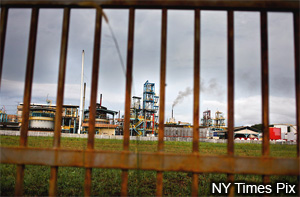
In a New York Times report, Lynas claims that it intends to dispose of the waste by diluting the waste with lime and forming tetrapods which will be then disposed off.
“It does not stop there. (Lynas) will have to show that the concentration in the tetrapod is smiliar to background (radiation levels) and there is no leaking into the environment where they are placed.
“Any products must be in placed the outdoors, and not indoors. For risks, AELB always practice the principle of ALARA (As Low As Reasonably Achievable),” he said.
Related story


Are you sure you want to delete this comment?
This action cannot be undone.