




Gov't 'not interested' in empowering EC
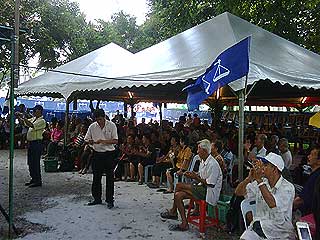
The Election Commission (EC) received another round of bashing from civil society groups and members of the public yesterday, at a forum organised by polls watchdog Coalition for Free and Elections (Bersih 2.0).
The Election Commission (EC) received another round of bashing from civil society groups and members of the public yesterday, at a forum organised by polls watchdog Coalition for Free and Elections (Bersih 2.0).
It saw active and energetic participa
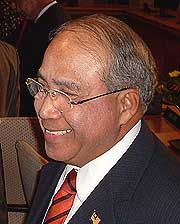 tion after the main speaker, EC deputy chairperson Wan Ahmad Wan Omar (
right
), appeared resigned to the fact that the EC has limited powers in controlling certain aspects of election procedures.
tion after the main speaker, EC deputy chairperson Wan Ahmad Wan Omar (
right
), appeared resigned to the fact that the EC has limited powers in controlling certain aspects of election procedures.
"Making laws is not under our purview, we are meant to conduct and manage elections, unlike in other countries. It is up to the government in power," Wan Omar said.
He told some 150 participants that only 50 percent of the decision makers in the government agree with the EC on the need to reform laws pertaining to election conduct.
"We have sent some proposals (on reform) to the government, but until now we haven't heard any response," he said.
Before Wan Ahmad could even conclude his keynote address, hands were hoisted as participants demanded to know whether the EC has been hesitant about implementing 'transparent' measures to ensure there is no vote-rigging.
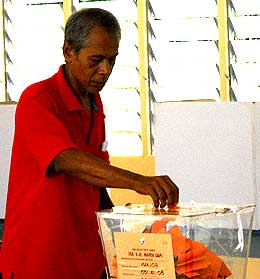 Issues of postal voting, use of indelible ink and automatic voter registration were among the matters the EC was grilled on.
Although there were two other panellists - Bersih 2.0 steering committee member Wong Chin Huat and Growing Emerging Leaders chairperson Jasmine Ng - the participants targeted Wan Ahmad during the entire 90-minute programme.
PKR's Lembah Pantai MP Nurul Izzah Anwar asked for clarification on a statement by Minister in the Prime Minister's Department Mohd Nazri Abdul Aziz, made when the idea of using indelible ink was first mooted, that it was up to the EC to decide on the matter.
However, Wan Ahmad deflected the question, repeating that the EC is all for implementation, but that the cabinet was opposed to the proposal.
"I don't remember him (Nazri) saying it is all up to the EC. The truth is, the government doesn't want indelible ink, but it wants the EC to look into something else and so the EC is looking into the biometric system.
"There are people who wrote in to the EC and asked why we should as we are not as backward as the countries using indelible ink, such as India, Bangladesh, Pakistan and Indonesia, where there are no sophisticated identification mechanisms like we have," Wan Ahmad said, drawing laughter from the floor.
'Fake Mykad' not detected
Although they has been a mountain of allegations about the multiple voting pattern and phantom voters, he pointed out that there has not been a single witness to any such incident.
He said that no election petition has ever been won, and that there is only one way of voting more than once.
"If someone wants to vote multiple times (they need a) fake (Mykad), that's all... but no person in Malaysia carries two same (Mykad).
 "Even if there are any that do, the polling station officers are no experts to differentiate between genuine and fake (Mykad). All that matters to them is that the serial number matches with the (Mykad).
"Voters with fake (Mykad) might come in the morning and probably the real voter may come in the evening, but only when we cross-check with the electoral roll will we know if someone was (using a fake document).
"We are now banking on the biometric system - it is costly, but is more appropriate in Malaysia - which has a small voting population - and it's more advanced. If we can do it at the Immigration Department, why not at polling centres?"
Wan Ahmad also said the Attorney-General's Chambers had advised that an amendment to election laws would be necessary in order to bring in the use of indelible ink.
Bersih 2.0 chairperson Ambiga Sreenevasan, who is a lawyer, disagreed that such measures would be needed and pressed Wan Ahmad to respond as to whether the EC would consider the cheaper mechanism of indelible ink, rather than the biometric system.
"Personally I think the biometric system will work. The EC is working in so many ways to stop impersonation, if there are any," Wan Ahmad replied.
But before he could complete his response, one participant, said to be a Gerakan member, interrupted, noting some people have received an education loan without applying for this.
"So, couldn't someone easily fake their identification document to vote? How are you going to stop people from making use of the information of those who have never voted? I'm part of the BN and I want BN to be accountable," he said.
'We will fight if EC backs us'
Another participant claimed that members of the public could easily take ballot papers out of polling stations, since the view of the polling officers at the voting centre where he had been based was blocked.
A Transparency International representative said the EC should back civil society groups in their push for electoral reform.
Wan Ahmad said the commission has always engaged with the civil society and has even recognised NGOs that help in the registration of eligible voters, which still stands at a staggering four million.
This explanation was again opposed by a participant, who insisted that automatic registration would solve all the problems.
Although this would be ideal in resolving the problem of scouting for non-registered voters, Wan Ahmad said there are still plenty of "cons".
Further, the law does not allow the EC to automatically register voters. Under Article 119(4)(b) of the federal constitution, a person has to apply to be registered as a voter.
Among other concerns, Wan Ahmad said, is that a "sudden surge" of four million new voters would alter the composition of certain areas and a re-delineation of constituencies would have to be done.
At every juncture, the participants jeered Wan Ahmad's reasoning, largely out of dissatisfaction with the EC and its work.
"So what?" aske
 d some participants, while another summarised the event as "joke fest" and kept calling on Wan Ahmad to move on to his "next point".
However, Wan Ahmad reiterated that the choice to register as a voter or not is in the spirit of democracy, as is the choice to vote - until and unless the constitution is amended.
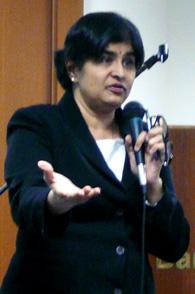
Ambiga ( left ) noted that if the EC is still keen and backs the proposal for automatic registration, Bersih 2.0 could easily come up with a proposal to amend the constitution.
"How independent is the EC? In India, for instance, even the prime minister cannot interfere with the EC's decisions," fired one participant.
Wan Ahmad's response was that the EC in Malaysia is limited in conducting elections, with various issues such as campaign financing and political financing beyond its powers.
"We collect the statements of returns and display them. It is entirely up to the losing candidate to challenge the disclosures in court because we don't have a disclosure law.
"Civil society must play up to the public to give us power, but believe me the EC is independent in running elections. The EC has a code of ethics that is given to everyone.
"We have had discussions with the government to give (free access to the) media but it says newspapers are owned by the ruling party, so why must they allow (this) for all? So what do we do?" he shot back.
"The ECs in India and Thailand are very powerful, I accept," he said, also responding to shouts of "Do you want the power?".
"Who doesn't want power?" said Wan Ahmad, drawing laughter.
EC to take over voting in military camps
On postal voters, who are considered the government's 'fixed deposit', Wan Ahmad said the EC has made some headway in renegotiating the terms.
He said the EC is i
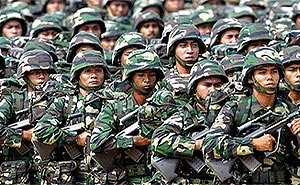 n talks with the government and related agencies to take over and run polling stations based in military camps. The process is now supervised by military personnel.
About 134,000 military officers and their spouses vote at these centres.
"We got some kind of ‘yes' answer and government seems to be fine with imposing this in the next election," he said.
But, the participants pointed out, this procedure is already in EC regulations, which means that the EC is empowered to amend the regulations without government approval or interference.
"Members of the EC are appointed by the Yang diPertuan Agong. If you are going to withhold information saying that you are governed by the Official Secrets Act, next time we will just call the AG or the prime minister to the forums," said PKR information chief and lawyer Lateefah Koya.
Wan Ahmad accepted the salvos, saying: "I would like it very much if you do, because I don't want to sit here and repeat (everything).
"I came with an open mind and I came with sincerity, although I knew I would be facing a hostile audience. But I say again, we are constrained. It is a fact, not an excuse!"


Are you sure you want to delete this comment?
This action cannot be undone.