




Anti-Chua factions gearing up for EGM sabotage
ANALYSIS After failing to deliver the Chinese vote at the Tenang by-election, MCA president Dr Chua Soi Lek is facing yet another challenge within his own party - which could threaten his leadership.
The party's central committee (CC) is mulling over an amendment to the party constitution to allow it to postpone the party polls, slated for next month, at all levels.
However, it will have to convene an extraordinary general meeting (EGM) and secure a two-thirds majority in order to achieve this.
ANALYSIS After failing to deliver the Chinese vote at the Tenang by-election, MCA president Dr Chua Soi Lek is facing yet another challenge within his own party - which could threaten his leadership.
The party's central committee (CC) is mulling over an amendment to the party constitution to allow it to postpone the party polls, slated for next month, at all levels.
However, it will have to convene an extraordinary general meeting (EGM) and secure a two-thirds majority in order to achieve this.
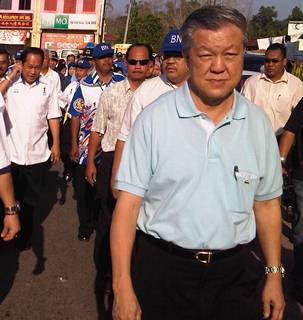 It is learnt that the anti-Chua forces within the party are converging to sabotage the proposed EGM as the first step to building up the momentum necessary to challenge Chua's (
left
) leadership in the coming party polls.
It is learnt that the anti-Chua forces within the party are converging to sabotage the proposed EGM as the first step to building up the momentum necessary to challenge Chua's (
left
) leadership in the coming party polls.
According to party insiders, supporters of former presidents Ong Tee Keat and Ong Ka Ting - both defeated by Chua in the 2010 party elections - as well as Ka Ting's elder brother Ka Chuan, who lost the contest for deputy president, have been eyeing an opportunity to make a comeback.
"The Ong brothers and Tee Keat still control some 600 to 700 delegates. Chua may not get the two-third supports at the EGM should they join forces," said a party leader who declined to be named.
"Chua's men are now lobbying the supporters of Tee Keat and the Ong brothers."
MCA has 2,377 central delegates and Chua needs win the support of at least 1,585 delegates to pass the two-thirds threshold.
From 42 to 36 months
Under its constitution, the party can only decide whether to postpone its polls if it is due 42 months after the last general election. But the next party elections is due next month, when it will be only 36 months after the March 2008 general election.
The MCA therefore needs to amend its constitution if it wants to shorten the existing requirement to defer the party polls to 36 months.
Although the CC had decided to postpone the party elections at a meeting last December, on the grounds that MCA unity and stability needed to be further consolidated ahead of a possible early general election, dissidents see it as a tactic by Chua to strengthen his grip on the party.
"It is less than a year since Chua took over the presidency. He wants more time to build up his support base, especially for his son Tee Yong," a critic of Chua said.
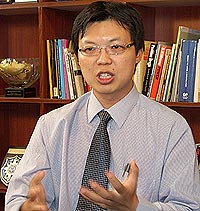 Tee Yong (
right
) joined MCA several months before contesting in the 2008 general election. Despite being a new face in the party, he rose quickly and was made a deputy minister, after Chua successfully took over the party leadership.
Tee Yong (
right
) joined MCA several months before contesting in the 2008 general election. Despite being a new face in the party, he rose quickly and was made a deputy minister, after Chua successfully took over the party leadership.
Tee Yong also inherited his father's Labis parlimentary seat after the senior Chua resigned over a sex tape scandal.
Some party members believe Chua's failure to woo Chinese support in last month's by-election in Tenang, which happens to be his power base, has eroded his authority within the party, making him vulnerable in the coming party polls.
Should the constitutional amendment be defeated at the EGM, it could be translated into a no-confidence vote against Chua, turning him into a lame duck president and sparking another round of infighting.
However, if Chua is able to sail through the EGM, not only can his presidential tenure be prolonged; he will have earned more time to consolidate his support.
Alternative less risky way
However, Chua has a less risky alternative - to hold March the branch and division elections as scheduled and then postpone the one for the central leadership to September.
The party constitution allows the contest for central leadership in September to be deferred, as it will fulfil the 42-month condition.
However, the downside is that Chua and his supporters will have to fight an early battle in the branch and division elections, which could also decide the central delegates who have the right to choose the central leadership.
The grassroots-level elections could also see intense contests among rival factions, with even the danger of again tearing the MCA apart.
But it could also allow Chua to remain unchallenged until the next general election is over. Thus, how the MCA performs in the coming general election will have a crucial bearing on Chua's leadership of the party.
How Chua will solve this Catch-22 situation will only be known at the CC meeting later this afternoon.
The meeting will decide whether an EGM should be called to amend the party constitution or to adopt other alternatives to defer the party polls.


Report this comment
Are you sure you want to delete this comment?
This action cannot be undone.