




New movement to revive Sabah languages takes off
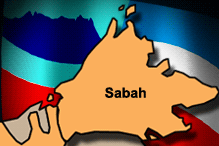
Sabah’s 30-odd fast-dying languages and dialects may get a much-needed shot in the arm with the formation of a federal government-funded body. At present, most of the KadazanDusunMuruts and other natives in the state speak the unofficial Bahasa Sabah at home.
Sabah’s 30-odd fast-dying languages and dialects may get a much-needed shot in the arm with the formation of a federal government-funded body. At present, most of the KadazanDusunMuruts and other natives in the state speak the unofficial Bahasa Sabah at home.
Bahasa Sabah, like the Iban-derived Sarawak Malay, is a local version of Malay distinct from the Johor-Riau-based standard Bahasa Malaysia.
 “We have already finalised a movement to revive the dying native languages of Sabah,” confirmed noted Dusun cultural activist Raymond Boin bin Tombung, 59, in an exclusive interview with
Malaysiakini
. “However, we have yet to settle on the name, pending the level of federal government funding support.”
“We have already finalised a movement to revive the dying native languages of Sabah,” confirmed noted Dusun cultural activist Raymond Boin bin Tombung, 59, in an exclusive interview with
Malaysiakini
. “However, we have yet to settle on the name, pending the level of federal government funding support.”
A memorandum to the federal government on the new movement is already in the works.
The new movement’s mandate differs from the Kadazandusun Language Foundation (KLF). Kadazandusun, it’s pointed out, is standard Dusun based on the Bundu and Liwan dialects and taught in schools in Sabah since the mid-1990s.
 The new movement met in Tuaran on July 16, and will meet again in Kota Kinabalu next week.
Tombung ( left ) and his multi-religious group are working with a Sabah senior federal government leader, along with state and community leaders, on the new movement. He is also a member of the Borneo Heritage Foundation’s (BHF) Bahasa Sabah Dictionary sub-committee. BHF is headed by Sabah strongman Jeffrey Kitingan.
Tombung has been through the whole gamut of education, media and publishing, and is currently a private consultant.
‘Modest funding’
The Sabah state government is expected to chip in with some funding for the movement, says Tombung, but it will only be a fraction of the annual RM1.6 billion the federal government spends on Tamil and Chinese education.
“I don’t want to hazard any figures at this juncture. But the initial funding request will be quite modest based on the number of activities planned for the first year,” said Tombung.
 Tombung also hopes to get aid from the United Nations Educational, Scientific and Cultural Organisation (Unesco) with the endorsement of the federal and state governments.
Initial activities will focus on setting up Language Nests in all districts to teach children their respective mother tongue with the active support and participation of their elders.
He says the Language Nests will be modelled after similar movements amongst the Punana Leo of Hawaii and the Maori of New Zealand.
In Tombung’s view, too much time has already been spent on merely writing and organising seminars on the issue. It was time to, “work on this serious job of reviving our dying languages without any foot-dragging,” he said.
Tambong thinks the numerous ethnic associations in the state will welcome the movement and can be counted on to work together with him on a project-to-project basis and on documentation work.
He has been in contact with them by email and so far “the response has been encouraging”.
Elsewhere, he’s also counting on the support of the federal government-funded Dewan Bahasa dan Pustaka, which has so far been promoting only standard Bahasa Malaysia.
Too late for some
Sadly, the battle of the local languages and dialects in Sabah may have already been lost in many cases, or may be a losing battle.
Tombung cites a Dusun tribe, the Lotuds of Tuaran, as a case in point. He doesn’t know of any family still speaking the dialect. “The remaining speakers are grandparents,” he lamented. “The communication between parents and children in Lotud is almost (never) heard.”
 The bottom line is that Lotud as a dialect will die out in Tuaran when the grandparents and the parents pass on.
“This situation is not unique to the Dusun tribes and Muruts, but is also true of the other non-Dusuns,” said Tombung. “Some examples include the Bajau or Sama, Irranun and Kadayan - all Muslims - and Lundayeh which is the same as the Lun Bawang (formerly Murut) of Sarawak and the Tidong.”
English, Mandarin and Bahasa Malaysia have also taken away the importance of local languages and dialects. Bahasa Malaysia in particular, it is noted, serves as the medium of local communication nationwide and in schools, despite having no economic value, unlike English and Mandarin.
In Sabah, Bahasa Sabah is long-entrenched in spoken communication and even during business and office meetings.
Rights under UN charter
Dusun newspaper columnist Joseph Yabai, who writes in English, is enthusiastic about Tombung’s movement.
“The United Nations, under its charter, has various articles on the rights of the indigenous peoples in the world,” said Yabai. “The rights include the transmission to future generations their histories, languages, oral traditions, philosophies, writing system and literature.”
He recalled that it was the Christian missionaries in Sabah who first made an attempt to preserve local languages and dialects through prayer in written form, worship, music and in song.
“In later years, the tendency among the faithful was to use religious books in Bahasa Indonesia,” said Yabai. “Local languages and dialects were neglected.”
It is noted that the Christian Bible in Sabah today is in Bahasa Malaysia and English. There is no version of the Bible in any local language or dialect. However, Catholic mass in Kadazandusun survives.


Are you sure you want to delete this comment?
This action cannot be undone.