




Fed's water figures 'serve only interested parties'
The federal government's claims that water supply in Selangor will be running dry by 2014 are based on projections set by vested interests.
The federal government's claims that water supply in Selangor will be running dry by 2014 are based on projections set by vested interests.
Klang DAP parliamentarian Charles Santiago ( left ) explained that the figures cited by both the federal and state governments in its recent spat over the construction of the Kelau Dam project to pipe water from Pahang to Selangor rely on two different methodologies.
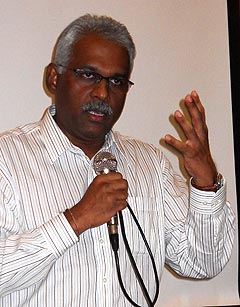 The issue of the depleting supply of water in Selangor which also caters to the federal territories of Kuala Lumpur and Putrajaya is a source of contention between the federal and state government.
Energy, Green Technology and Water Minister Peter Chin Fah Kui said that based on the National Water Resources Study Report (NWSR) 2000-2050 published by the Economic Planning Unit (EPU) it is projected that Selangor, Kuala Lumpur and Putrajaya would have to deal with a water crisis by the end of 2014.
This is because water demand in Selangor, Kuala Lumpur and Putrajaya is projected to increase to 4,907 million litres per day (mld) against the capacity at 4,431 mld, he said, adding that this would create a shortage of 476 mld, Chin said.
In a press conference in Klang today, Santiago pointed out that the NWSR figures were based on "highly inflated estimates" and the report was sponsored by three main players in the water industry - Ranhill Bersekutu Sdn Bhd, SMHB Sdn Bhd and Jurutera Perunding Zaaba Sdn Bhd.
These companies are also believed to be "directly and indirectly" linked to the raw water transmission project from Pahang to Selangor.
According to him, the NWSR is also "radically different" from the Design Guidelines for Water Supply Systems published by the Malaysian Water Association (MWA) in 1994.
The MWA guidelines was adapted from the Public Works Department (JKR) Design Criteria and Standards for Water Supply Systems published in 1989 as a recommended method for estimating water demands in the country.
Khalid's argument based on MWA guideline
These guidelines were also the basis to Selangor Menteri Besar Khalid Ibrahim's counter-argument that the state has enough water until 2019.
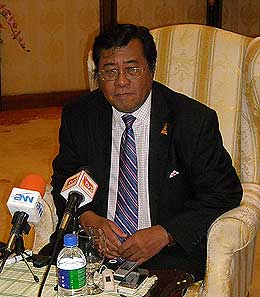 "We wanted to resolve all water issues with the federal government as soon as possible but the federal government feels that the (Selangor) water restructuring and the supply from Pahang are two different things," Khalid (
right
) had said.
"We wanted to resolve all water issues with the federal government as soon as possible but the federal government feels that the (Selangor) water restructuring and the supply from Pahang are two different things," Khalid (
right
) had said.
However, the NWRS has sidelined the recommended method and instead used a method that excessively inflates the per capita water consumption figures, said Santiago.
"For example, the NWRS is suggesting that water demand in 1995 was about 400 to 657 litres per capita per day; and in 2010 this will increase up to 500 to 1,224 litres per capita per day and in 2050 it will reach an estimate of 729 to 1,077 litres per capita per day," he said.
This estimates were "far higher than and double the maximum estimates" of the Design Guidelines for Water Supply Systems 1994, he added.
The figures cited by NWRS are based on these variables:
• Estimate the projected national GDP (Gross Domestic Product) growth for 2000 to 2050
• Calculate the projected per capita GDP (whole country)
• Estimate the projected total GDP of each state in peninsular Malaysia
• Estimate the “Manufacturing Value-Added (MVA)” component in the estimated total state GDP
• Calculate the estimated total gross value of manufacturing output for each state from the MVA
• Estimate the projected total cost of industrial water, for each state from the estimated total gross value of manufacturing output
"The variables were designed in such a way that it is based on an upward trend, which is in contrast to the GDP growth in recent years which were lower than estimated ," said Santiago.
"In this case it should be consumption should be lower, but instead it's higher," he said.
Climate change, the ultimate decider
However, it is more crucial at this juncture for both governments to look at water conservation rather than predicting and arguing about the state's water supply drying up, stressed Santiago.
"Climate change will ultimately decide whether we will have water shortage... weather patterns all over the world are changing, in China rainfall has dropped from 50 percent to 40 percent," he said.
In Malaysia, 97 percent of drinking water comes from rivers and streams but most of these are polluted, said Santiago.
"Excessive logging needs to stop, we have to gazette forest reserves and catchment areas and we have to start rain water harvesting which can save up to 40 to 80 percent from water bills.
"The way we use water is as if there is no tomorrow," he concluded.
Oxford grad MPs clash over sand and water
Water shortage threats 'mere scare tactics'


Are you sure you want to delete this comment?
This action cannot be undone.