




Tearful memories of May 13
special report Tuesday of May 13, 1969, is still vividly remembered. Those caught in the middle of the fateful day will never forget the eruption of racial violence that shocked the nation.
special report Tuesday of May 13, 1969, is still vividly remembered. Those caught in the middle of the fateful day will never forget the eruption of racial violence that shocked the nation.
The country was then barely more than a decade old and was rapidly soaring economically after independence was achieved in 1957.
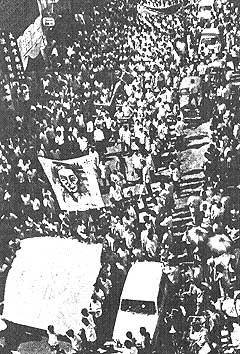 Outwardly it looked like everything was fine. But three days after the general election in 1969, blind rage conquered the streets of Kuala Lumpur.
Dead bodies piled on the corners of the streets, public vehicles, shops and houses were burned to the ground, and hundreds were maimed.
Days afterward, the streets were silent with the people afraid to emerge from their homes, counting their dead, nursing the wounded and agonising over missing family, relatives and friends.
The international magazine Time reported on May 23, 1969: “Malaysia’s proud experiment in constructing a multiracial society exploded in the streets of Kuala Lumpur last week. Malay mobs, wearing white headbands signifying an alliance with death, and brandishing swords and daggers, surged into Chinese areas in the capital, burning, looting and killing.
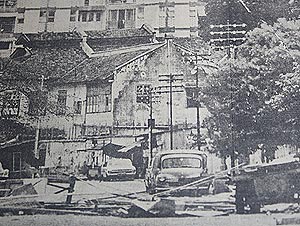 "In retaliation, Chinese, sometimes aided by Indians, armed themselves with pistols and shotguns and struck at Malay kampongs. Huge pillars of smoke rose skyward as houses, shops and autos burned.”
A 66-year-old retiree of the then National Electricity Board (LLN, now known as Tenaga Nasional Berhad) from Kampung Baru was in the thick of things that day.
The sexagenarian, who wanted to remain anonymous to protect his privacy, said that he was the founder of Kampung Baru's Umno division.
'Both sides equally cruel'
H
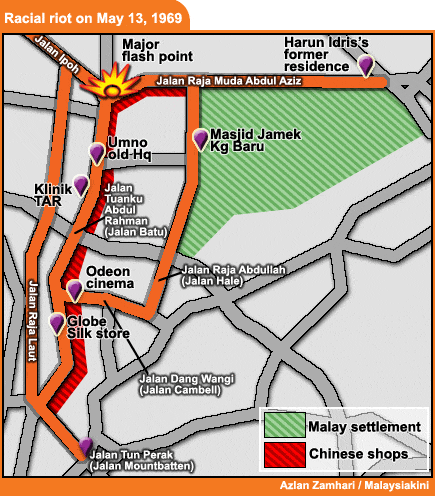
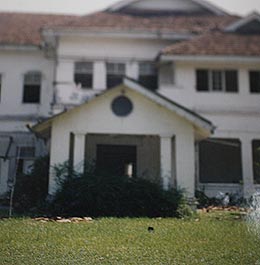 e was then 25. He said the Malays had gathered at the then menteri besar Harun Idris' residence (
right
) for a victory celebration as the Alliance had maintained its majority in Parliament, albeit a reduced one, and had retained Selangor with the support of the single independent assemblyperson.
e was then 25. He said the Malays had gathered at the then menteri besar Harun Idris' residence (
right
) for a victory celebration as the Alliance had maintained its majority in Parliament, albeit a reduced one, and had retained Selangor with the support of the single independent assemblyperson.
“A Land Rover with four Indian men bearing the flag of a cow head from Parti Rakyat Malaysia passed by the menteri besar's house, egging the MB to come out of the house.
“Those gathered lost their patience, stopped the vehicle in its track and mercilessly slashed the four Indians on the spot with parang (machetes).”
Their atrocities were, however, not as cruel as what the Chinese had committed against the Malays, he defended.
“A husband and wife couple were hung on a tree to die, and prior to that tortured and dismembered by the Chinese.
“The Malays were furious, because they had earlier received news that Malay couples were being butchered at Rex theatre and at the Central Market.”
But he felt compelled to do what he could, and hid his Chinese neighbour in his house. Indeed some of the Malays in Kampung Baru acted similarly.
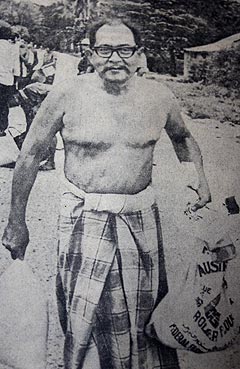 As horrifying and gruesome as it was, May 13 brought the Malays together, he said, adding that he had no wish to seek revenge for the dead.
“It was their destiny to die... the only thing after that is for years we had to be careful when we stepped outside.”
He was afraid that children who had lost their families would want to seek vengeance but as time passed, he felt that the desire for revenge had faded away.
He is proof of that.
“I have adopted two children - one Chinese and one Indian. Today, only a fool will be deceived if this issue is politicised.
“I regret the incident for its violence and killings. Let's forget about May 13 in hopes of a more peaceful and prosperous life.”
'Alliance losses taken badly '
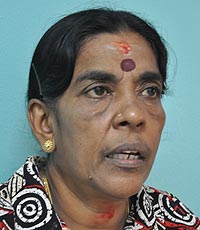 Sixty-year-old Renumathi Suppiah (
left
), who was a young salesperson then at the once renowned Globe Silk Store on Jalan Tuanku Abdul Rahman, recounted her May 13 experience.
Sixty-year-old Renumathi Suppiah (
left
), who was a young salesperson then at the once renowned Globe Silk Store on Jalan Tuanku Abdul Rahman, recounted her May 13 experience.
”My elder sister's engagement was scheduled for the evening but we had to go to work because it was just after the general election.
“It was business as usual that morning but there was some uneasiness. It was the first time the opposition won a lot more than expected.”
(In the 1969 general election, the Alliance shockingly won only 66 parliamentary seats out of the 104 seats, while 13 were bagged by DAP, 12 by PAS, eight by Gerakan and four by PPP.)
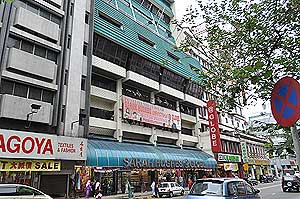 “Some of my Malay friends in my department were upset... they felt that the other races had not supported the Alliance,” said Renumathi, who was barely 19 at that time.
It was not acceptable for anyone to turn their backs against the national coalition because it was through unity Malaysia achieved independence, she explained.
“But we thought it was just talk although some people were angry. The only out of the ordinary thing - we noticed there were many Malays purchasing black-and-red materials that day.”
Surprisingly, the store decided to shut down much earlier than usual and locked up before even accounts were tallied, she said.
'Saved by Malay cabbie'
“I remember that two other girls - one Malay and one Chinese - were with me and we waited for a very long while for the bus, but it never showed up. A relative of mine then passed by and suggested that we take a taxi home.”
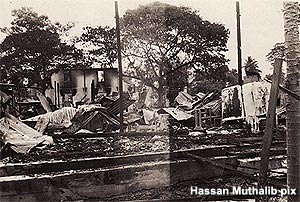 Renumathi lived at Kampung Pandan, a multiracial residential area, about 7km from central Kuala Lumpur.
“As we approached the junction turning into Kampung Pandan, the row of shops and buses parked nearby were roaring with fire. That was when we heard screams from inside the shops.
“As the taxi slowed down from all the commotion, all of sudden Malays armed with parang surrounded us and demanded to know where we were going.
“Luckily for us then the taxi driver was a Malay and he said that all of those in the car were Indians. But we had to walk from that point onwards and my Chinese friend managed to sneak away.
“Only when I got home, my brother told me the whole story. He was trying to reach me since morning but my bosses had cut the call. My sister’s engagement was postponed till after the emergency was lifted.”
Despite retaining her composure throughout the conversation, her memories of lost neighbours and friends brought her to silent tears.
May 13 special reports by Kuek Ser Kuang Keng, S Pathmawathy, K Pragalath, Zulaikha Zulkifli and Puteri Aida Haryani.


Are you sure you want to delete this comment?
This action cannot be undone.