




M'sia may be the next Greece, warns economist
While protestors gather in Kuala Lumpur to oppose to the goods and services tax (GST) today, the National Economic Advisory Council (NEAC) is mulling over how best to go about it.
While protestors gather in Kuala Lumpur to oppose to the goods and services tax (GST) today, the National Economic Advisory Council (NEAC) is mulling over how best to go about it.
According to council member and London School of Economics (LSE) professor Danny Quah, the council is proposing a reduction in corporate and income tax to soften the blow of the GST.
"We are proposing to drop one percent of corporate and income tax every year for the next three to five years, while at the same time implementing a broad-based tax like the GST," he said.
In addition to that move, he said, the needs of roughly 80 percent of Malaysian workers who do not earn enough to pay income tax will be catered for through rebates.
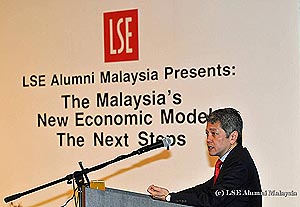 Speaking to reporters after addressing the LSE alumni in Kuala Lumpur last night, Quah (
right
) said that this is among the tax reform measures considered for the final version of the New Economic Model (NEM) due in June.
Speaking to reporters after addressing the LSE alumni in Kuala Lumpur last night, Quah (
right
) said that this is among the tax reform measures considered for the final version of the New Economic Model (NEM) due in June.
A broad overview of the NEM, was unveiled on March 30, with the council currently collecting multi-stakeholder feedback to inform the final version, which will be announced with the 10th Malaysia Plan.
Quah ( right ) added that as a country with a narrow tax revenue base, Malaysia has no choice but to implement the GST as a long-term solution, with a view to gradually raising the rate.
As a long-term venture, he said, it is acceptable if the initial implementation at four percent only serves to neutralise the sales and services tax and does not generate extra income.
"There has been political opposition to the GST but this is something we desperately need because the traditional steady sources of revenue are literally drying up," he said.
He added that lower personal and corporate income tax can encourage savings and investments, while GST provides a reliable stream of income.
That way, Malaysia can use the revenue from natural resources to invest in human capital and capacity building, he said.
High debt-to-GDP ratio
Taking a question from the floor about political will, Quah said that he is positive that the government will undertake economic reforms even in the face of short-term pain.
"Everybody expects no political will on the most dramatic reforms, so I am impressed that that the political leadership does not want to take the easy way out which has been prepared by the pessimism and negative reports," he said.
In his presentation, Quah said that among the more urgent matters which need to be addressed is the government debt-to-GDP ratio.
He said that with the fiscal stimulus, Malaysia's ratio is heading towards 70 percent in 2015 and is on an upward trajectory.
 If the reforms are not in place and the economy is not weaned off the fiscal stimulus, the Malaysian economy may face issues similar what Greece is facing.
"Greece is in trouble, among other reasons, because their debt-to-GDP ratio is 130 percent.
"With (the sort of trajectory), it would not be long before we head into the region of the PIGS countries," he said.
PIGS is an acronym referring to Portugal, Italy, Greece, Spain, and more recently the Ireland and the UK, which are all facing issues of high government debt and deficit, relative to GDP.


Are you sure you want to delete this comment?
This action cannot be undone.