




GST U-turn will 'drive away investors'
Despite being on different sides in the Goods and Services Tax (GST) debate, economists and academics are in agreement that flip-flopping by the government will only drive away investors.
Despite being on different sides in the Goods and Services Tax (GST) debate, economists and academics are in agreement that flip-flopping by the government will only drive away investors.
 Last Saturday, Second Finance Minister Ahmad Husni Hanadzlah announced that the second reading of the GST Bill will not be done during the current parliamentary session, in order to give the government time to
gather public feedback
.
Last Saturday, Second Finance Minister Ahmad Husni Hanadzlah announced that the second reading of the GST Bill will not be done during the current parliamentary session, in order to give the government time to
gather public feedback
.
The surprise postponement joins a series of policy U-turns by the administration over the past few months, including the scrapped fuel tier-subsidy scheme and changes to the real property gains tax.
According to Ratings Agency Malaysia chief economist Yeah Kim Leng, investors will read the postponement of debate on the GST Bill as a sign that the government does not have the ability to make tough decisions.
Yeah said that investors look to the government for clear direction, and that a wavering government cannot instil confidence particularly in a recovering economy.
The government should carry out the necessary reforms to ensure economic resilience in facing fiscal challenges, he said.
 USM Deputy Dean of Social Sciences P Sivamurugan
(right)
agreed, saying that investors want smooth implementation of practical policies.
USM Deputy Dean of Social Sciences P Sivamurugan
(right)
agreed, saying that investors want smooth implementation of practical policies.
Richard Yeoh, the collaborations and governance director at Research for Social Advancement, was more forthright.
“If they don't have the capacity to develop policy, then they should consult the private sector for further input,” he said.
Saturday’s announcement, he said, reflects lack of thinking and planning on the part of policy makers.
“(But) this should not come as a surprise, as it seems to be the standard operating procedure,” he said.
Jeyapalan Kasipillai, the deputy head of Monash University’s School of Business, attributed the government’s change of heart to “lack of courage” resulting from its uncertainty about public support for the Bill.
 Political economy analyst Khoo Kay Peng
(left)
pointed out that a study should have been done earlier.
Political economy analyst Khoo Kay Peng
(left)
pointed out that a study should have been done earlier.
Added Yeah: “We need to think through the policy first before it is announced. Otherwise confidence (in the government) would be eroded. Gather feedback, (do) research and just go ahead with (implementation).”
Bid to win votes?
The timing of the postponement has also raised speculation that the decision was made with a general election in mind.
“The U-turn may have been made to win votes in the next election, as the GST is not a popular policy,” said Sivamurugan.
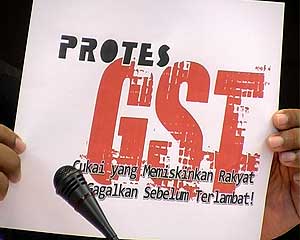 Analysts are not convinced that the reversal was solely due to public pressure, in particular from Pakatan Rakyat and Protes, the anti-GST coalition that had threatened to hold a mass demonstration yesterday before
calling it off
.
Analysts are not convinced that the reversal was solely due to public pressure, in particular from Pakatan Rakyat and Protes, the anti-GST coalition that had threatened to hold a mass demonstration yesterday before
calling it off
.
“It could be due to a combination of the pressure mounted from the planned protest and the need to garner public feedback,” explained Yeah.
Sivamurugan speculated that there may have been conflict within the Finance Ministry itself.
Noting that the Bill has not been abandoned, Jeyapalan advised the government to use the intervening time to convince the people about its usefulness.
Yeah said one way to win support is to clarify the objectives and to paint the bigger picture of GST.
“The government needs to (factor in) the concerns of stakeholders, and ensure that the public understands the objectives and consequences of policies,” he said, adding that policies that affect livelihood are usually tougher to implement.


Are you sure you want to delete this comment?
This action cannot be undone.