




Teoh Beng Hock 'possibly' choked before fall
Sungai Buloh hospital head pathologist Dr Shahidan Md Noor was today drilled by two lawyers on the possibility that Teoh Beng Hock was choked or strangled before falling from Plaza Masalam, Shah Alam, on July 16 last year.
Sungai Buloh hospital head pathologist Dr Shahidan Md Noor was today drilled by two lawyers on the possibility that Teoh Beng Hock was choked or strangled before falling from Plaza Masalam, Shah Alam, on July 16 last year.
He was asked by Gobind Singh Deo, the lawyer for Teoh's family, and Selangor government counsel Malik Imtiaz Sarwar as to whether that possibility could explain the mysterious circumstances surrounding Teoh's death a day before his wedding.
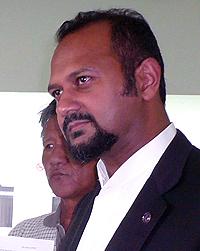 Replying Gobind (
right
), Shahidan agreed that Teoh could have been choked or tortured before he fell from the 14
th
floor of Plaza Massalam.
Replying Gobind (
right
), Shahidan agreed that Teoh could have been choked or tortured before he fell from the 14
th
floor of Plaza Massalam.
"It was a possible scenario but not probable," said the doctor, who performed the second post-mortem on Nov 22 last year.
Shahidan was asked by Malik and Gobind to explain the red mark (which stretches from the left of Teoh's neck to the right), after being shown a photo from the first post-mortem. The mark was clear, as stated in his report.
Agreeing that it was not stated in the first post-mortem report, Shahidan also concurred that this was a serious omission on the part of the two pathologists who performed the first post-mortem.
Teoh, 30, a political aide to Ean Yong Hian Wah, was found dead on the fifth floor of Plaza Masalam, where the Selangor office of the Malaysian Anti-Corruption Commission is located.
The night before, he had given a witness statement on alleged abuse of allocations for state assemblypersons in Selangor.
'Crucial to examine neck bruises'
The Sungai Buloh chief pathologist agreed that looking at the bruises on the neck was an important factor to consider in the case.
The first two post-mortems were done by Dr Khairul Azman Ibrahim of the Klang Hospital and Dr Prashant Naresh Samberkar of the Universiti Malaya Medical Centre, Kuala Lumpur.
Shahidan noticed there was a hemotoma suggesting a haemorrhage as a result of force being appied to the neck.
"There was also a left platysma muscle contusion on the left side of the neck and also similar but smaller signs on the right (side of the neck)," he agreed in looking at his report.
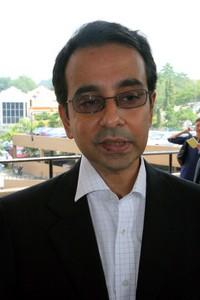 "This implies there was some form of oxygen deprivation to the blood. Contusion of the platysma could be a sign of choking or strangulation," he told Malik (
left
).
"This implies there was some form of oxygen deprivation to the blood. Contusion of the platysma could be a sign of choking or strangulation," he told Malik (
left
).
The platysma muscle is located on the neck and runs up to the chest and collarbone. It assist's a person's facial expressions.
Shahidan ruled out Teoh's death as a result of strangulation or choking, as there was no clear indication of petechial haemorrhages.
"If there was petechial, there would be signs of grimace that would be prevalent in the platysma muscle," he said, adding the bruise to Teoh's tongue also does not indicate it could be as a result of strangulation.
 However, the witness agreed there was a possibility that Teoh (
left
) may have been choked before the fall, but said it did not cause his death.
However, the witness agreed there was a possibility that Teoh (
left
) may have been choked before the fall, but said it did not cause his death.
He agreed that the deprivation of oxygen to the brain may result to someone fainting or collapsing.
When answering Malik's questions, Shahidan explained the injuries as a result of the fall, but could not explain the cause of the red bruise to the neck.
He maintained that Teoh's injury was consistent from falling from a high place. Teoh, he said, fell on his feet first, and landed on the right side of the chest and face.
"This was done through a simulation done from a CT scan performed on Teoh's body," he said, denying Malik's suggestion that Teoh may have fallen chin first, resulting in the fracture of the third and fourth backbone behind the neck.
First post-mortem 'not prudently done'
Earlier, Shahidan agreed that the first post-mortem on Teoh may not have been done in a prudent and competent manner.
He made his reassessment after 40 minutes of questioning, after having earlier defended the two pathologists who conducted the first post-mortem.
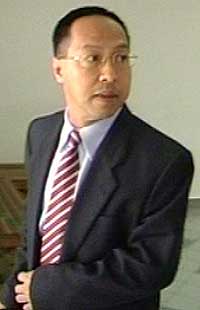 Shahidan (
left
) said that in any death-in-custody case, two procedures have to be observed:
Shahidan (
left
) said that in any death-in-custody case, two procedures have to be observed:
1) Examination for evidence of pressure imposed on the neck, such as signs of strangulation
2) Dissection of limbs and certain muscles would need to be carried out to ascertain whether there were beatings
He agreed with Gobind that if such procedures were not observed in post-mortems into custodial deaths, it could suggest a possible cover-up.
Shahidan confirmed he had been briefed about Teoh's case. He determined there are three likely causes of death, either:
- Teoh had died in custody; or
- he was thrown out of the window or
- he had jumped out of the window.
In this case, Shahidan said limb dissections were not done during the first post-mortem. However, he performed this during the second post-mortem.
"I also discovered some superficial marks on Teoh's neck," he said.
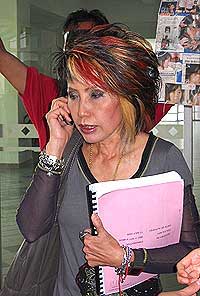 This finding was missing in the first post-mortem report, Pornthip (
right
) spotted it.
This finding was missing in the first post-mortem report, Pornthip (
right
) spotted it.
Pathologists carrying out the first post-mortem did not do the dissection of the limbs and muscles as efforts were concentrated on the neck, chest and abdomen.
The Sungai Buloh pathologist was at a loss for words when Gobind pointed out the two pathologists who performed the first post-mortem did not spot the superficial bruise marks on the neck while Pornthip was able to do from a photo taken during the first post-mortem.
Gobind said that, if it were not for Pornthip, the marks would not have been noted.
Throughout the session, Shahidan defended the two pathologists. He described the first post-mortem report as the best possible, but later agreed that proper protocol had not been followed when it was performed.
In the end, he also agreed that his post-mortem examination was more detailed.
Shahidan, at the last hearing, had listed Teoh's cause of death as due to a fall from a high place.


Are you sure you want to delete this comment?
This action cannot be undone.