




Women say caning 'good' for them
Three Malaysians who became the first women to be caned under the country's Islamic laws said they "deserved" their punishment and that it would help stem sex outside marriage.
Three Malaysians who became the first women to be caned under the country's Islamic laws said they "deserved" their punishment and that it would help stem sex outside marriage.
The three women were caned for having sex out of wedlock in a move that has angered human rights activists and some lawyers who say the punishments are illegal in this mainly Muslim country that runs parallel civil and Islamic justice systems.
"I deeply regret my actions as I should have married before having sex," the New Straits Times newspaper quoted one of the women who it said was aged 17, as saying in its Friday edition.
The newspaper did not reveal the women’s real names and a picture showed the three clad in traditional Malaysian dress and headscarves seated before reporters.
The 17-year-old said that she had become pregnant and gone into labour while at school, losing the baby, and then had turned herself in to the authorities last December.
A second woman said she had to support her family after her father left home and had a three-year-old daughter out of wedlock. She said that she too turned herself in due to feelings of guilt.
"On the day I was caned, I was scared but, at the same time, I knew I deserved it and was willing to take the punishment," said one of the women, a 25-year-old who went by the name of 'Ayu'.
She told NST that the punishment - administered while they were fully clothed and by a female prison officer wielding a thin rattan cane - did not hurt.
"Those out there who are having sex before marriage should really consider the consequences and not only think about momentary pleasure," she told the daily.
The three women said they turned themselves in to religious authorities after being wracked by guilt over having pre-marital sex.
'Ayu' has a one-year-old daughter with her boyfriend, who she plans to marry.
All three women were caned on Feb 9 and the punishments were announced by Home Minister Hishammuddin Hussein on Wednesday.
Hishammuddin said they were "carried out perfectly".
The punishment of six strokes of the rattan is carried out while they are seated. The person administering the punishment is not allowed to raise their arm above shoulder level.
"Even though the caning did not injure them, the three women said it caused pain within their souls," Hishammuddin said.
Political stress
The caning has received widespread support from Muslim groups in this Southeast Asian country of 27 million people where around 55 percent of the population is Malay and Muslim.
"The guilty have also repented and there is no proof of injuries at all. What is the problem now?" Fadhalina Sidek, vice-president of the Islamic Youth Movement was quoted as saying on the Malaysian Insider website.
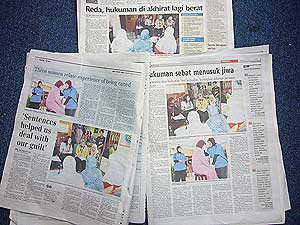 Caning is used in Malaysian prisons for other crimes.
The sentences were, however, criticised by human rights advocates and by some lawyers.
Former law minister Zaid Ibrahim called Malaysia a "lawless" state on his Facebook page and said federal laws precluded women from being caned.
Human rights campaigners, who were stunned by the caning of the three women which had not been foreshadowed by authorities, were sceptical over the comments published in several Malaysian newspapers.
"These three women are just normal people who have been surrounded by all kinds of legal mumbo jumbo and pressured into agreeing to be caned," said one activist, declining to be named because of the sensitivity of the issue.
The canings were carried out at a time when some political commentators have warned of a rising tide of Islamicisation in this traditionally moderate Muslim country.
The government that has ruled Malaysian for 52 years stumbled to its worst ever election losses in 2008 and has lost the support of ethnic Chinese and Indian voters who have been further unnerved by a spate of attacks on churches.
It is now competing for the votes of Malays with an opposition Islamist party that advocates setting up an Islamic state with an Islamic judicial system.
At the same time as the government battles the opposition for votes, it is trying to woo foreign capital to boost economic growth here after foreign investors withdrew US$35 billion between the second quarter of 2008 and the second quarter of 2009.
An earlier caning sentence on a woman for drinking beer that has not yet been carried out triggered concern among foreign investors who questioned Malaysian prime minister about the issue when he spoke to fund managers in New York last year.
- Agencies


