




Federal Court rules no extra evidence for Anwar
Opposition leader Anwar Ibrahim has lost his final chance to get more key evidence such as CCTV footage and medical reports from the prosecution to prepare for his sodomy trial, which is to start next Tuesday.
Opposition leader Anwar Ibrahim has lost his final chance to get more key evidence such as CCTV footage and medical reports from the prosecution to prepare for his sodomy trial, which is to start next Tuesday.
Federal Court Judge Abdull Hamid Embong read the judgment for the three-member panel, led by Chief Judge of Malaya Arifin Zakaria, in dismissing Anwar's appeal and upheld the Court of Appeal's decision.
The Federal Court panel had on Jan 20 heard submissions on the matter from senior counsel Karpal Singh and solicitor-general II Mohd Yusof Zainal Abiden.
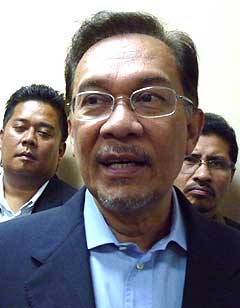 However, they could not arrive at a decision then, resulting in the announcement of the verdict today. The panel also ordered Anwar's sodomy trial to begin on Feb 2.
Abdull Hamid said the High Court judge had erred when he adopted a liberal meaning of section 51 and section 51 A of the Criminal Procedure Code. He said section 51 does not grant wide ranging application to get the document.
"Its scope is restricted in law. In our view, the high court judge went overboard in deciding to expand section 51 and had effectively changed the law by ordering the prosecution to provide the documents.
"Changes in the law is for the parliament to decide not the judiciary. Judges interpret the law and judges under the guise of interpretation should not provide their own preferred amendments to the statutes," he said.
On Nov 6, the appellate court allowed the prosecution's appeal when it ruled that the PKR de facto leader was not allowed to fish for information before his sodomy trial.
Justice Hasan Lah, who was leading the Court of Appeal panel, interpreted section 51 of the Criminal Procedure Code strictly and limited the judge's discretionary power with regards to the application for discovery of documents at the pre-trial stage.
No documents in pre-trial
On July 16, in a rare victory for Anwar, the high court ordered the prosecution to hand over evidence including video footage and medical reports to the accused.
Anwar, 62, is charged with sodomising his former aide, Mohd Saiful Bukhari Azlan, 24, at the Desa Damansara Condominium, in Jalan Setiakasih, Bukit Damansara on June 26, 2008.
Among the key documents sought were the recorded witness statements of Mohd Saiful and the condominium owner Hasanuddin Abdul Hamid, the examination notes of Dr Osman Abdul Hamid from Pusrawi Hospital, statements and notes of three doctors from Hospital Kuala Lumpur Hospital (HKL), a chemist's notes and medical reports.
It has been reported that the medical reports indicated that there was no sign of penetration of Saiful's anus. Anwar also wanted the CCTV footage of the condominium at the alleged time.
On July 16, High Court Judge Mohd Zabidin Mohd Diah allowed Anwar to obtain Mohd Saiful's medical report from HKL and the CCTV footage but rejected the application to obtain the original DNA specimens as they have been packeted and sealed.
Meanwhile, Abdull Hamid said the court ruled that Anwar wanted the documents and evidence at a pre-trial stage instead of during the commencement of the trial.
He said the stand taken by Karpal for the application to have the documents now was wrong.
Karpal had during submissions contended that the trial had started following Anwar's plea of not guilty.
Section 51 operates with limitation
In their considered view, Abdull Hamid said the application for discovery by Anwar was one made at the pre-trial stage and not made "in the course of the trial".
"At this stage, Anwar is only entited to documents and materials pertaining to the charge for him to understand and prepare his defence.
"We have looked at the authorities presented during submission including those from India and Singapore and found them united in holding that section 51 must operate within certain inbuilt limitations," he added.
The judge said the scope of the section is confined to the production of documents and materials which are "necessary or desirable" for the purposes of the trial.
Abdull Hamid said the lawyers however contended that the documentation was needed for Anwar to prepare his defence.
"But at this stage, the defence is not yet a relevant consideration for the court hearing this application. The appellant (Anwar's) application should not be turned into a mini trial to detemine his defence on the charge.
"A roving inquiry for evidence is not permissable during pre-trial. The appellant is not entitled to know by which way the prosecution intends to present the facts. This remains the prerogative of the prosecution," he said.
Abdull Hamid noted that the the trial judge had took into consideration of irrelevant matters for the basis of his decision.
Commenting on a point raised by co-counsel Param Cumaraswamy over human rights provision, Abdull Hamid said the court was reminded of the rights to equality and a person's right to a fair trial.
"In our view, the new provision under section 51A strengthens the guarentee of a fair trial in providing adequate facilities. This in our opinion has made the battlefield more level, to ensure fairness of a trial and uphold the integrity of the court," he added.
Dangerous precedent
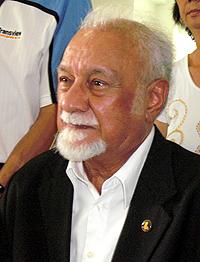 In an immediate reaction, Karpal said the defence will file for review of the decision on Tuesday.
He lamented that the Federal Court's rejection of the preliminary objection raised and also its ruling that such documents cannot be handed before the commencement of a trial had set a dangerous precedent.
In rejecting the preliminary objection, the apex court ruled that the high court's decision to give the evidence was appeleable.
Abdull Hamid said the order made by the high court was not an interlocutory order nor one that was made in the course of a trial as it stands on its own and hence appelleable.
Karpal said this goes against the spirit of section 3 of the Court of Judicature Act which was passed in 1988, where its purpose is to ensure smooth running of a trial without any interruption.
"The decision to reject our preliminary objection would open the floodgates for each and every case to contest decisions made while the matter is still under trial. This will prolong and delay hearings.
"The court has gone backwards to before the days of 1988 with this ruling," he added.


