




PM's pro-free trade stance a climate change risk
The Malaysian prime minister, like most other contemporary leaders, displays gross ignorance about both global economics and global ecosystems.
The Malaysian prime minister, like most other contemporary leaders, displays gross ignorance about both global economics and global ecosystems.
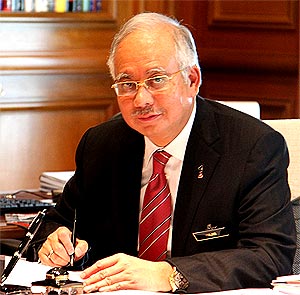
The prime minister is reported to have said in his keynote address to the Commonwealth Business Council in Trinidad and Tobago that:
 1. "Efforts to address climate change must be consistent with keeping global trade and investment open and free, without raising new barriers to trade and investment"
2. "Changes in industrial systems, business models, economic assumptions, market rules and governance frameworks to tackle the challenges posed by environmental degradation."
This type of position is a red-carpet invitation to environmental disaster.
Why?
Because the current economic development paradigm founded on unrestrained economic growth and trade at all cost is without dispute in direct conflict with climate stability and the prevention of biodiversity loss (biodiversity loss, among other things, reinforces climate change through the destruction of peat swamps and rainforests and the subsequent purging of vast amounts of carbon dioxide into the atmosphere).
The current economic-growth mania stems from the expansionist worldview that was born post-World War II. Economists now recognise that unmitigated economic growth and expansion may have been a valid thing to do under the 'empty world' scenario, when the Earth still had ample spare carrying capacity, abundant natural ecosystems and resources and excess capacity for assimilating pollution and waste.
We have approached the limits
But under the current 'full world' scenario, we have six billion human beings, a substantial portion of whom strive for American standards of living, even though the planet is considered now highly exploited and modified. Between one third and half of the planet's surface has been modified; more than a third of the ice-free surface of the earth has been converted for agriculture.
Water bodies have been pushed to the brink: overfishing depleted major oceanic fisheries, important rivers are polluted. Further damage to natural ecosystems threatens to upset hopes of sustaining the economic system into the future.
There comes a point where further exploitation and trade will result in reduced net human welfare, rather than any improvement in it (what can be called as growth that is actually 'uneconomic growth'). To quote the ecological economist, Herman Daly:
"Eventually a population having uneconomic growth reaches the futility limit, the point at which it is not adding any utility with its increased consumption. The futility limit may already be near for rich countries. In addition, a society may be felled by an ecological catastrophe, resulting in a huge increase of disutility. This devastation could happen either before or after the futility limit is reached."
Evidence indicates that in many parts of the world we have approached environmental limits that threaten to undo any economic welfare gains. This warning has been issued by the Millennium Ecosystem Assessment (MEA) carried out by the UN and others (for a summary of the findings, read here and here ). But the findings and recommendations of the MEA have not been seriously considered and acted upon by any government to date.
This is not new. A controversial book in the early 1970s called "Limits To Growth" warned of the approach of this situation in the 2000s but it was quickly dismissed by the hard-nosed mainstream economists. Since then, neoliberal economic policies have only accelerated economic exploitation at the expense of the Earth.
Thus it is dangerous and worrying when the Malaysian prime minister embraces the free trade dogma, with little reservation. The prime minister has shoveled praises on George Bush's extreme neoliberal economic stance and appears keen to emulate his economic approach for our country.
A gung-ho free trade thrust would spell not only serious environmental consequences for the nation, but also would aggravate socioeconomic inequities, especially under conditions of highly compromised institutional structures, or when institutions have been captured by the powerful few (the 'elite capture' problem).
Production, wealth and rents increase but it becomes concentrated in the hands of a few, whilst the realm of public goods and services diminishes (no more forests, just oil palm landscapes; water supply problems etc.).
These are economic aspirations detached from ecological reality.
The WTO, free trade and carbon emissions
The WTO is all for the "liberalisation" of trade, unrestricted and flourishing commercial trade. If a country seeks to restrict trade by imposing bans on imports or tariffs or quotas, because it wishes to protect its environment or local industries, action can be taken against this country through the WTO. Trade should not be hindered; corporations should be allowed to make money and provide job opportunities. This is the WTO position.
The prime minister's statement no. 1 mirrors this position.
But the point is missed that ever-increasing trade is a signal of ever-increasing economic production that is one of the major roots of the climate change problem. If excessive trade and all the carbon emissions linked to the increasing production of goods that drive trade is not controlled in som e way, how do you rein in greenhouse gas emissions and thereby climate change?
One of the major economists of the 20th century, John Maynard Keynes, whose theories helped the world lift itself out of the Great Depression, was himself of the opinion that we should only trade for the things we truly need and cannot make ourselves. To quote:
"I sympathise, therefore, with those who would minimise, rather than with those who would maximise, economic entanglement between nations. Ideas, knowledge, art, hospitality, travel - these are the things which should of their nature be international. But let goods be homespun whenever it is reasonably and conveniently possible; and, above all, let finance be primarily national."
Must we have ships burn fuel oil into carbon dioxide and traverse thousand of miles from China just to deliver us paperclips that we can produce by employing our own people? Why all that economic entanglement between nations at the cost of the environment and local labour? Why are we letting Goldman Sachs and another major (Chinese) bank into our financial system? Who benefits and who loses? Why no debate?
Why technological fixes won't do
It is argued by some that free trade can be compatible with combating climate change because 'green technology' will save the day.
But technological fixes only affect the efficiency with which good are produced or pollution is controlled. Even if we install expensive equipment (produced and sold by developed-world corporations) to cut carbon emissions in all the factories in the world by half (which itself is a big ask even by engineering standards), if world economic production and trade doubles (or if China quadruples its GDP by 2020 as it plans to), then we are back to square one or worse off.
What this tell us is this: that while technological fixes can help, it is a marginal factor. The primary lever for controlling climate change is not efficiency but the scale or size of trade and economic production itself, which can continue growing even beyond the limits of technological fixes. For a broader and clearer discussion on this, read this article entitled 'Can advances in science and technology prevent global warming'.
This shoots down the prime minister's statement no. 2.
What should be done then?
Leaving everything to markets as the WTO prefers is folly. This is because markets are unable to adequately provide public goods and services that are important for social welfare but which have no markets (clean air, a healthy atmosphere, natural forest ecosystems).
Government intervention is necessary
To prevent climate change from going out of control, we need to cap and moderate the scale or size of the human economy and not let it expand out of hand. This is why there is so much resistance by politicians and corporate groups to truly abating greenhouse gas emissions, because more growth means more profits for capitalists even if it is at the expense of society.
Relatively inexpensive technological adjustment is also necessary, but secondary to the above.
To encourage moderation in the use of resources, to reduce wastage, and minimise carbon emissions, new tax systems need to be instituted. One such tax system would involve taxing throughput (or input) into economic production, instead of raising income taxes on ordinary people. This would force manufacturers to create good that last, not goods that become obsolete, forcing consumers to buy again.
Another component of a new tax system could be the taxation of consumption of non-essential goods and services and of luxury goods. If someone wants to purchase goods whose production results in greenhouse gas emissions, they should bear the cost of the climate impact. It's only fair.
In relation to this, the GST tax may be a good thing because it taxes consumption but it must be designed to have a progressive and not a regressive effect. Income tax should be lowered for the working class if a GST is to be imposed, and essential goods and services should be excluded from GST.*
The important step of directly controlled greenhouse gas emissions by government regulation was recently taken by the Obama administration. The powerful Environmental Protection Agency (EPA) has been tasked to do this. It is a move to be lauded. Strangely, it is a move that has received little attention in the media.
This move is not without opposition. The pro-market libertarians and economic conservatives have called this "Green Fascism" and they have gone on to say that "US President Barack Obama sidestepped the democratic checks and balances of the US Congress, to have his Environmental Protection Agency administrator Lisa Jackson declare carbon dioxide a threat to “the public health and welfare of current and future generations” (I quote from an email I received on this morning).
What say you, Mr Prime Minister?
Note: A GST would be pointless if the taxed earnings are frittered away due to corruption or if they are not used to provide public goods and services for the people. A GST put in place with the goal of raising revenue would be an exercise in futility if more money is being lost elsewhere because of corruption.
'PAK SAKO' is an economist and an academic.


Are you sure you want to delete this comment?
This action cannot be undone.