




'Gov't must decide' on elimination of racism treaty
The government must decide on its priorities with regards to inking the 1965 International Convention of Elimination of All Forms of Racial Discrimination (ICERD).
The government must decide on its priorities with regards to inking the 1965 International Convention of Elimination of All Forms of Racial Discrimination (ICERD).
United Nations resident coordinator in Malaysia Kamal Maholtra said the government needs to decide internally and solve its constitutional contradiction before signing any UN convention.
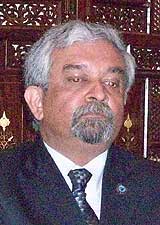 "Apart from Article 153, there is a clause that provides for the equality and freedom to its citizens, therefore the government needs to decide on its priorities," he told a press conference at the sidelines of a seminar in Kuala Lumpur yesterday.
Kamal was asked if the signing of ICERD will contradict with section 153 of the federal constitution which guarantees the special privileges of the bumiputera.
Nevertheless, he said the government is in fact looking into other aspects of the six conventions recommended by the UN which has not been signed by Malaysia.
In his speech earlier, Kamal disclosed that the government has only signed three and ratified two of the nine core international human rights treaties.
Malaysia has only signed and ratified the Convention on the Elimination of all Forms of Discrimination against Women (Cedaw) and the Convention on the Rights of the Child (CRC). Both were signed with reservations in 1995.
"In addition, Malaysia has also signed but not yet ratified the 2006 Convention on the Rights of Persons with Disabilities," Kamal said.
On the issue of sustaining human rights, the UN coordinator is of the view that a strong culture must be embedded within Malaysians and this should start with young children.
"Human rights education should also be a continuous effort and it would be best if the education curriculum entrenches human rights issues as well," he said.
Governments have reservations
Meanwhile, UN human rights officer Pablo Espiniella explained that some governments have reservations to sign and ratify conventions because of the fear that they cannot fulfil the requirements and therefore have to face international repercussions.
"The process is as such where after the government has signed and ratified any convention, there should be moves and efforts to assimilate these principles into local laws and legislation," he said.
However, he said, the UN will hold dialogues, provide support and expertise to the government to implement the principles of the conventions once they are recognised.
Pablo also said that with Thailand signing seven out of the nine human rights conventions and Laos closely catching up, he hopes that this momentum will encourage the Malaysian government to do the same.
In a statement, United Nation High Commissioner for Human Rights Navi Pillay said discrimination is still rampant all over the world.
 The disabled, women and girls, the poor and the migrants are among the most vulnerable categories of people who are susceptible to different forms of discrimination.
"Women work two-thirds of the world's working hours and produce half of the world's food, yet earn only 10 percent of the world's income and own less than one percent of the world's property," she said.
Among other issues that were discussed in the seminar were on women's role in society, rights of the indigenous people, discrimination of migrant workers and refugees and even the search for Malaysian identity.
Other speakers included Umno veteran Tengku Razaleigh Hamzah, co-chair of the human rights committee of the Bar Council, Andrew Khoo, activist Marina Mahathir and founder of Transparency International-Malaysia, Tunku Abdul Aziz.
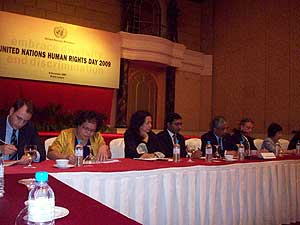
The seminar, themed 'Embrace Diversity, End Discrimination’, was held in conjunction with Human Rights Day 2009.


Report this comment
Are you sure you want to delete this comment?
This action cannot be undone.